Roger J. Wendell
Defending 3.8 Billion Years of Organic EvolutionSM

|
Perl:
|
"Perl is the Swiss Army chainsaw of scripting languages: powerful and adaptable."
(From O'Reilly's Beginner's Introduction to Perl)

|
Click Here for my main computer page... |
|
|
Click Here for my UNIX page... |
Y = CX^2 + B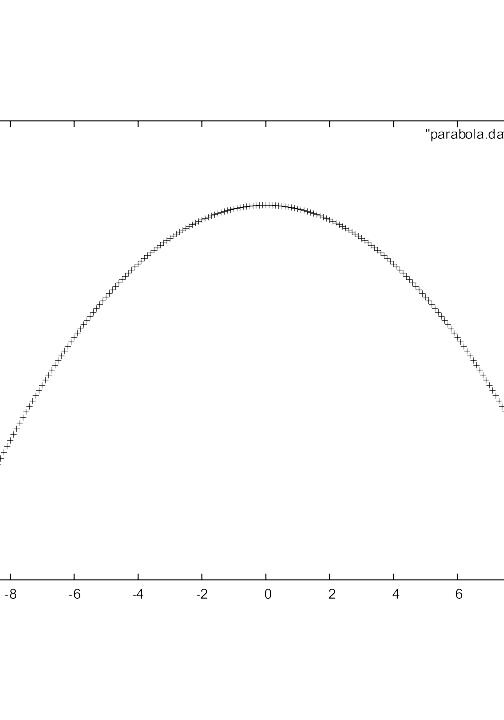 pico parabola.pl perl parabola.pl -2 3 cat parabola.data gnuplot plot "parabola.data" quit |
#!/usr/bin/perl # experimenting with a parabola 12-25-2007 # c is the concavity of the parabola # Y = CX^2 + B # B is the intercept with the Y axis # ARGV is argument variable containing the arguments # to the program on the command line $c = $ARGV[0]; $b = $ARGV[1]; open (filehandle, ">parabola.data"); for ( $x = -10; $x<=10; $x=$x+.1 ) { $y = $c * $x * $x + $b; print filehandle $x, " ", $y, "\n"; } close (filehandle); |
|

|
Under UNIX, Perl acts like a shell interpreter.
Most UNIX systems store Perl in /usr/bin/perl
In Perl, numbers and strings are the basic unit of conversation and are called scalars. Scalars that represent information that does not change over the life of the program are called constants or literals. Examples of literals are pi (3.14159265...), the name of the fourth planet from the sun (Mars), or the absolute limit of causal interation (299,792,458 metres per second [1,079,252,849 km/h]).In Perl, scalars that change are called scalar variables. You can change the contents of a variable because they merely act as as handles for the data they represent. Variable are usually given convenient and easy-to-remember names that allow you to easily refer to the data you are manipulating.
|
|
Perl Operators |
|
|
Simple bits of Code: |
Hello, world!
  #!/usr/local/bin/perl
   print "Hello, world!\n";
|
Current Time
# file: time.pl
  $time = localtime;
  print "The time is now $time\n";
|
A Simple Calculator
while(<STDIN>) {
|
|
|
Perl References and Related Stuff: |
- ActiveState - Industry-standard Perl distribution
- Beginning Perl
- CPAN - Comprehensive Perl Archive Network
- GNOME Project - Free desktop environment
- GNU Project - Free Unix-like operating system
- Perl.com - The source for Perl
- Perl Directory
- Perl introduction
- Perl Monks (The Monestary Gates)
- Perl Tutorial
- TPJ - The Perl Journal, purportedly and excellent resource, printed its
last issue in January, 2006. I'd link their site but it no longer exists...

|

|
Links:
|
|
 Back to Roger J. Wendell's Home Page...

Abbey |
About |
Blog |
Contacting
Me |
Copyright |
Disclaimer |
Donate |
Guest
Book |
Home |
Links |
Site
Index |
Solutions |
Terms,
Conditions
and
Fair
Use |
What's
Changed
or
New?
Copyright
© 1955 -