Roger J. Wendell
Defending 3.8 Billion Years of Organic EvolutionSM

|
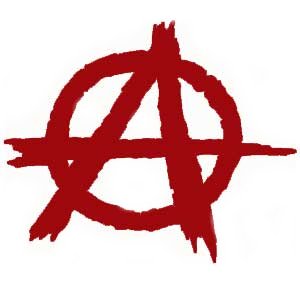
Edward Abbey and Henry David Thoreau |
|
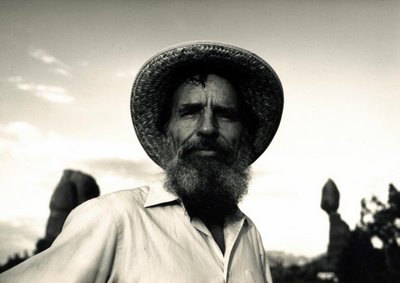
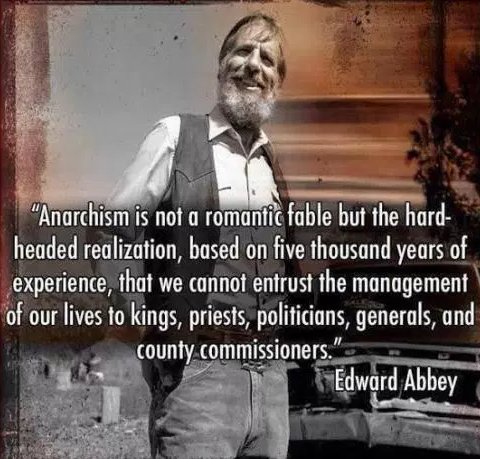
Edward Abbey was born in the town of Indiana, Pennsylvania on January 29, 1927. He died on March 14, 1989 from surgery complications at age 62. Photo permission and copyright Terrence Moore |
|

|
|
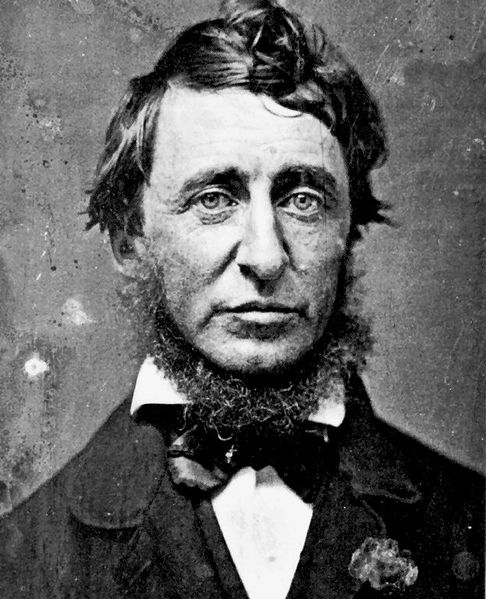
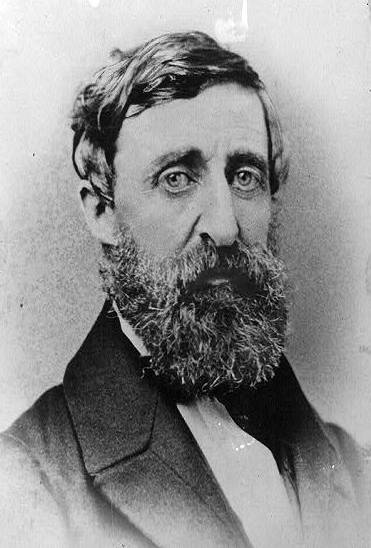
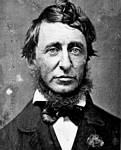
Henry David Thoreau was born on July 12, 1817 in the village of Concord, Massachusetts. He died from Tuberculoses on May 6, 1862 at the age of 44. |
|
Neither Edward Abbey or Henry David Thoreau would have wanted to be anyone's hero. Although
I, myself, could consider them both heroes I mostly just admire what they wrote and stood for.
Why? Despite personal faults and idiosyncrasies, they both excelled at speaking their minds
regardless public ridicule and government pressure (Thoreau was jailed for failing to pay war taxes
and the FBI spied on Abbey for nearly two decades).
Equally important, both were passionate protectors of wilderness and Nature - commodities definitely in short supply throughout our so-called "modern" world. How could anyone devote even part of a career, let alone nearly all of it, to Nature advocacy and things not of man? Well, these two writers did it, and they did it well. Admittedly, Thoreau and Abbey weren't the only ones who did good things for Nature, there were many others who did so too. It's just that these two caught my imagination from a very early age so I created this page as a kind of "quick reference" to parts of their work that captivated me most. I'm not an "expert" on either Abbey or Thoreau, what's here are just bits and pieces that I've picked up over the years like any reader. Luckily, unlike most readers, I got to meet Abbey, privately, to conduct some business for a local environmental group. Unfortunately, in the case of Thoreau I was born about a dozen decades too late...
|
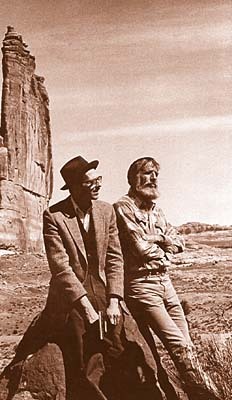
Edward Abbey contempletating the bust of Henry David Thoreau.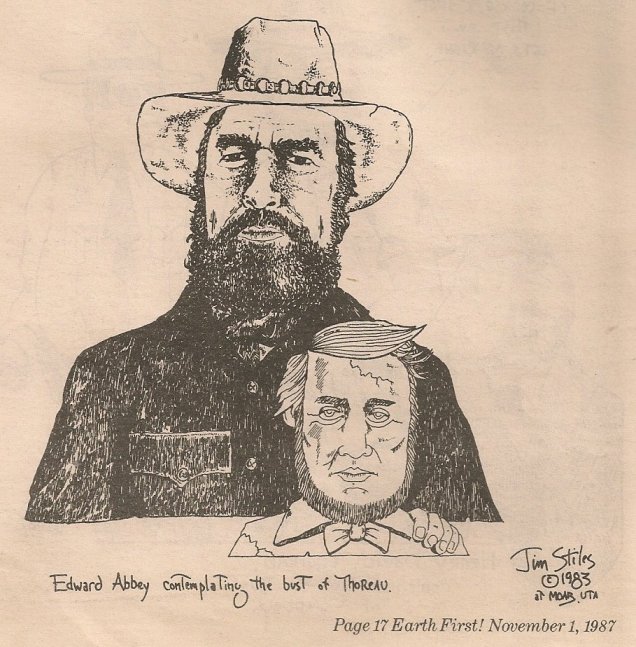
|
Henry David Thoreau contempletating the bust of Edward Abbey...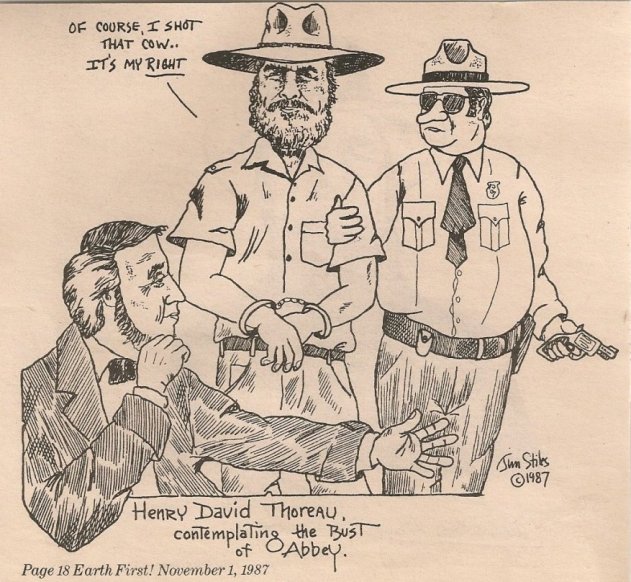
|
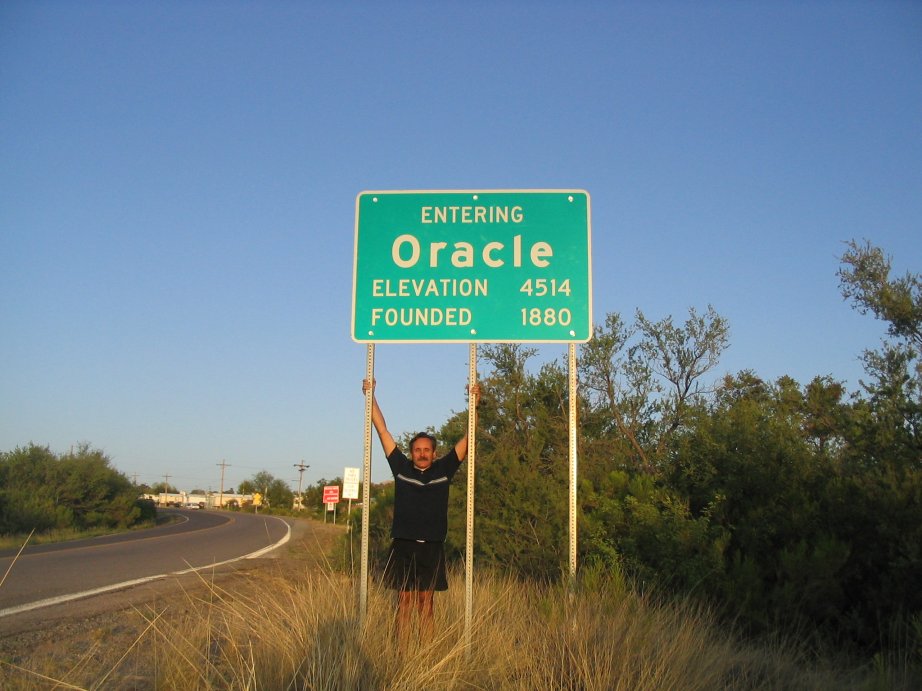 Me in Oracle, Arizona - an alleged stompin' ground of Cactus Ed... |
I was also lucky enough to meet Dave Foreman a couple of times (he's cofounder of Earth First!) and here's what Dave had to say about Abbey:
"Ed Abbey was the Mudhead Kachina of the conservation movement, perhaps
of the whole goddamn social change movement in the country. He was the
coyote. Farting in polite company. Enraging pompous twits, prudes
and prigs. Goosing the true believers. Pissing on what was politically
correct. And thereby doing sacred work. "It is our joy that he lived and spoke so eloquently that which we feel so deeply. We cannot replace such a man. None of us can emulate him or fill his shoes. But we can continue the work we shared with him His life, like each of his books, is a rock. A piece of sandstone that fits comfortably in the hand. You know what to do with it. He told you."
|
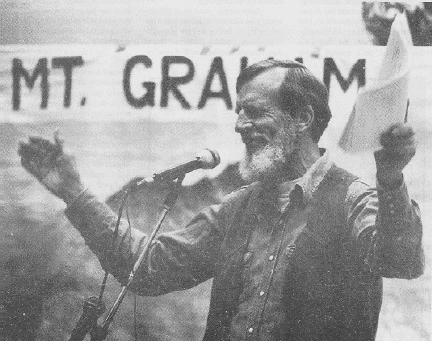 |
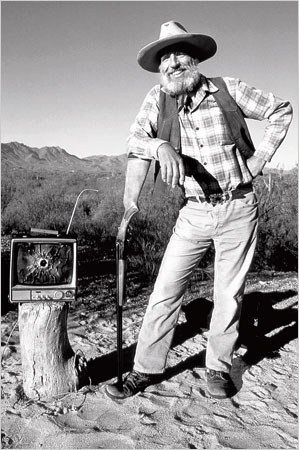
With the permission of photographer Charles "Chip" Hedgcock, I use this photo of "Cactus Ed" here and on my main web page.
Chip had this to say about Ed's photo; "That photo by the way is of Ed's last public appearance, a reading at an Earth First! rally for Mt Graham. Ed had just finished reading from his newly completed Hayduke Lives!. As he finished the room jumped to it's feet with wolf howls and applause. Ed lifted his arms to embrace the roaring crowd. Days later he was dead." |
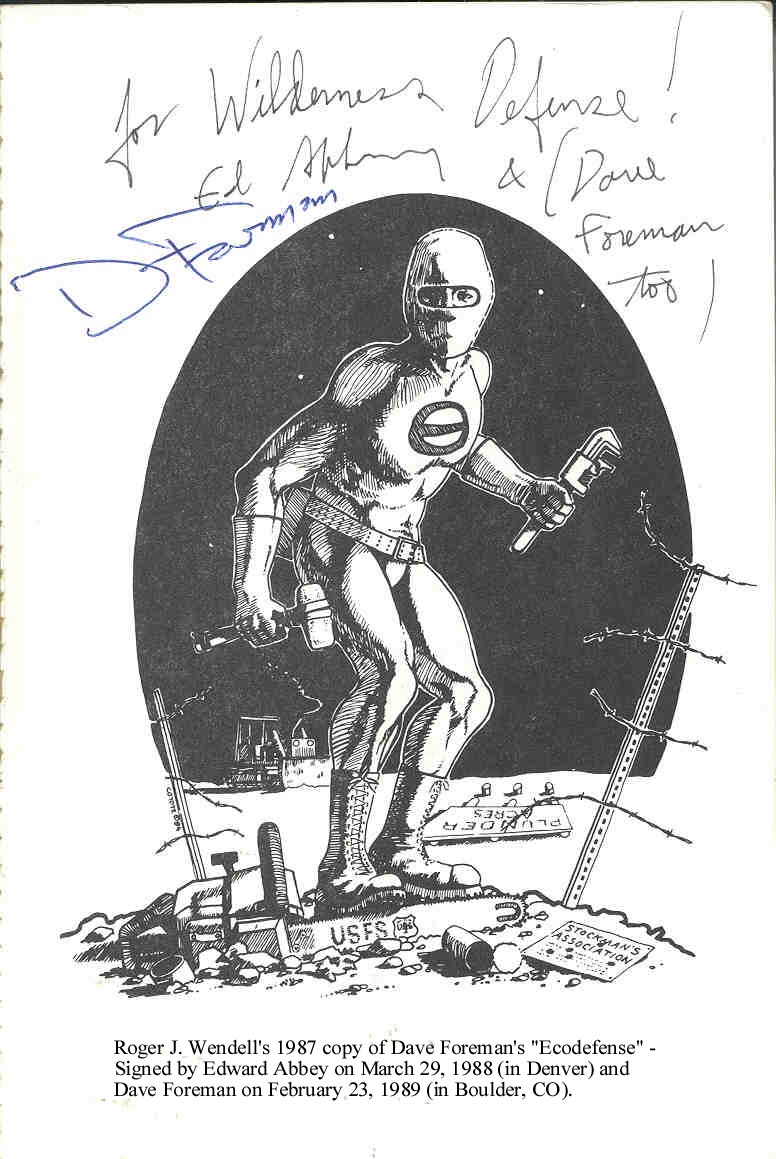
Ed and Dave signed my book!
This is the page Ed Abbey autographed for me out of Dave Foreman's book, EcoDefense. Ed wrote, "For Wilderness Defense! (in recognition of a group I had formed) and Dave Foreman too! At the time of the signing Ed was having a bit of fun since I didn't have one of his own books with me. Dave Foreman then signed beneath Ed's entry 11 months later - just a few weeks before Ed's death...
- Roger J. Wendell
Elegy for Cactus Ed
Edward Paul Abbey (1927-1989) was born in Pennsylvania and died sixty-two years later in the beautiful yet often inhospitable landscape that is the American southwest. Ed loved this arid land, this no-place-for-man, over-populated sand-and-rock paradise where grumpy misanthropists go to wear down the better half of an otherwise wasted existence. So it is with me, world-weary before my time, eyes squinting at the burning mirage of industrial civilization, raised on the words of fools for wilderness, the original earth defenders: Thoreau, Muir and Ed Abbey.
by J. Aceves - EF!J, July-August 2009, p. 23
(Reproduced here with permission)Twenty years. Twenty years that have seen the transformation of the world: the election of America's first president of color, 9/11. Two decades more of war, famine, pestilence - the usual miseries of life, as well as love, hope, fighting for one's beliefs, fighting for wilderness and especially the wide, wild desert. Twenty years since Cactus Ed rode off into the Sonoran sunset.
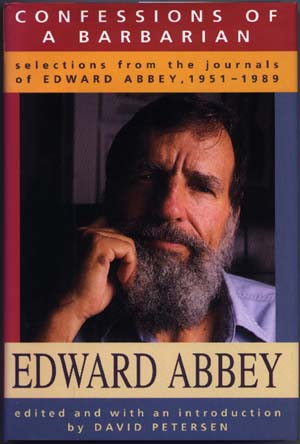
Desert Solitaire is Ed's masterpiece of wilderness memoir and human angst. It is his elegy for the wild southwest, for the wilderness that slips away like hot sand between our fingers. The Monkey Wrench Gang defined the terms of eco-defense (there were no terms: no prisoners taken, no quarter given). Confessions of a Barbarian summarized his angry "get off my fucking property" mentality - only all wilderness was his beloved front garden.
Ed abbey wrote more than twenty books, married and sired offspring a number of times, pissed off governments and corporations alike with fell swings of its mighty pen, lived hard and drove his bright-as-sun art straight through the unforgiving earth. The story goes, he is buried somewhere in his magnificent desert, but I will not seek his grave. His words are his legacy, countless pages filled with not so gentle pleas to save what is left of the wild. Angry or content, I can find strength and courage and damnable conviction in the enduring literature of Cactus Ed. And I miss him. So should you too.
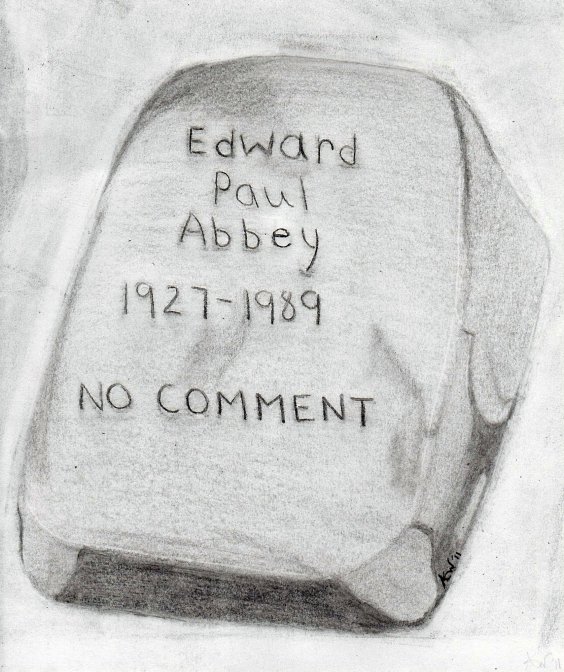 "Cactus Ed" lies in his illegal burial site somewhere in Arizona's Cabeza Prieta wilderness... Drawing by ALAW |
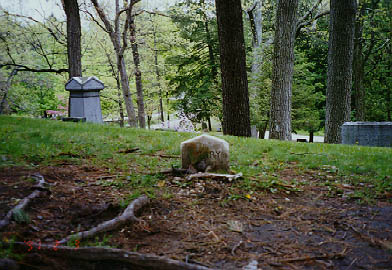 Thoreau lies on "Authors' Ridge" at the Sleepy Hollow cemetary in Massachuessettes |
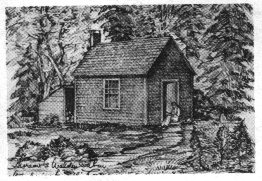 Thoreau's sister, Sophia, drew this of his one room cabin at Walden Pond. The cabin was later removed from the property and eventually broken up into scrap wood... |

|
Click Here for other memorials... |
Thoreau:
from Walden
"Where I lived and what I lived for"
"I went to the woods because I wished to live deliberately, to front only the essential facts of life, and see if I could not learn what it had to teach, and not, when I came to die, discover that I had not lived. I did not wish to live what was not life, living is so dear; nor did I wish to practice resignation, unless it was quite necessary. I wanted to live deep and suck out all the marrow of life, to live so sturdily and Spartanlike as to put to rout all that was not life, to cut a broad swath and shave close, to drive life into a corner, and reduce it to its lowest terms, and, if it proved to be mean, why then to get the whole and genuine meanness of it, and publish its meanness to the world; or if it were sublime, to know it by experience, and to be able to give a true account of it in my next excursion. For most men, it appears to me, are in a strange uncertainty about it, whether it is of the devil or of God, and have somewhat hastily concluded that it is the chief end of man here to 'glorify God and enjoy him forever.'"
At age twenty, in 1837 Ralph Waldo Emerson suggested to Throeau that he maintain a journal
to develop his writing and observation skills. Thoreau kept up the habit, two million words
later, until his death at age 44 in 1862. I'll post some of his journal entries as time permits:January 21, 1852
"This winter they are cutting down our woods more seriously than ever, - Fair Haven Hill, Walden, Linnaea Borealis Wood, etc., etc.
Thank god, they cannot cut down the clouds!"
Abbey:
from Desert Solitaire
"The First Morning"

"The personification of the natural is exactly the tendency I wish to suppress in myself, to eliminate for good. I am here not only to escape for a while the clamor and filth and confusion of the cultural apparatus but also to confront, immediately and directly if it's possible, the bare bones of existence, elemental and fundamental, the bedrock which sustains us. I want to be able to look at and into a juniper tree, a piece of quartz, a vulture, a spider, and see it as it is in itself, devoid of all humanly ascribed qualities, anti-Kantian, even the categories of scientific description. To meet God or Medusa face to face, even if it means risking everything human in myself. I dream of a hard and brutal mysticism in which the naked self merges with a nonhuman world and yet somehow survives still intact, individual, separate. Paradox and bedrock."
|
At age 19, while serving in the army in 1946, Edward Paul Abbey begain keeping a personal journal as a resource for his hoped-for-career as a "writer of creative fictions." He, too, kept the practice up until his death almost 43 years later - creating 20 handwritten volumes (the first three were lost in the flooding of his family's rural Pennsylvania basement where they were in storage.) of about a half million words or more. I'll post some of his journal entries as time permits as well: |
Mother Earth News
(Ed's response to Plowboy asking about wilderness and civilization)
May/June 1984
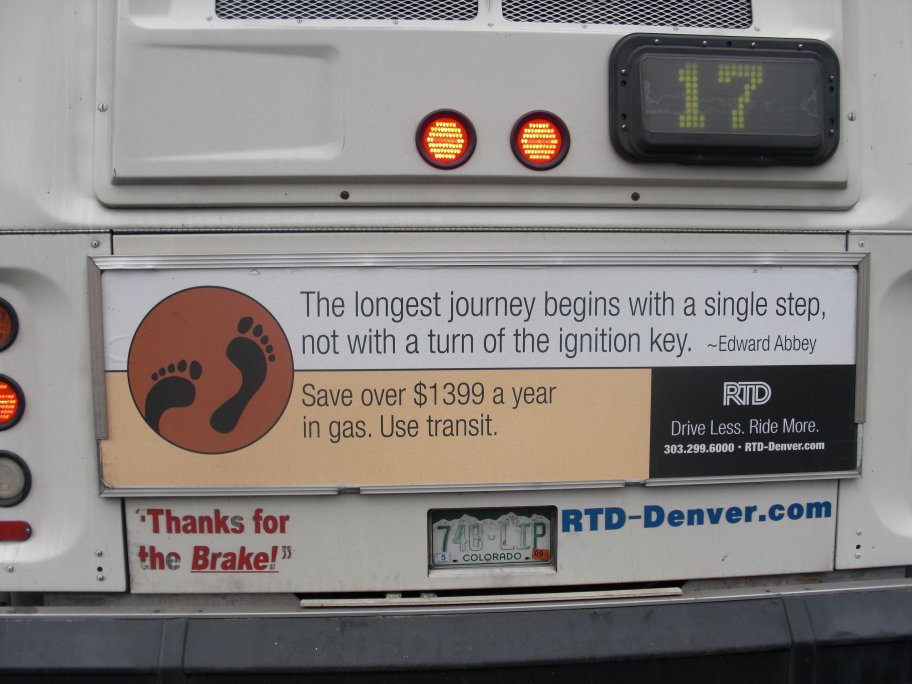
"A true civilization, for me, embraces tolerance as one of its cardinal virtues: tolerance for free speech and differences of opinion among humans, and tolerance for other forms of life... bugs and plants and crocodiles and gorillas and coyotes and grizzly bears and eagles, and all of the other voiceless, defenseless things everywhere that are in our charge. Any true civilization must provide for those other life forms. And the only way to do that is to set aside extensive areas of the Earth where humans don't interfere, where humans rarely even set foot." It's good for us to live on a planet of great diversity and variety. I think that a completely industrialized planet, a completely humanized planet would be intolerable. It would be a diminished life, as if the whole world were one great city. We'd lose the small-town way of life, the agrarian way of life, the farms, ranches, open spaces, forests, deserts, mountains and seashores. All of them would be completely taken over, devoured. That seems to be the direction in which we're moving right now. And if we succeed with this mad project of trying to dominate the whole planet and reduce everything to an industrial culture, we'll then turn on each other and start devouring one another even more vigorously and ferociously than we already are."
|
My question to Ed about Two Forks Dam!
Although Ed Abbey and I may have been at the same Round River Rendezvous a time or two I didn't actually meet him until March 29, 1988 - about a year before his death. He was in Denver for a speaking engagement, at the Denver Public Library, and the Audubon Society asked me to meet with him for the signing of some documents. So, as luck would have it I was able to meet privately with Ed for the transaction of some business and the signing of my copy of Dave Foreman's EcoDefense (A Field Guide to Moneky Wrenching). Later that evening Ed gave a presentation to a packed house with standing room only in a lecture hall that seated 900 at the time - the most attendance, thus far, for the Denver Public Library's speaker's series. Anyway, toward the end of Ed's program he offered up a question and answer period as most authors do. Hundreds of hands were raised in an audience full of eager people with all kinds of questions for the famous author.
At the time of Ed's visit there was huge controversy brewing throughout the Denver area, and Colorado in general, concerning the proposal to dam the South Platte River at Deckers - about 80 kilometres (50 miles) southwest of downtown Denver. The Army Corp of Engineers, the City of Denver, and other water entities were pushing hard to have this monstrosity built despite the relentless efforts of me and countless others to stop it. Tensions were high and the Two Forks Dam controversy was in the news each and every day until the project was finally killed by overwhelming public opposition.
Anyway, as luck would have it (again!), not only was I able to meet with "Cactus Ed" privately a few hours earlier, but it turned out I got to ask him a few questions before 900 admirers, media, and law enforcement at the library's lecture series. During his question-and-answer period my enthusiastic waiving caught the moderator's attention and an attendant ran up the isle to thrust a microphone at me. I stood up and looked toward the great author and, using my clearest (albeit young!) voice I simply asked, "Mr. Abbey, what do you think of Two Forks Dam?"
The crowd went dead silent as Ed slowly pondered the question while lightly stroking his chin hairs. Another moment or two passed, while the crowd held its breath, and the author finally answered, "You know, I've never heard of Two Forks Dam but, if it's a dam, I'm against it!" 900 People jumped to their feet screaming, applauding, and clapping while Ed beamed with delight at having pleased a local audience over what I'm sure he felt was an easy, sensible answer to a typical dilemma plaguing most everybody's quality of life around the planet.
Although Edward Abbey's response to Two Forks Dam wasn't the project's final blow it certainly helped fuel and inspire the thousands of us working against the proposed monster. Local media made mention of Ed's thoughts on the subject, the following day, and, as history now shows us, the project was eventually killed.
My public radio interview with Doug Peacock:
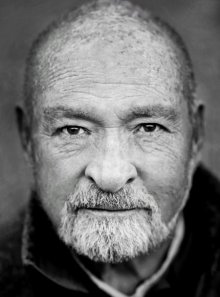
Click Here for interview with Doug Peacock on KGNU.
I spoke with Doug Peacock about climate change, grizzly bears (and Timothy Treadwell), his relationship with Ed Abbey, and humanity's impact on the natural world.
Doug Peacock is an author, Vietnam veteran, filmmaker and naturalist. Doug has published widely on wilderness issues: from grizzly bears to buffalo, from the Sierra Madres of the Sonoran desert to the fjords of British Columbia, from the tigers of Siberia to the blue sheep of Nepal. Doug Peacock was a Green Beret medic and the real-life model for Edward Abbey’s George Washington Hayduke in The Monkey Wrench Gang.
Essay by Edward Abbey "I Loved it...I Loved it All" from Ned Judge on Vimeo.
Links:
|
 Back to Roger J. Wendell's Home Page...

Abbey |
About |
Blog |
Contacting
Me |
Copyright |
Disclaimer |
Donate |
Guest
Book |
Home |
Links |
Site
Index |
Solutions |
Terms,
Conditions
and
Fair
Use |
What's
Changed
or
New?
Copyright
© 1955 -