Roger J. Wendell
Defending 3.8 Billion Years of Organic EvolutionSM

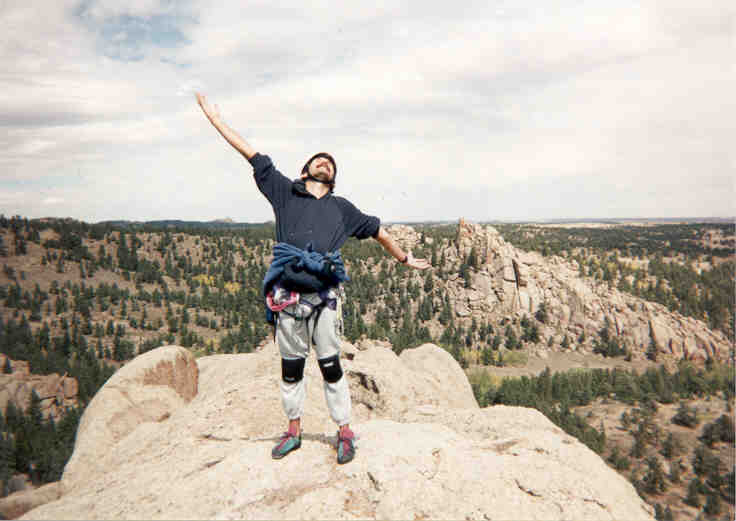
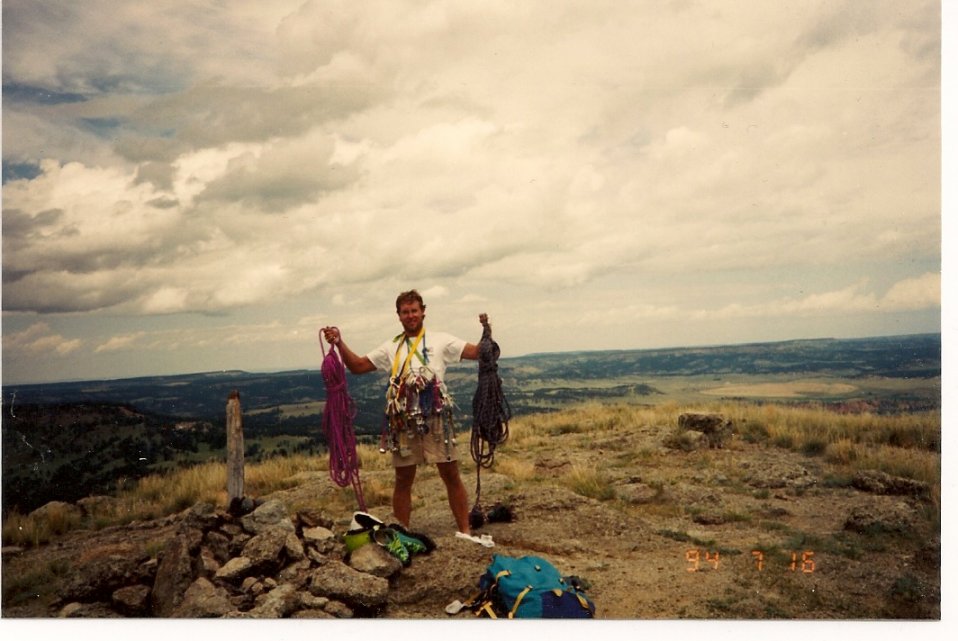
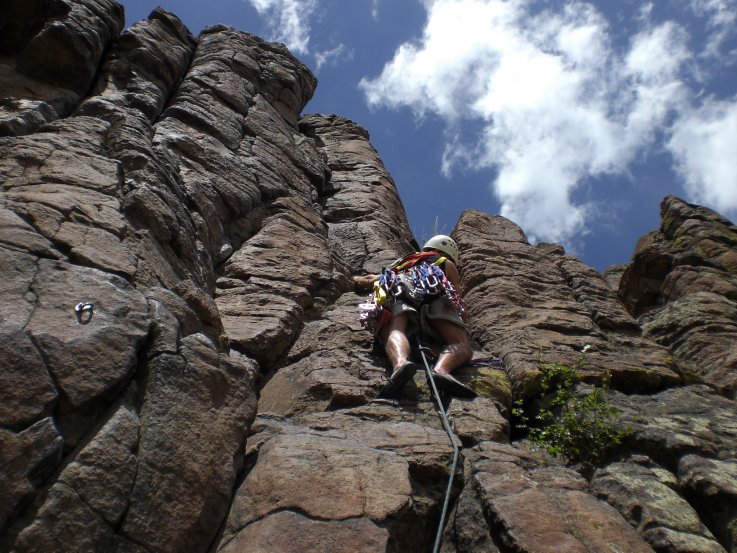
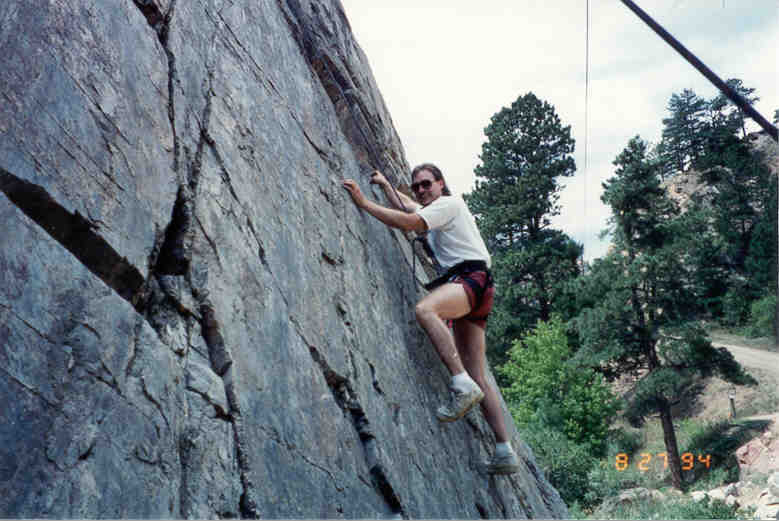
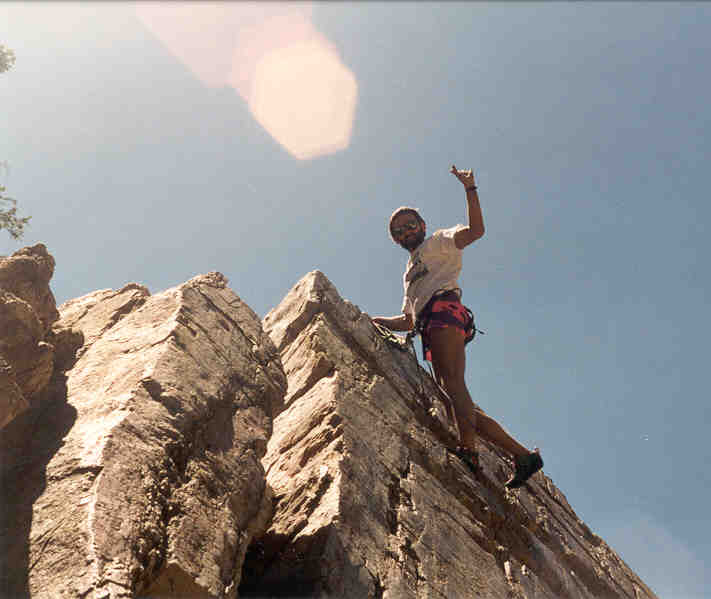
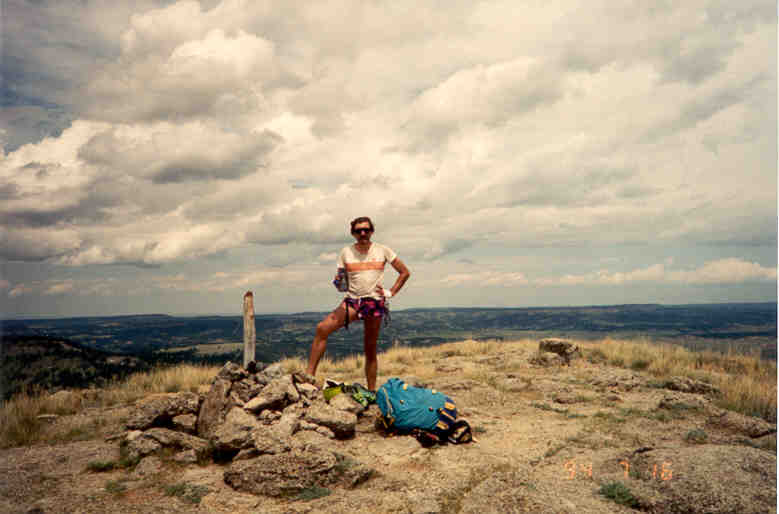
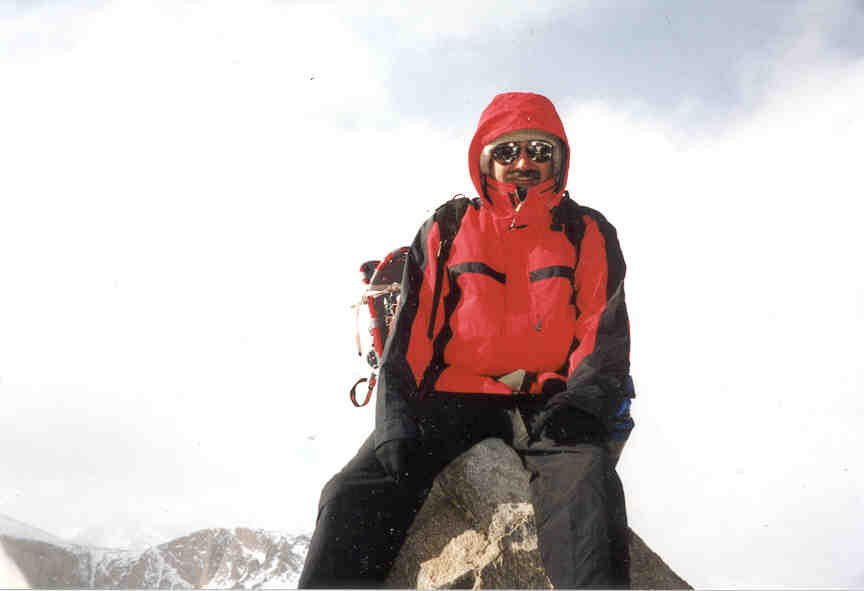
Me on top Vedauwoo's Reynold's Hill, Wyoming
Maybe true.
Maybe not true.
Better you believe.
- Old Sherpa Saying
NOTE: LIDAR (Light Detection and Ranging) was put into use many decades after I started hiking and climbing. LIDAR is a more accurate way of measuring the Earth's surface and, as such, has changed what was believed to be the elevation of many mountains and highpoints. As a result, the "prominence" (at least 300 feet above a connecting saddle) of many mountains has changed along with their elevations. A personal example, for me, is Republican Mountain - a previously "unranked" 12er near Silver Plume that I climbed in 2022 after learning that LIDAR had determined it now had 312 feet of prominence. Peak 8, near Breckenridge is another personal example of change brought on by LIDAR. When I originally climbed Peak 8 I believed it to be a 12er, only to learn later that it's actual elevation is 13,005 feet! So, in summary, many of the elevations you see on my pages may not (yet) be accurate - requiring an update someday in the future as time permits!

|
Click Here for more climbing photos! |
|
|
Click Here for my 14ers page... |

|
Click Here for the Ten Essentials - Don't leave home without 'em! |
|
|
Click Here for my 13ers page... |
|
|
Click Here for my 12ers page... |
|
|
Click Here for other peaks and mountaintops that I've summited... |

|
- John Muir
- Hermann Buhl
(First ascent Nanga Parbat and Broad Peak)
|
|
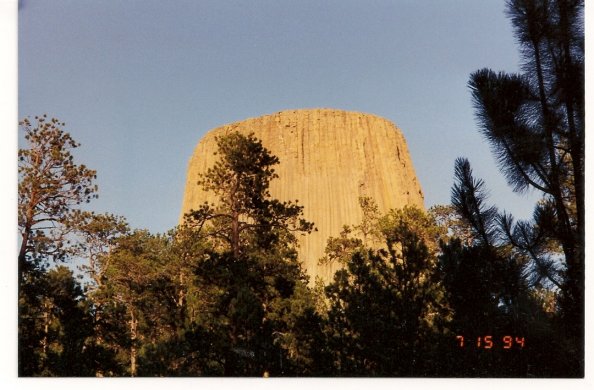
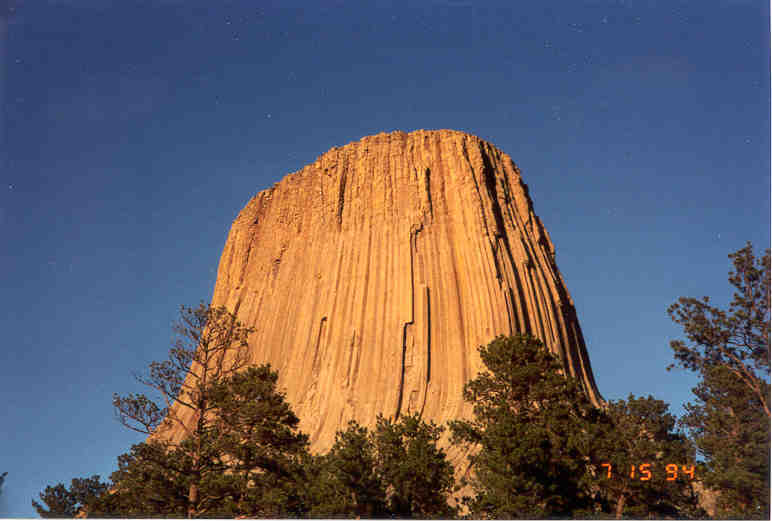
Devils Tower, Wyoming
Me and my pink climbing shorts...
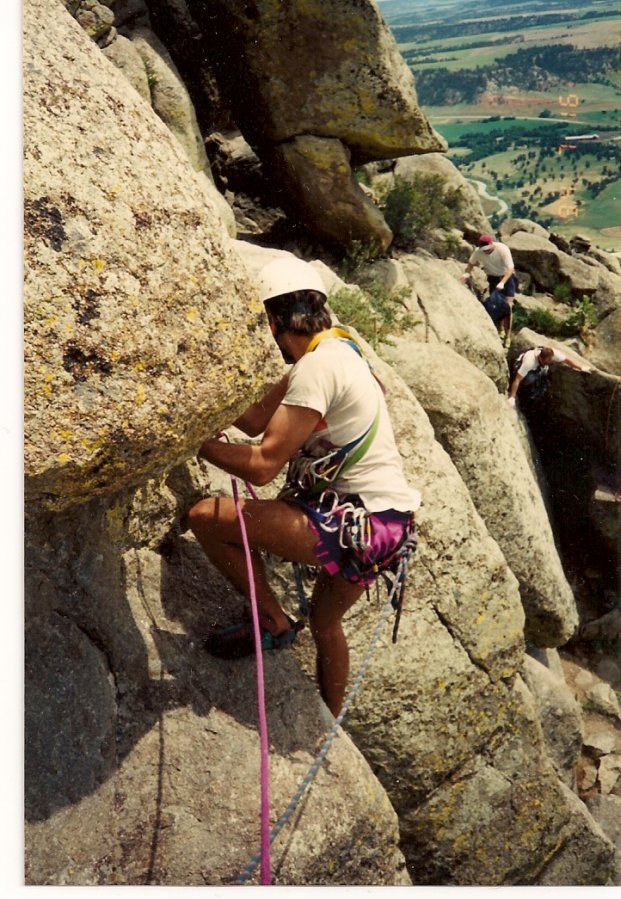
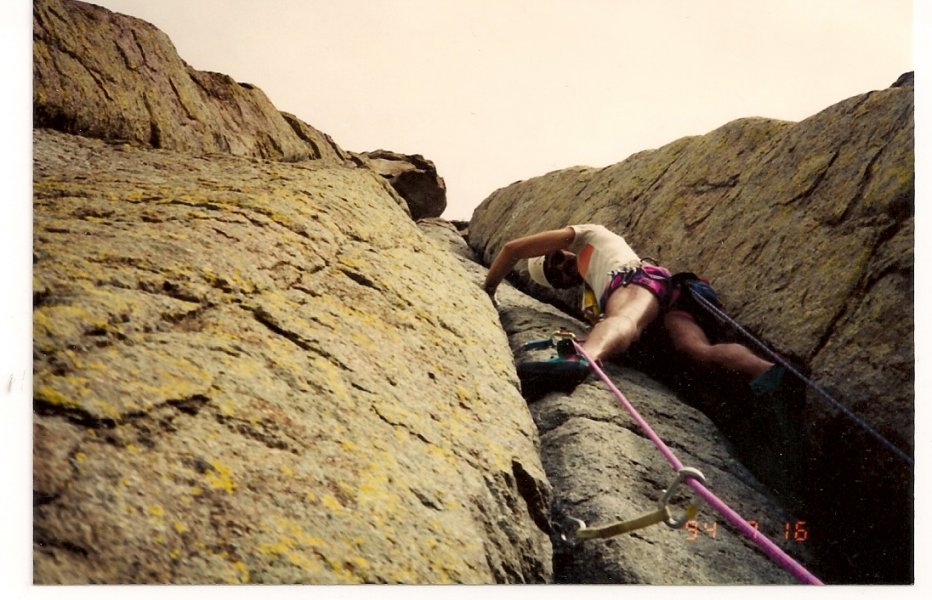
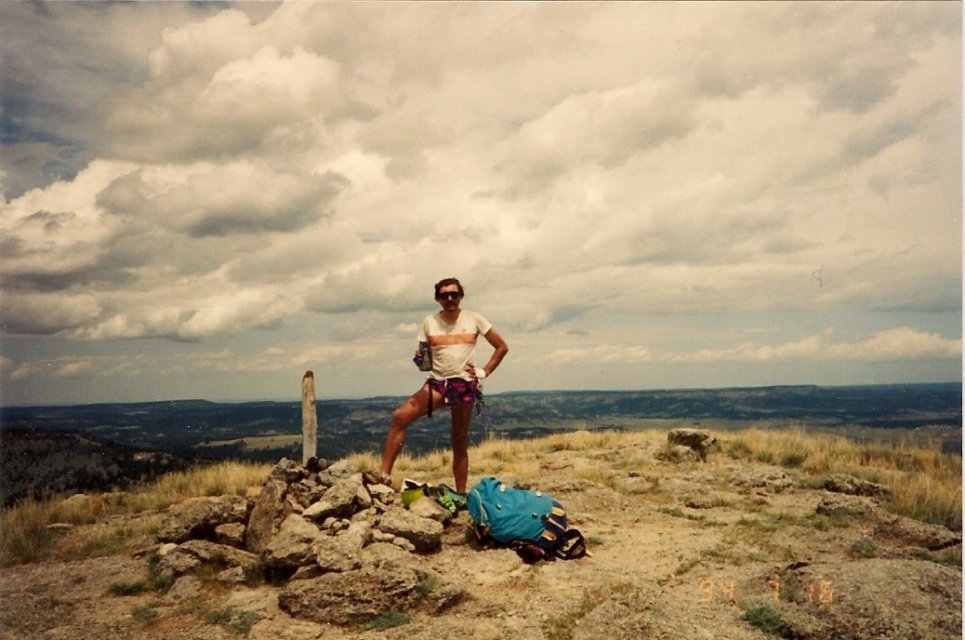
Dan Howell and I climbed Wyoming's Devils Tower "Durrance" route in 1994. This route was first pioneered by Jack Durrance and Harrison Butterworth in September 1938 - it was the second free ascent of Devils Tower, following the first ascent led by Fritz Wiessner in 1937. At the time of our climb the route was rated 5.6 but I believe today it's consdiered a 5.7 (5a). The Durrance Route is the most popular on Devils Tower and is considered one of the fifty classic climbs in North America.
Here I am leading again
Me on top
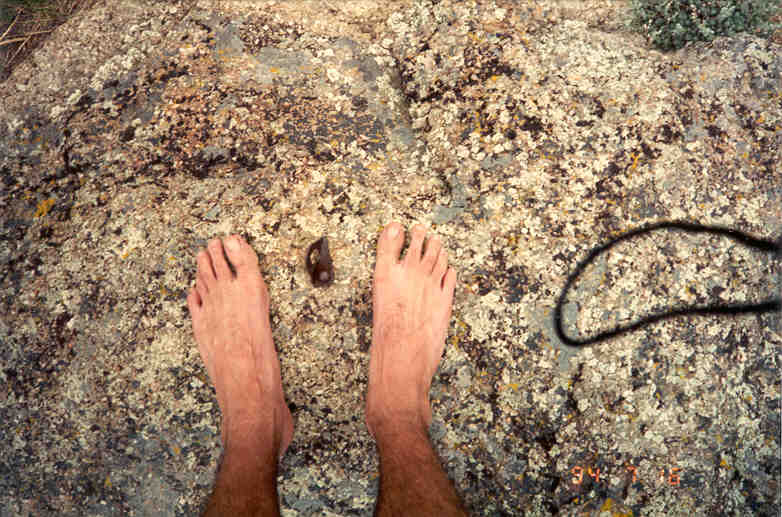
No shoes for me!
Devils Tower
Dan on top
If you look closely you may notice that our hands are taped yet still a little bloody from so many hand-jams. Also, in the summit photos you can see I'm barefoot despite the cactus and rattlesnake hazard...
"Climbing mountains is the only thing I know that combines the best of the physical,
spiritual, and emotional world all rolled into one. Yes, I'll keep climbing!"My friend, Steve Gladbach
Post Maroon Bells Avalance, 1992
"Mountaineering is a complex and unique way of life, interweaving elements of sport, art and mysticism. Success or failure depends on the ebb and flow of immense inspiration.
Detecting a single rule governing this energy is difficult - it arises and vanishes like the urge to dance and remains as mysterious as the phenomenon of life itself."- Wojciech "Voytek" Kurtyka
(Pioneered the "Alpine" style of self-sufficient climbing)
Kilimanjaro
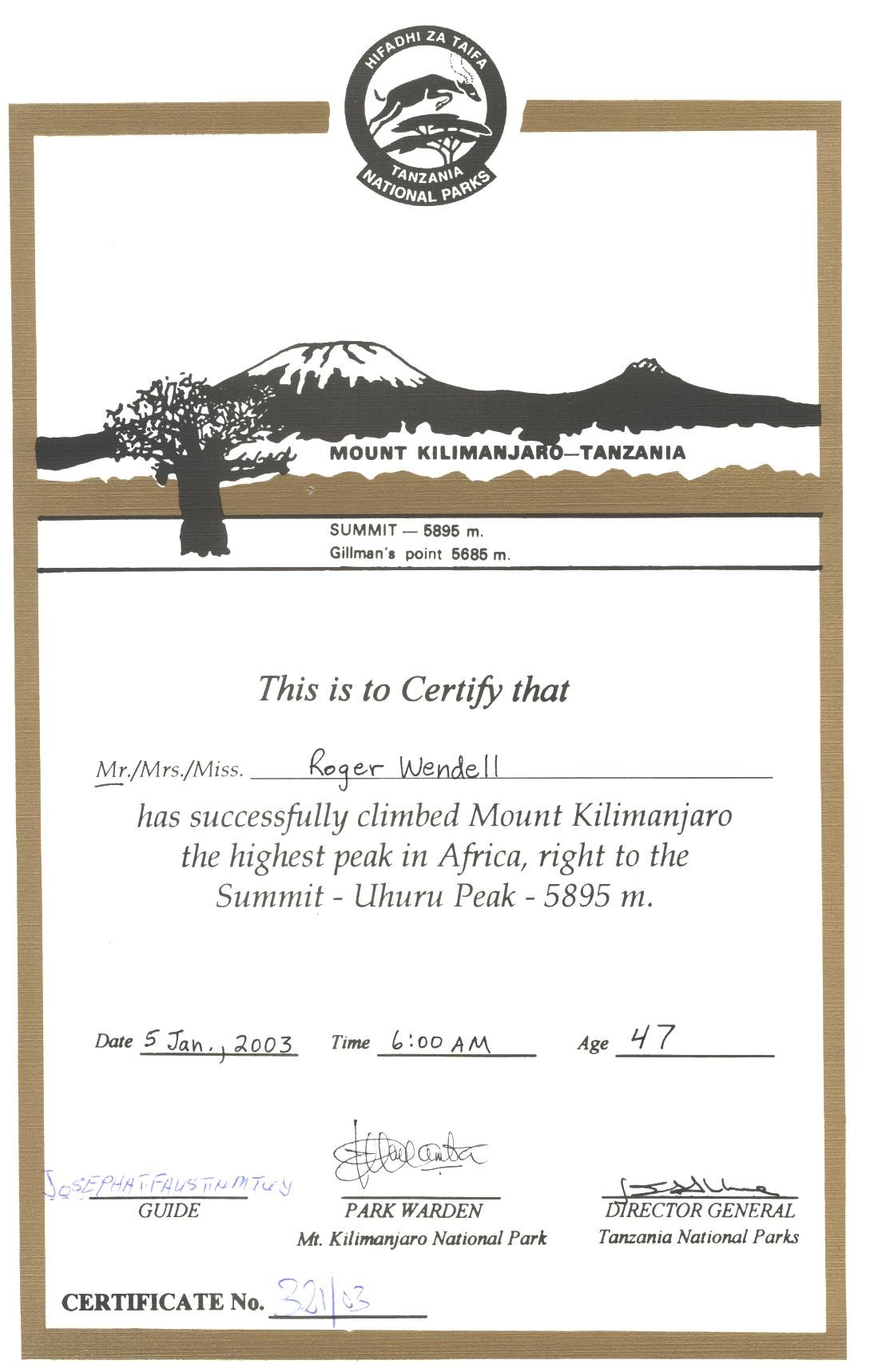
My summit certificationIn 2003, Colorado Mountain Club (CMC) leader Steve Bonowski led 13 of us on a climb up Kilimanjaro and then Mt. Kenya's Point Lenana. In-between the two mountain climbs we also participated in a Safari (the Swahili word for travel) at Lake Manyara, the Ngorongoro Crater and Conservation Area, and the Serengeti Plains. Although I enjoyed the Kilimanjaro climb I felt even the "Trekkers Summit" (16,355 foot Point Lenana) of Mt. Kenya was a better mountaineering experience. There were less crowds, better views, and more contact with snow and ice. For Kilimanjaro we took the Machame or "Whiskey" route as opposed to the regular tourist or "Coca Cola" route from Marangu. The difference being our travel was a day or two longer and probably a bit more difficult since we lost nearly 3,000 feet of elevation throughout various parts of the climb. This, however, is a good thing since it helps one better acclimatize to the altitude.
I also believe IMAX did its audience a great disservice by not emphasizing the intimate relationship everyone develops with their porters and guides - these were hard working young men who, if asked, would cater to any whim or need - a bit embarrassing to anyone desiring to carry all of their own food and equipment but an integral part of the Tanzanian economy. On average, porters probably earn about $30 (USD) for the four to six days they spend with clients. This equates to nearly three months' wages in their economy.
What did a three week trip to Africa like this cost back in 2003? Depending on vendors, lodging, souvenirs and the number of photos [many people still used film back then...] you take it could have been anywhere from about $4,000 to $10,000 (USD 2003). For most of us this particular trip the cost was about $5,000 USD which included tips to porters, cooks, and guides. Also, unimanagable amounts of travel via bus, van, and airplane were part of the price as well. The $5k also covered tons of food since the Africans believe Americans need a minimum of 3 full meals per day and ensured that we each received the maximum calories consumable (Me and one other vegetarian were specially catered to throughout the entire trip). Other expenses, included in that $5k figure, were a few hotel rooms that we all shared at strategic points throughout the trip, visas and other travel processing fees.
The "washout" rate, on Kilimanjaro, averages nearly 50% out of the approximately 25,000 summit attempts each year. Like other big, popular mountains, Kilimanjaro's trails and camps are strewn with ample evidence of human intestinal distress and other discomforts. This is not an indictment against Africa - anyone not accustomed to the food, water, and altitude in the Rocky Mountains of my own home state will experience similar maladies as well. My own health was pretty good throughout the entire trip except for our return from Amsterdam. It was there, in Holland, that I experimented with a pound of chips (french fries) drenched in mayonaise - the next day (mostly in flight) was spent in considerable GI discomfort...
Roger J. Wendell - Happy Trails!
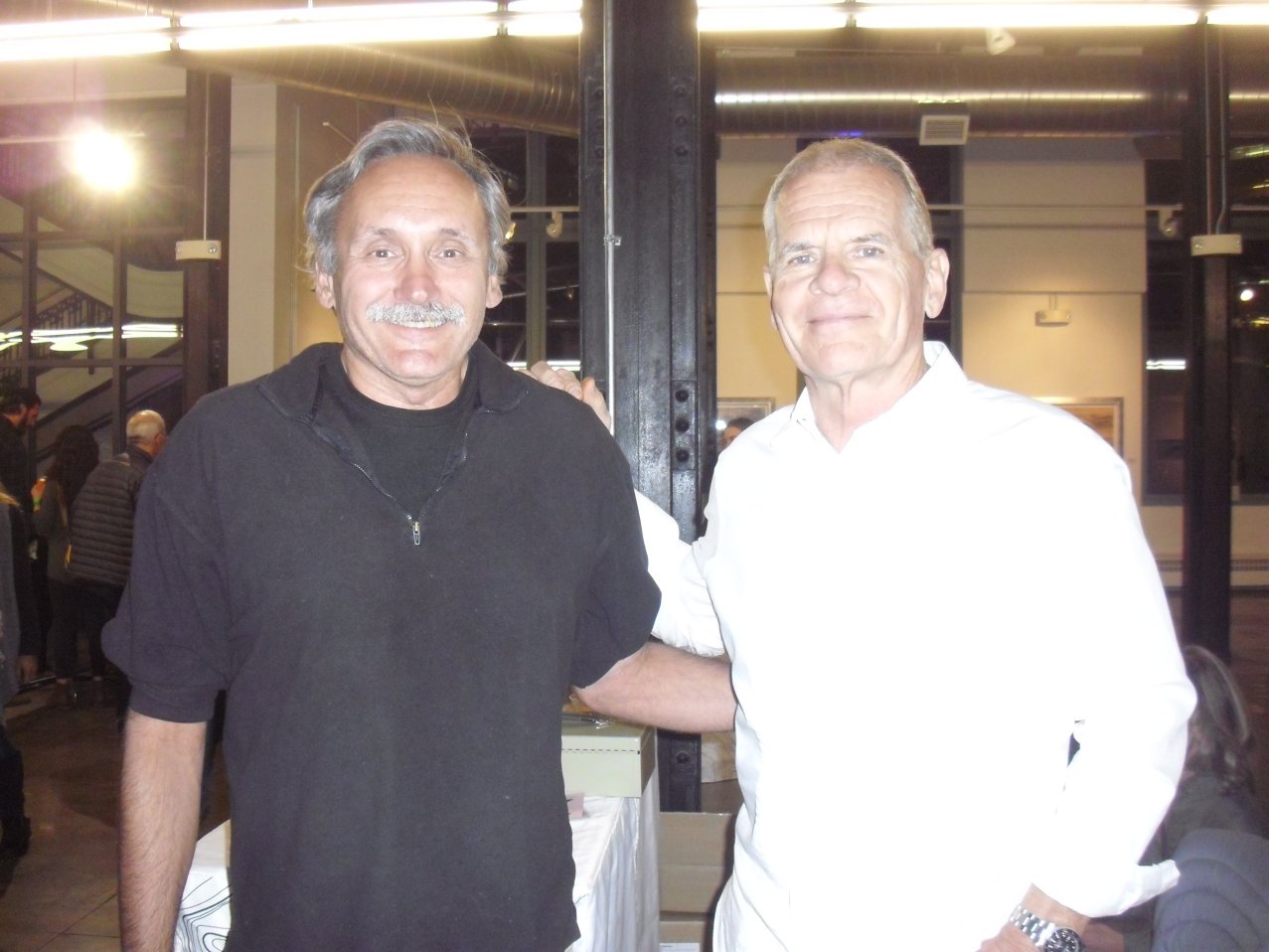
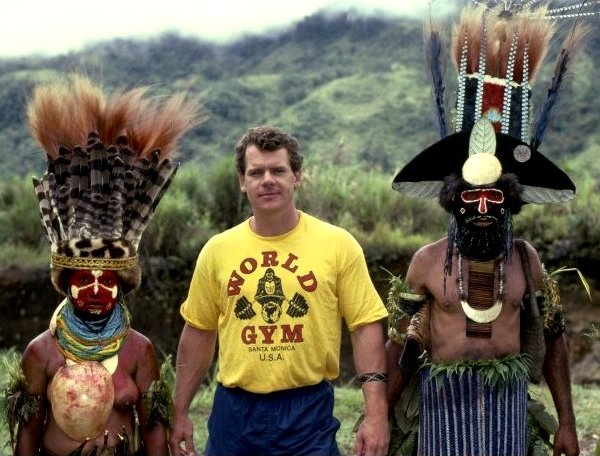
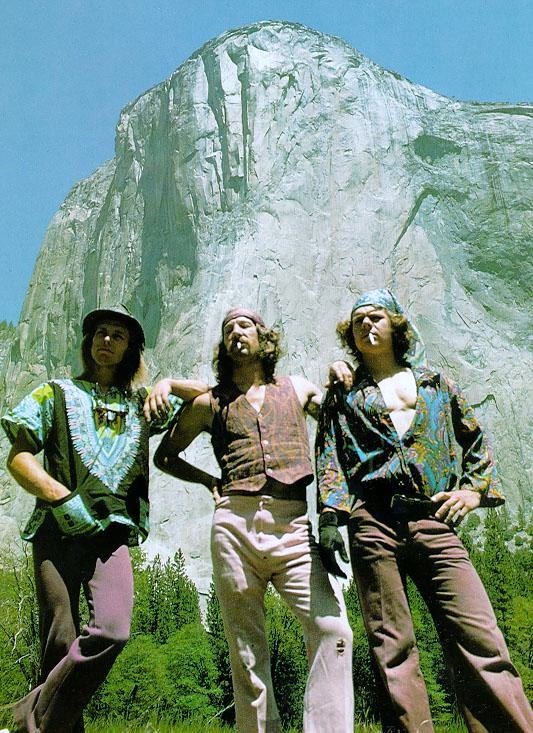
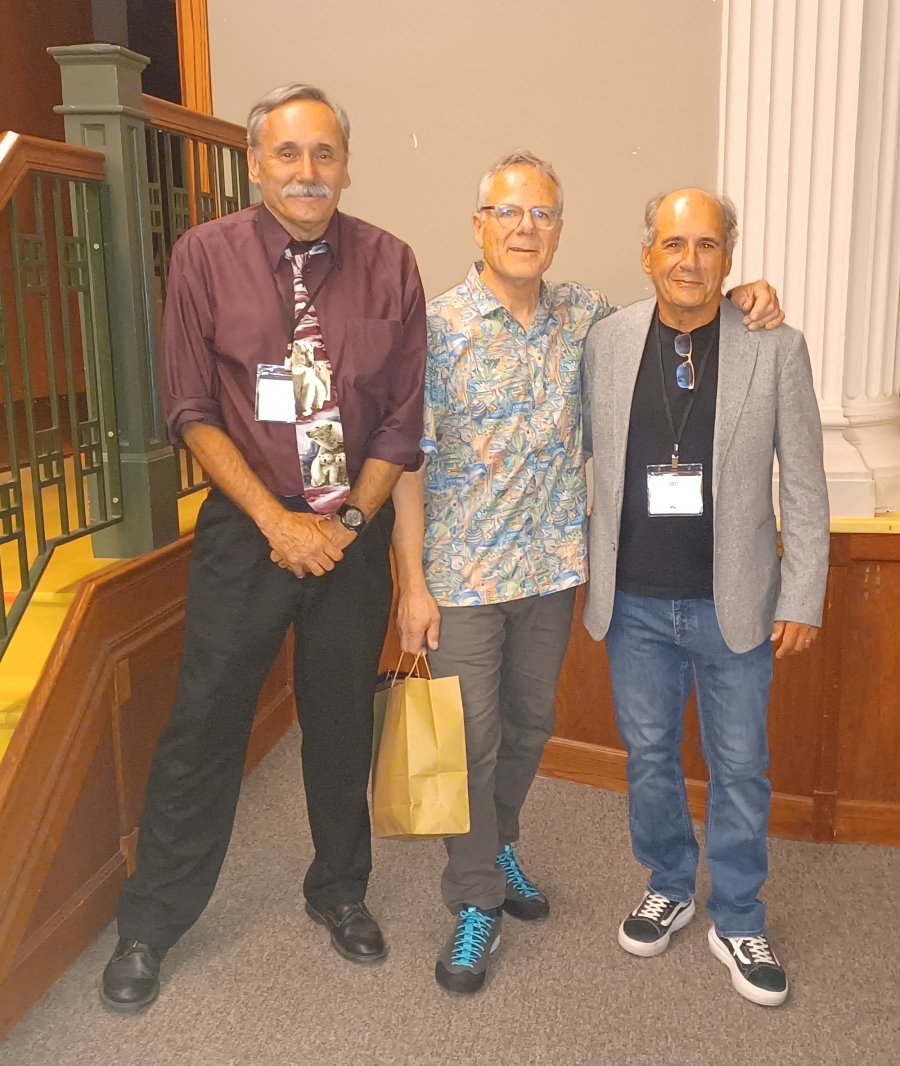
John Long
Mountaineering Museum (2019)
Me and John at the CMC Bash
Papua New Guinea (1982)
Yosemite (1975)
The following year, John partnered with Dale Bard to make the second one-day ascent of El Cap via the West Face, in the remarkable time of five hours. He followed this with blitz ascents of Leaning Tower, Washington Column, Half Dome and Ribbon Falls, precipitating the modern speed climbing movement so popular today, both in Yosemite Valley and beyond.
The fourth picture is of Billy Westbay, Jim Bridwell, and John after the first one day ascent of El Capitan in Yosemite Valley, California (Memorial Day, 1975).
The first and second pictures, above, are of encounters I had with John at the Bradford Washburn American Mountaineering Museum (in 2019) and the Colorado Mountain Club's "Backcountry Bash" (in 2017), respectively.
Charlie Sassar and Jack Tackle
Me, Charlie, and Jack at the American Mountaineering CenterIn this presentation to the Colorado Mountain Club's 2023 gala event, climbing legends Charlie Sassara and Jack Tackle recalled their epic survival story and rescue from Alaska's Mount Agusta in 2002. During that climb, Jack was hit hard by rockfall breaking his back and being knocked unconscious. Jack regained consciousness and together they determined there was only one course of action: Charlie would have to leave his partner tied to a tiny ledge, rappel off the mountain, and try to get help.
"Mountaineering is more than climbing, panoramic views, and wilderness experience. It is also challenge, risk, and hardship. And it is not for everyone. Those drawn to mountains can find them exhilarating and irresistible, as well as frustrating and sometimes even deadly. There are qualities to mountaineering that bring inspiration and joy in a pursuit that is more than a pastime, more than a sport - a passion, certainly, and sometimes a compulsion."- Mountaineering, The Freedom of the Hills
6th Edition, Chapter 1 "First Steps" p. 15
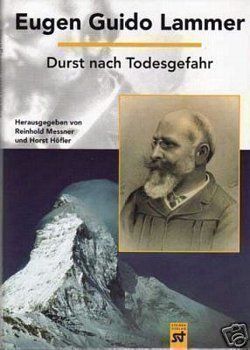
Eugene Guido Lammer
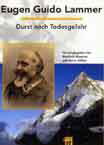
"I was resolved to attempt the impossible and never let slip an opportunity to risk my life." - Prof. Guido Lammer 1862 - 1945 (from a Neptune Mountaineering T-shirt, circa 1990) "This new book by Messner is a biography of Guido Lammer who was the greatest German speaking climber of the 19th century. He was particularly drawn to dangerous rock and ice, where he had success with important new routes, many of them solo. The essence of his many faceted interests and development was to search out extreme danger and survive."
(from Chessler Books, 2005)
"In the clearness of the Himalayan air, mountains draw near, and in such splendor tears come quietly to my eyes to cool on my sunburned cheeks. This is not mere soft-mindedness, nor am I that silly with the altitude. My head has cleared in these weeks free of intrusion - mail, telephones, people and their needs, and I respond to things spontaneously, without defensive or self-conscious screens. Still all this feeling is astonishing: not so long ago I could say truthfully that I had not shed a tear in twenty years."- Peter Matthiessen
in his book, The Snow Leopard

Click Here for our YouTube video slogging up Mt. Baker!
Mt. Baker (Komo Kulshan)
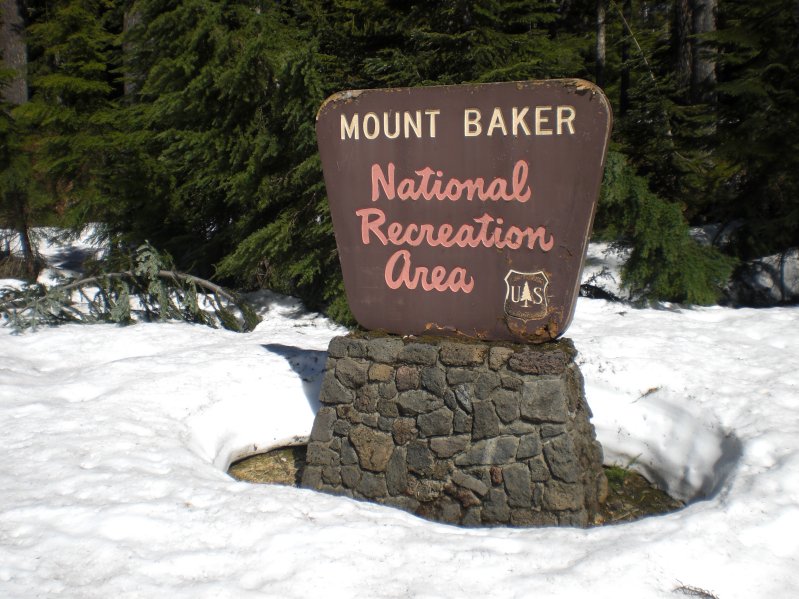
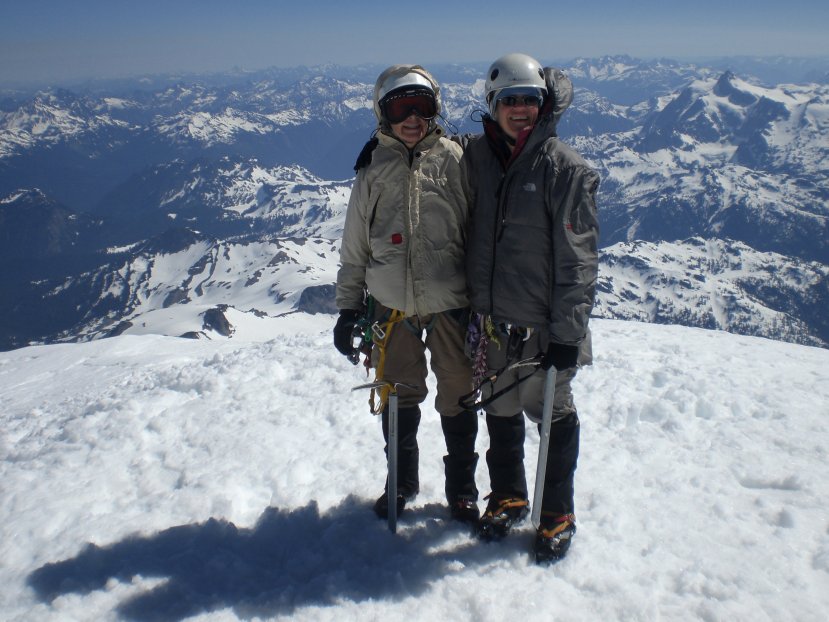
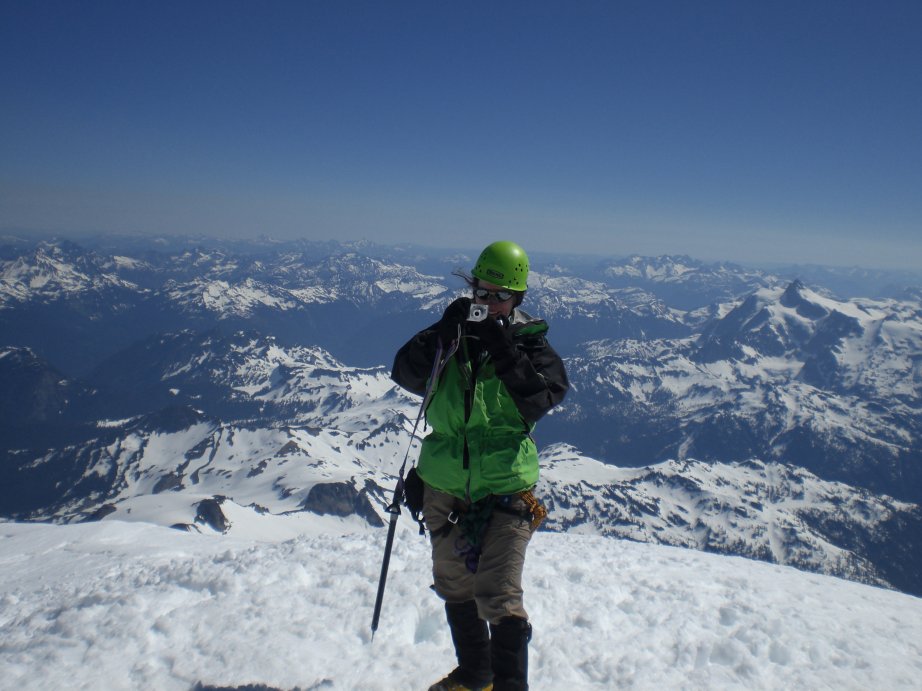
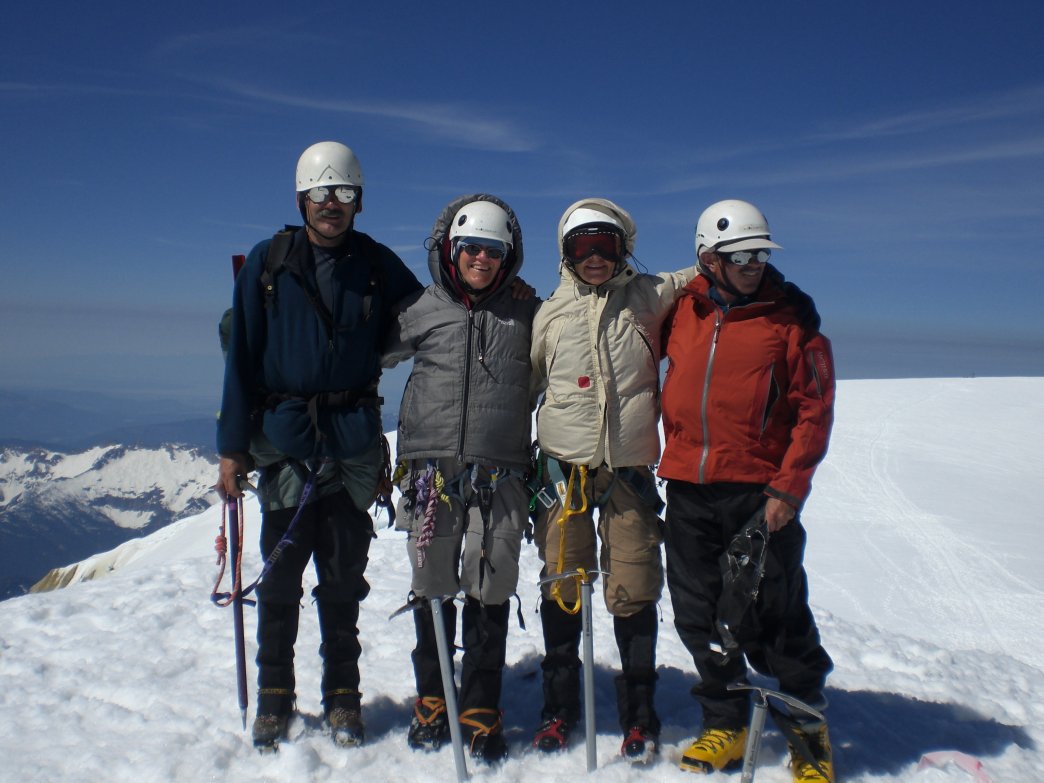
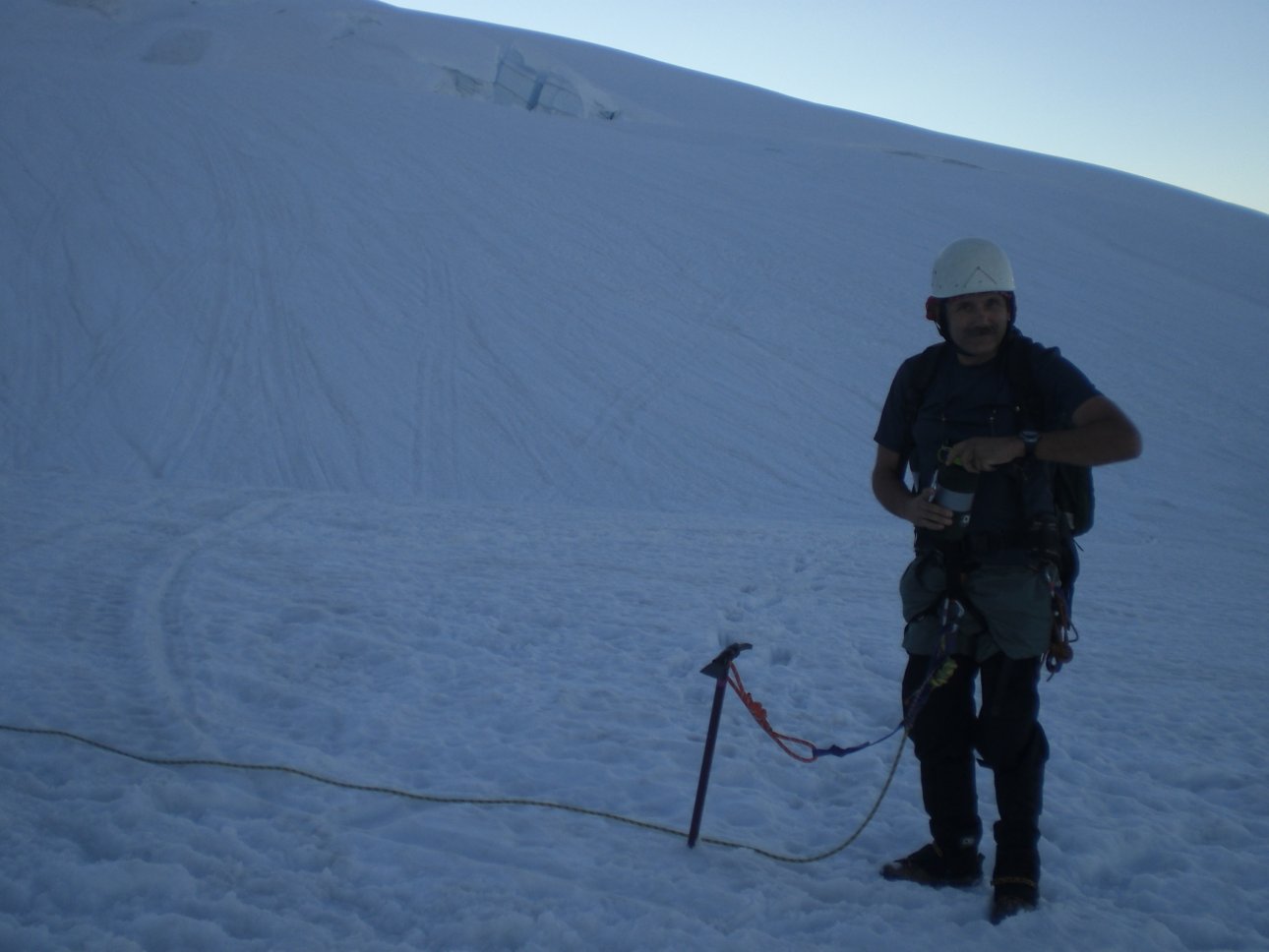
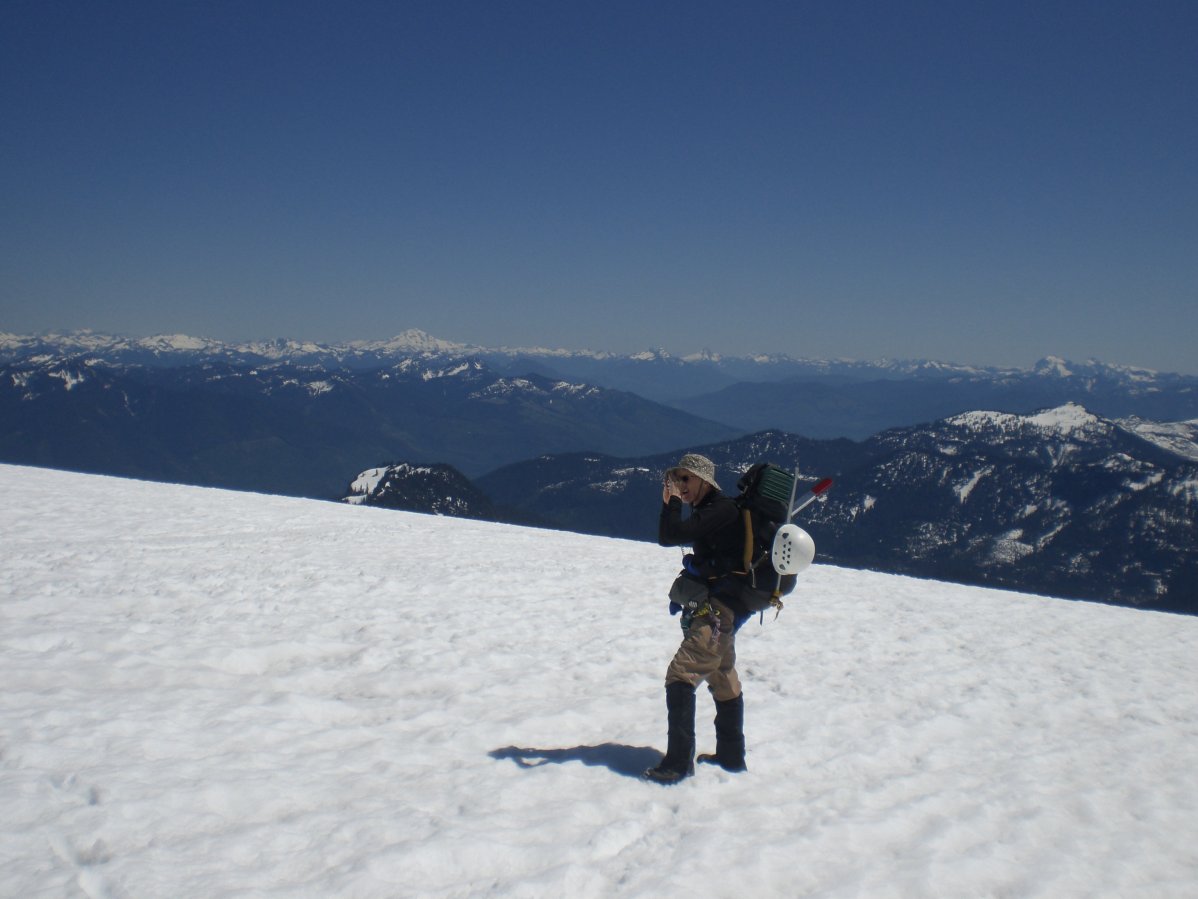
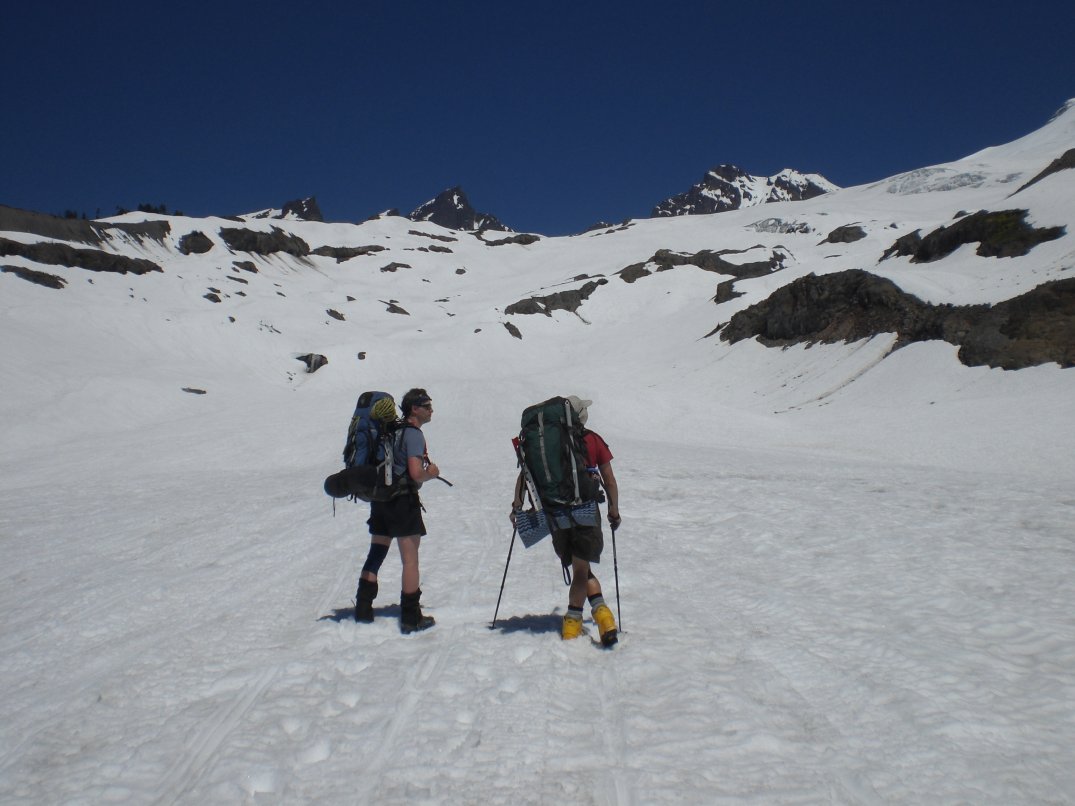
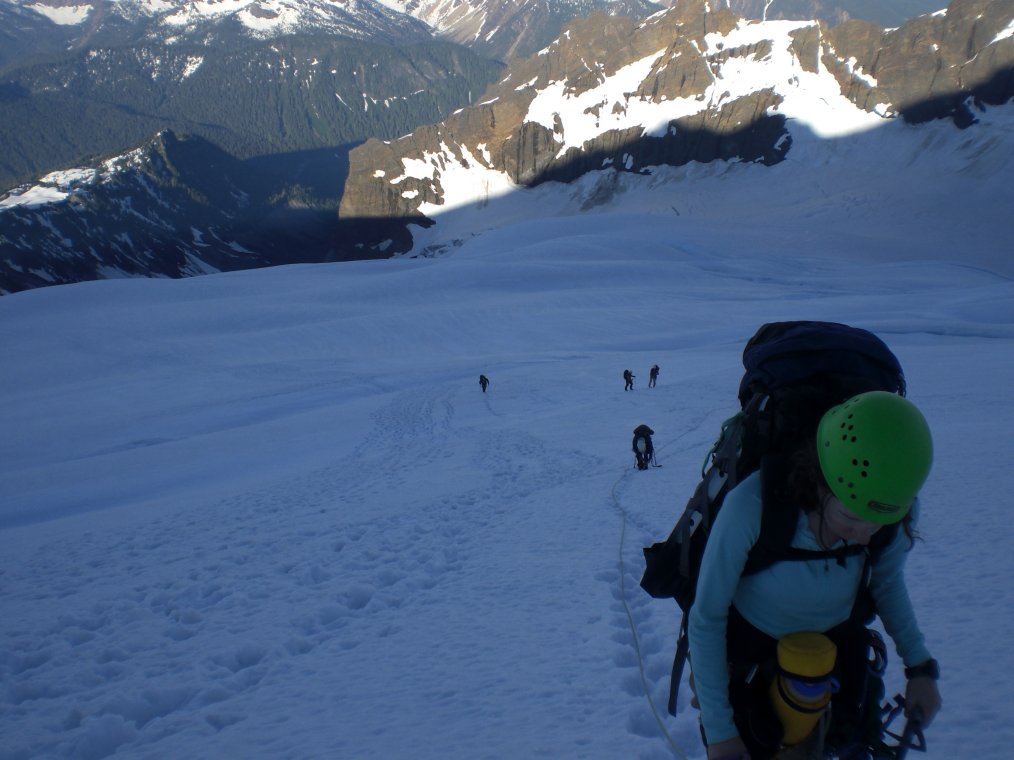
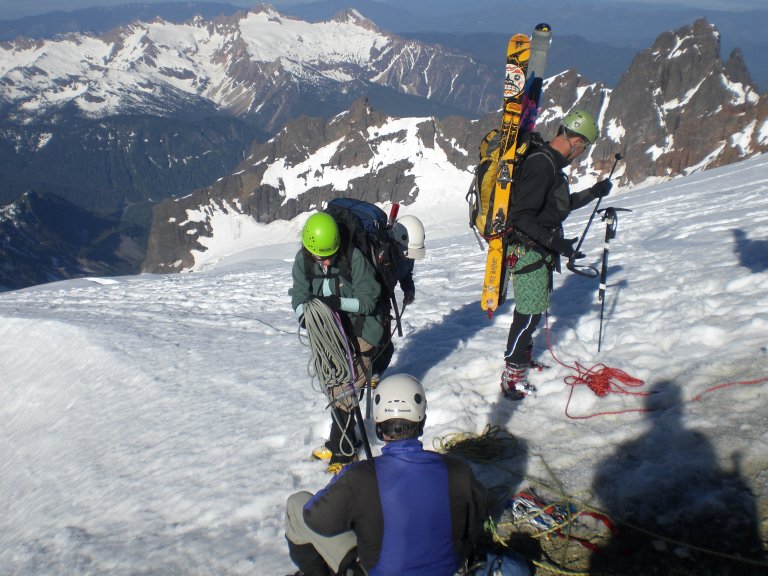
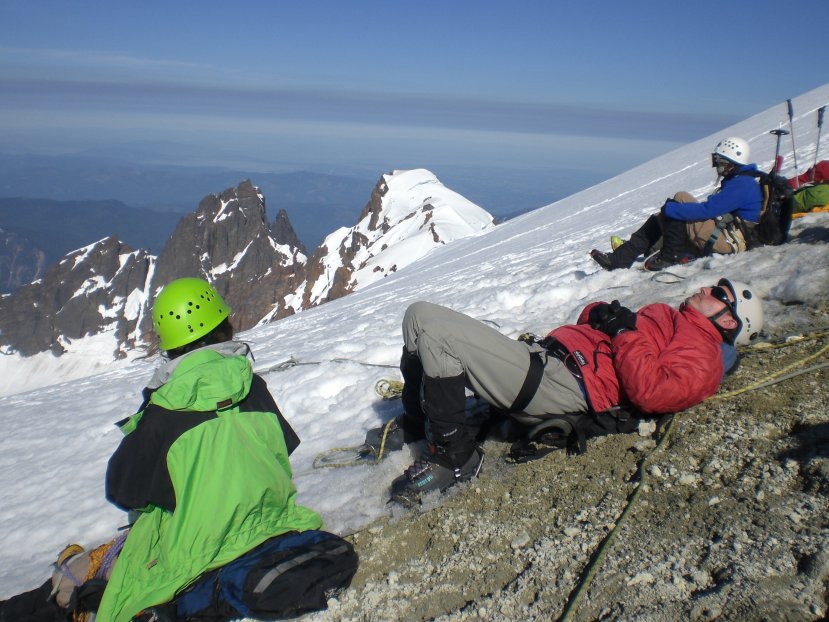
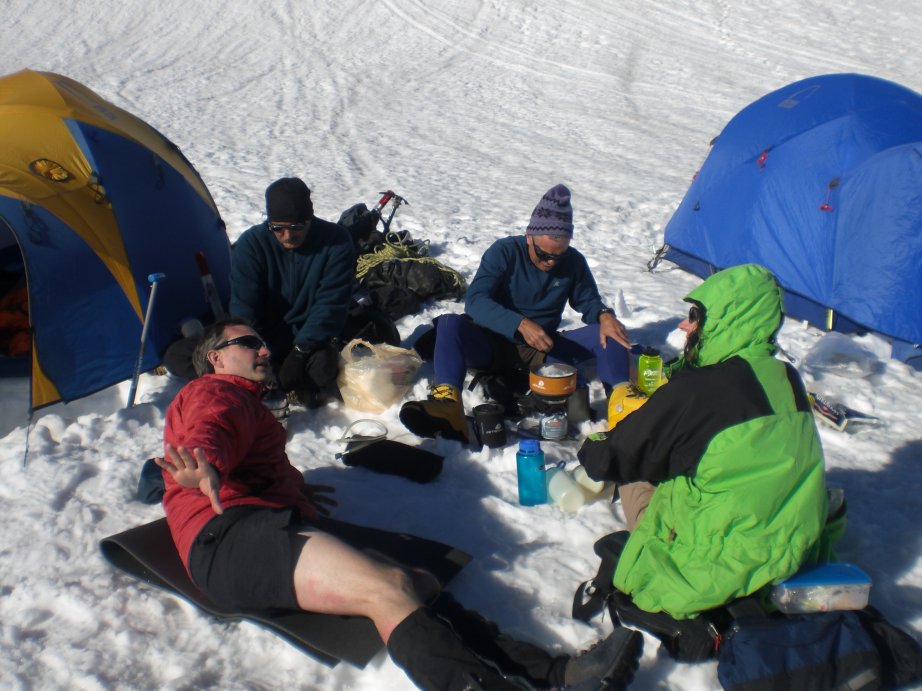
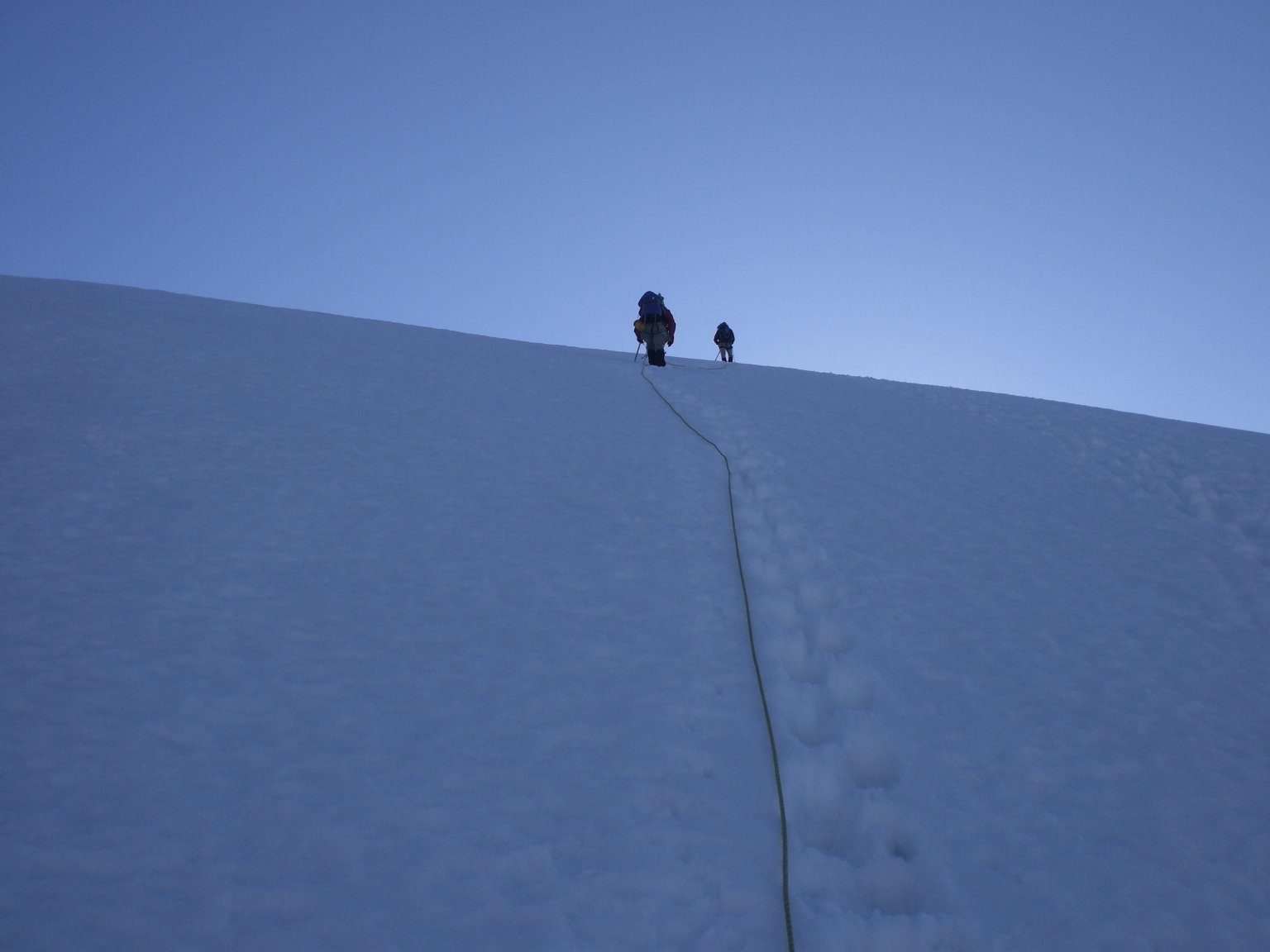
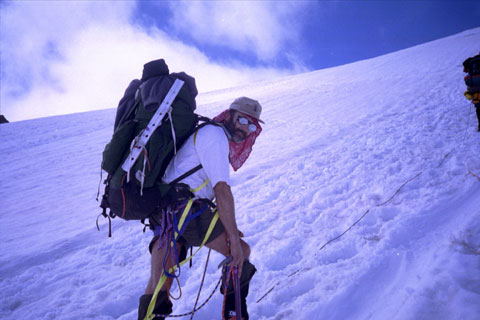
10,778 ft/3285 m - Washington StateOn June 29, 2008 six friends summitted Mt. Baker (Komo Kulshan) an hour before noon. Led by Jeff Bowman and Amy Hastings, Georgia Briscoe, Tom and Linda Jagger, and I all made way up steep glaciers and volcanic vents for over 7,000 feet of elevation gain. Using two rope teams with ice axes, crampons, pulleys and prussics, it was quite the adventure and I'm grateful have been invited along for all the fun! - Roger J. Wendell, Independence Day '08
Trailhead still snowed-in!
Georgia and Linda
Amy
Me, Linda, Georgia and Tom
Me opening a water bottle...
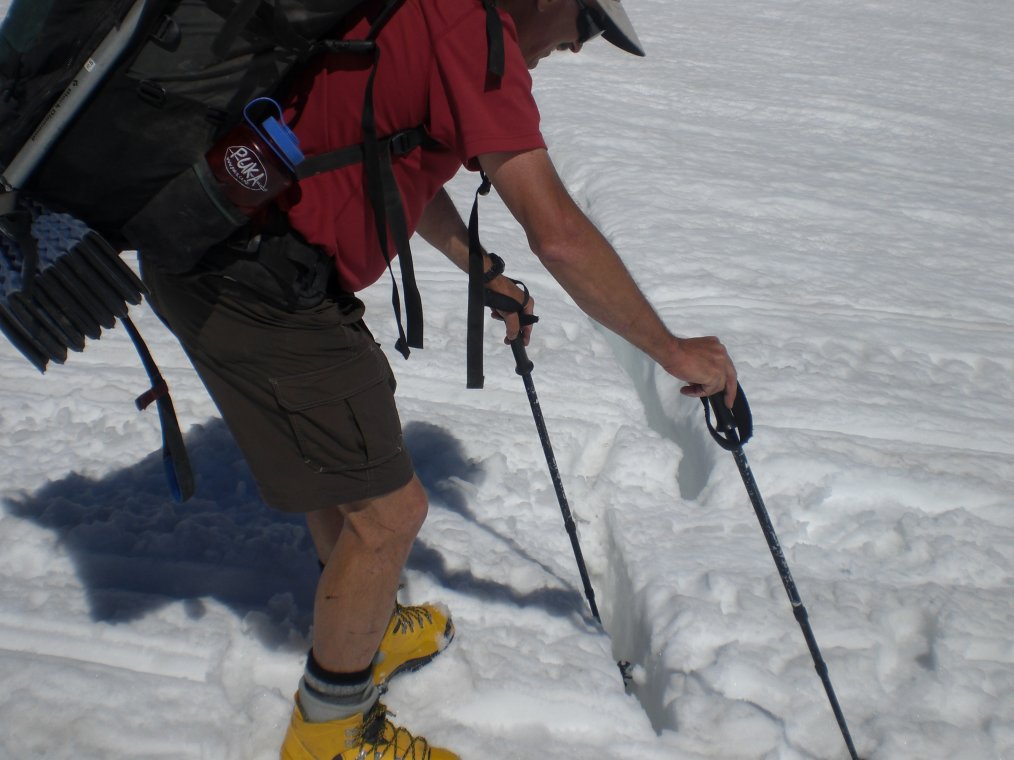
Tom tests a crevasse
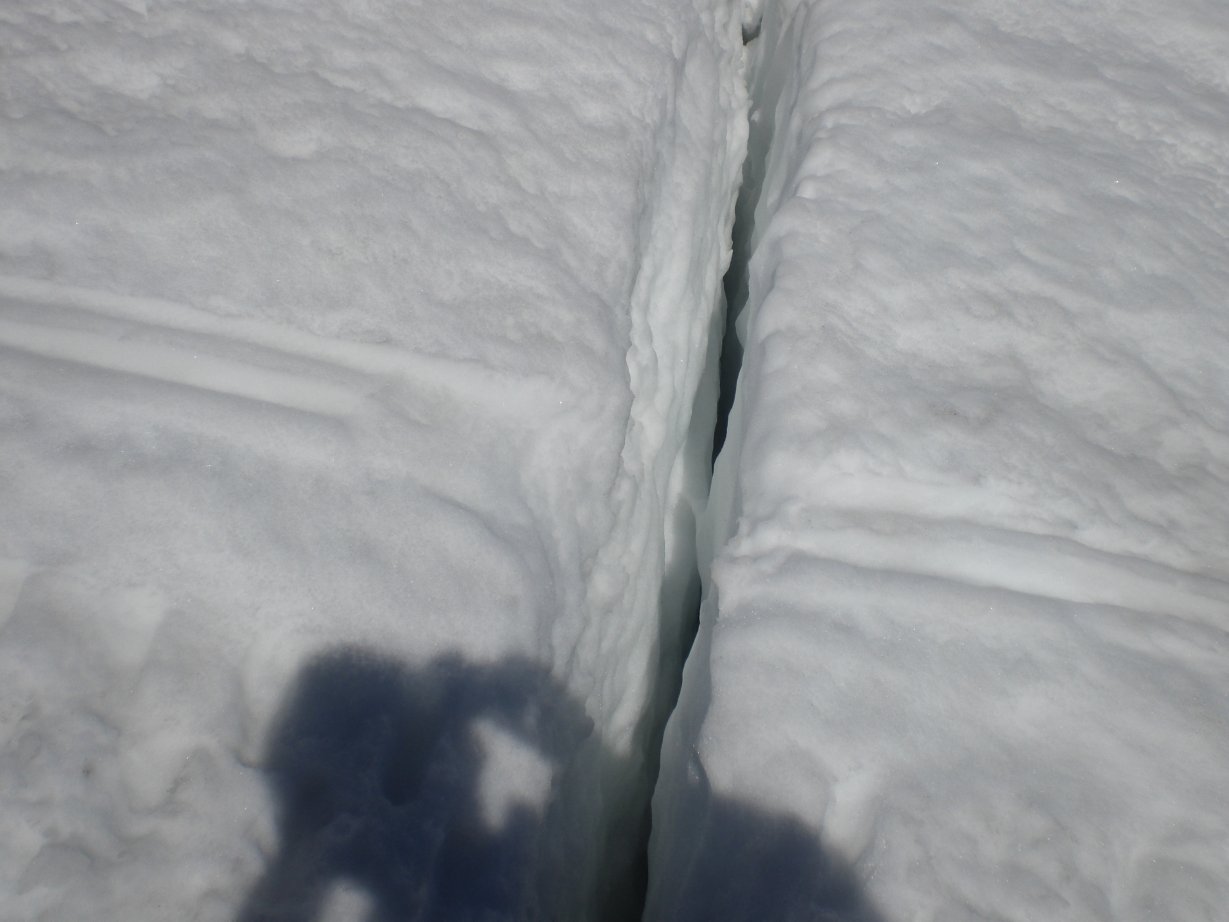
Small crevasse
Volcanic steam vent
Georgia
Jeff and Tom
Amy
A skier rests with us
Amy and Jeff
Jeff, me and Tom
Sunrise on Mt. BakerA Mini Epoch:
It took us about six hours to descend from the summit back to our cars - stopping half way down to dismantle our camp. While taking down our tents another rope team stopped to ask if we had any cell phone or radio communications off the mountain - one of their companions, a young woman, had been hypothermic and immobile all morning - wrapped up inside of two sleeping bags trying to get warm. I gave it a try and was able to reach the Vancouver, British Columbia 911 dispatcher by cell phone. With a lot of yelling up and down the mountainside, via roped teams, it was finally determined that the woman would be okay and could get out on her own. Apparently that part of the message never made it to the Skagit County Sheriff's Department as a Navy Black Hawk helicopter was dispatched to search for the climber. Although we were unaware, and never saw the helicopter, the Sheriff's Department made many attempts to reach me by cell phone after my first call. Back in town, when I was within range again, I was able to assure the Sheriff's Department that the woman had recovered and didn't need assistance. The Sheriff's Deputy was good natured but advised me they had pulled my name, driving record, and even pictures from my website in preparing for the search!
Click Here for our YouTube video on the summit of Mt. Baker!
Click Here for our YouTube video of Mt. Baker's volcanic steam vent...
Solid Rock
Roger & Roger at Eldo"At its purest, rock climbing involves finding a weakness in an expanse of rock and exploiting that weakness to get to the top. There are many variations on this primary objective. If the rock face or cliff is long, then you need to puzzle it out in rope lengths, or pitches. When the climber puts several such sections together, the result is a multi-pitch climb. To keep oneself safe while climbing, one uses a complex array of gear, called protection, and a nylon rope tested and rated to withstand forces far greater than what a long plummet might generate.""The rock feature one climbs is most often a crack or fissure, ranging from pinky width to wider than your head. Cracks provide both a place to cram hands and feet to make upward progress and a place to put the protective gear that will keep you safe should you fall. All our team knew before coming to Ethiopia was that we might be climbing multi-pitch routes on sandstone towers and cliffs via cracks. We came to establish new climbs - our routes - and thus did not know where we would find them, what they would look or feel like, and if they would even 'go.' We came, in short, to do first ascents."
- Majka Burhardt
Vertical Ethiopia Climbing Toward Possibility in the Horn of Africa, p. 27
An opinion:
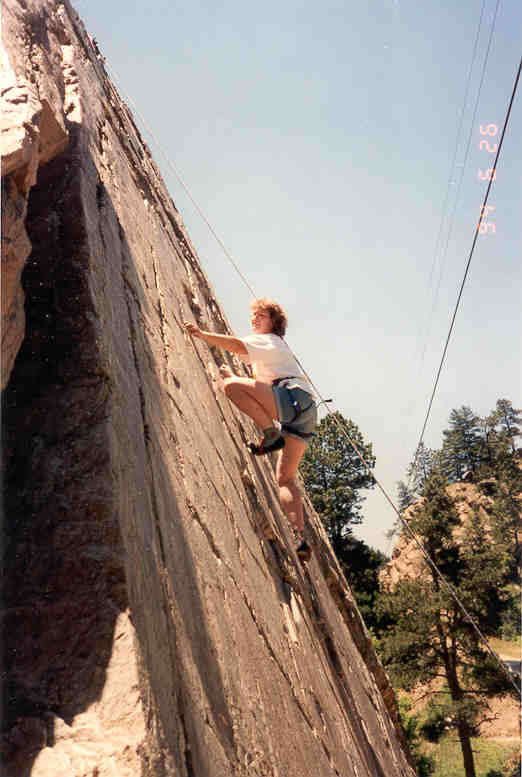
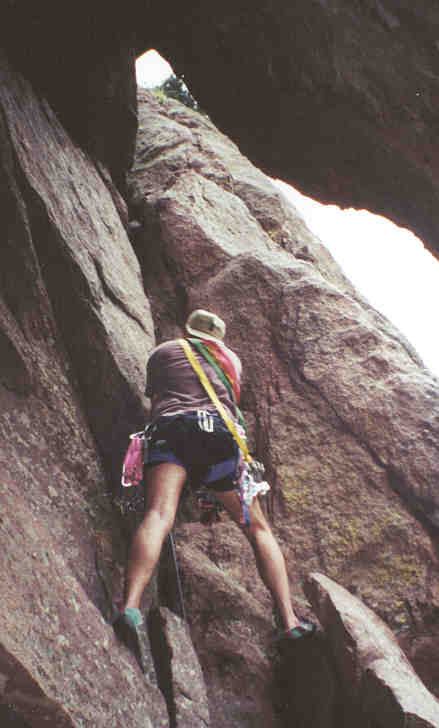
Technical climbing, and the occasional "free solo" (even across the First Flatiron sans clothing!), has always been one of my Colorado passions. There's nothing like the feel of a solid fist-jam while leading a climb up a hand crack 1,000 feet over some river or sandstone landscape. Although I never reached the 5.12 realm, I enjoyed many of the classic climbs Colorado is famous for (Lumpy Ridge, Bastille Crack, all of the Flatirons, etc.). Unfortunately I don't have a lot of photographs to share as carrying cameras (especially back in the 35 mm film days) was a bit difficult due to weight, expense, and the ever present crushing-falling-smashing hazard - Even on Aconcagua I saw a guy's camera fall over 400 feet as it "zinged" by all of our heads below. Okay, enough excuses - I didn't take many pictures over the years!Anyway, like all of my other web pages, I like to provide some cautionary notes as things can get dangerous out there. Back in the late 60s (when I was 14 and 15 years old) I had no money and actually used clothes-line and other dangerous/useless pieces of rope to anchor me and my fellows in as we scrambled over rock faces and cracks in the San Gabriel mountains of Southern California. Those days are long-gone and that kind of foolishness needs to be avoided at all costs! For proper, safe climbing you need the appropriate gear and training. Period!
Ethics:
Oh, and for a little note on climbing ethics: Always stop to help other climbers in need. In the early 2000s, at about the time I was putting this page together, there were way too many newspapers stories about climbers stepping over the bodies of others who were injured or freezing to death without offering a lick of assistance. We can all do better than this - the summit doesn't mean that much! Another climbing ethic, in the technical world, is to avoid any direct aid from your equipment or that of others. That means when you're on a roped 5th class climb you should never use the rope to pull yourself up nor should you ever step on a spring-loaded or piton (most pitons out there are decades old and shouldn't be trusted anyway) to gain additional purchase or security. Technical climbing, in effect, is "free-soloing" (climbing the rock without any gear) but with the added benefit of a rope, spring-"loadeds," stoppers, and tri-cams catching you should you fall. The idea of "free-soloing" is what sours me, to a great extent, on the practice of Via ferrata that I describe further, below.Never say never!
When I say don't use your climbing gear for direct aid that doesn't mean to be stupid, either! If you and your climbing buddies are in trouble don't hesitate to use your gear in any way, shape or fashion to save your lives or prevent injury!! It's just that I've been on a few climbs where I've seen somebody receive a "high-five" for completing a five pitch route but know they stepped on that #3 Camalot to get them over the crux - which means they didn't really "free" the route - just my opinion (and that of a few hundred other climbers I've met over the years...)...
- Roger J. Wendell
Click on any of this page's "Thumbnail" images for a larger view...
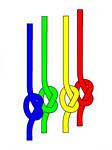
Knots for Climbers:
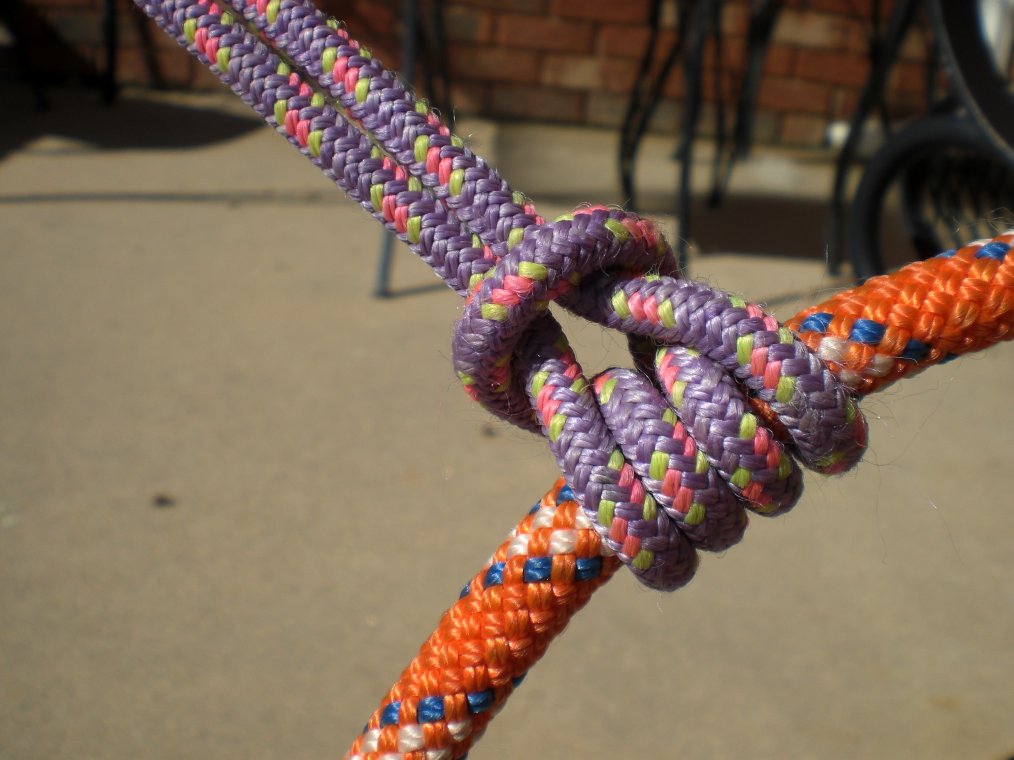
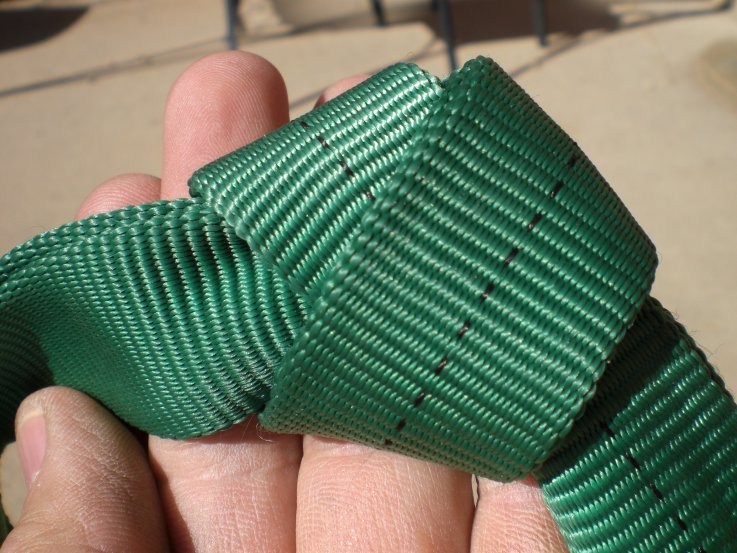
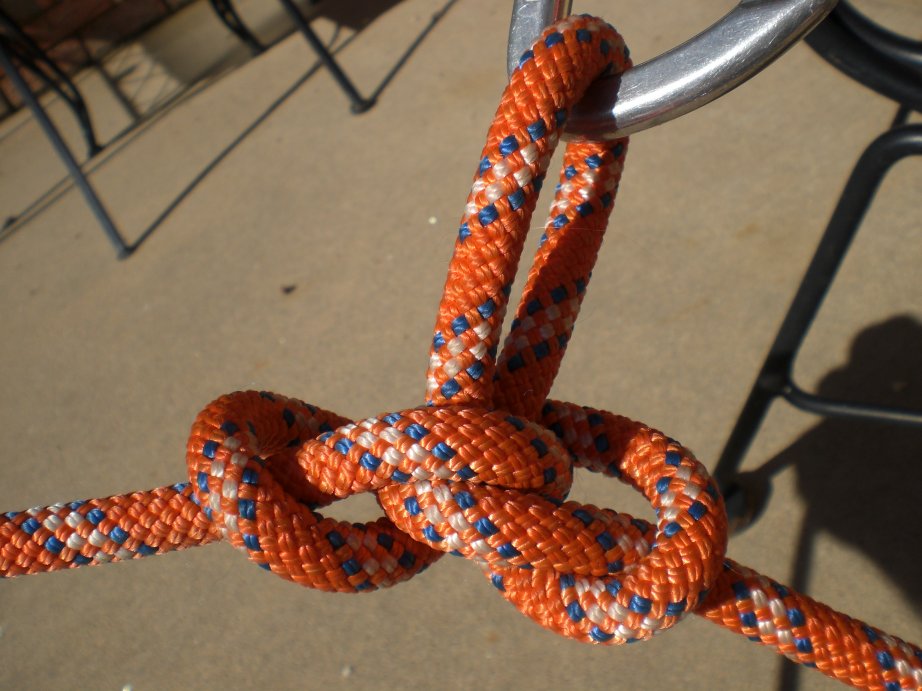
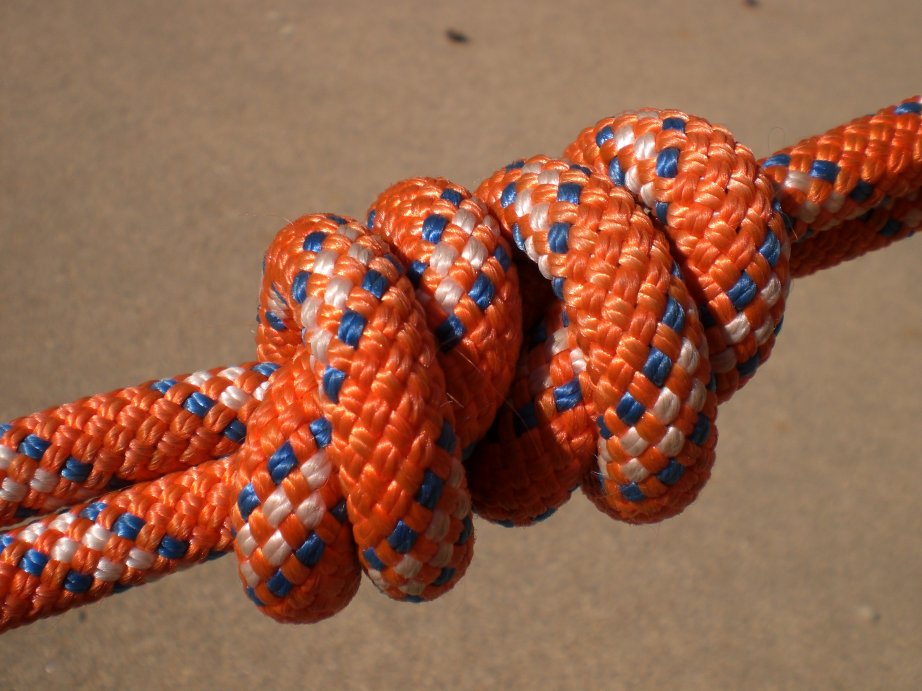
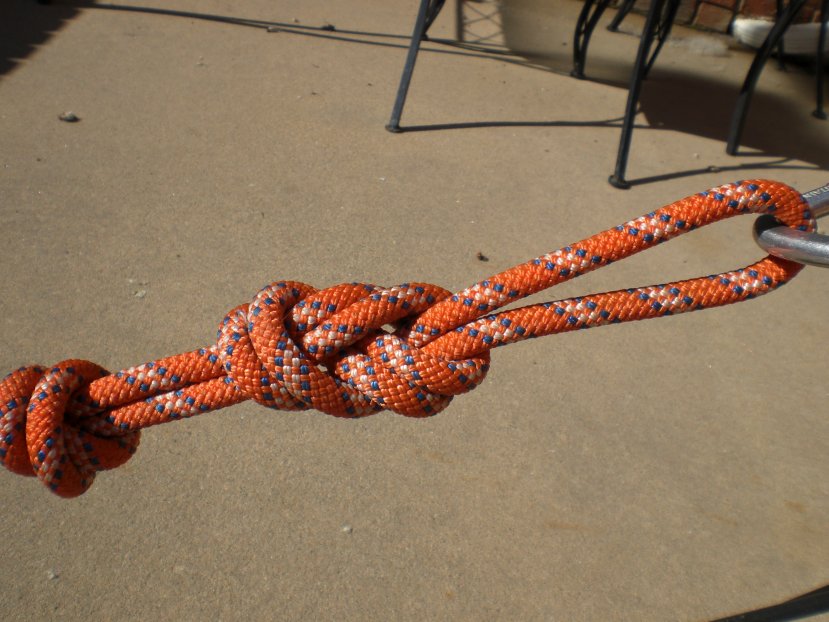
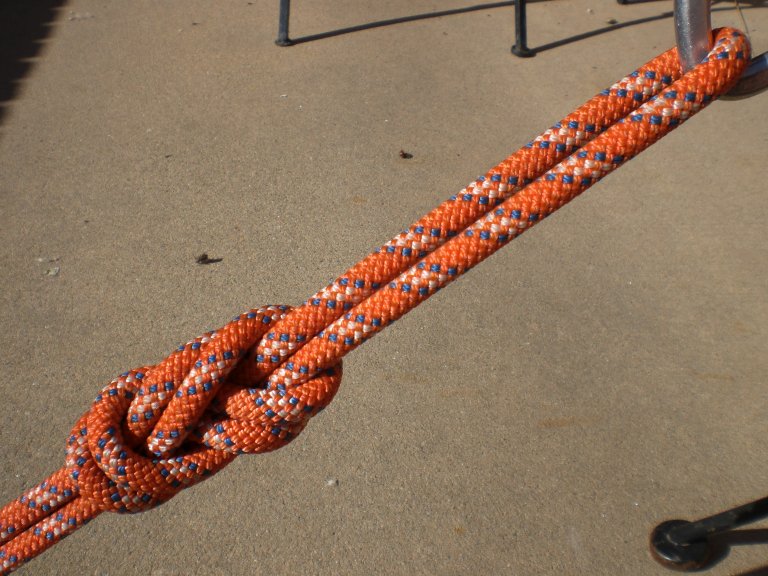
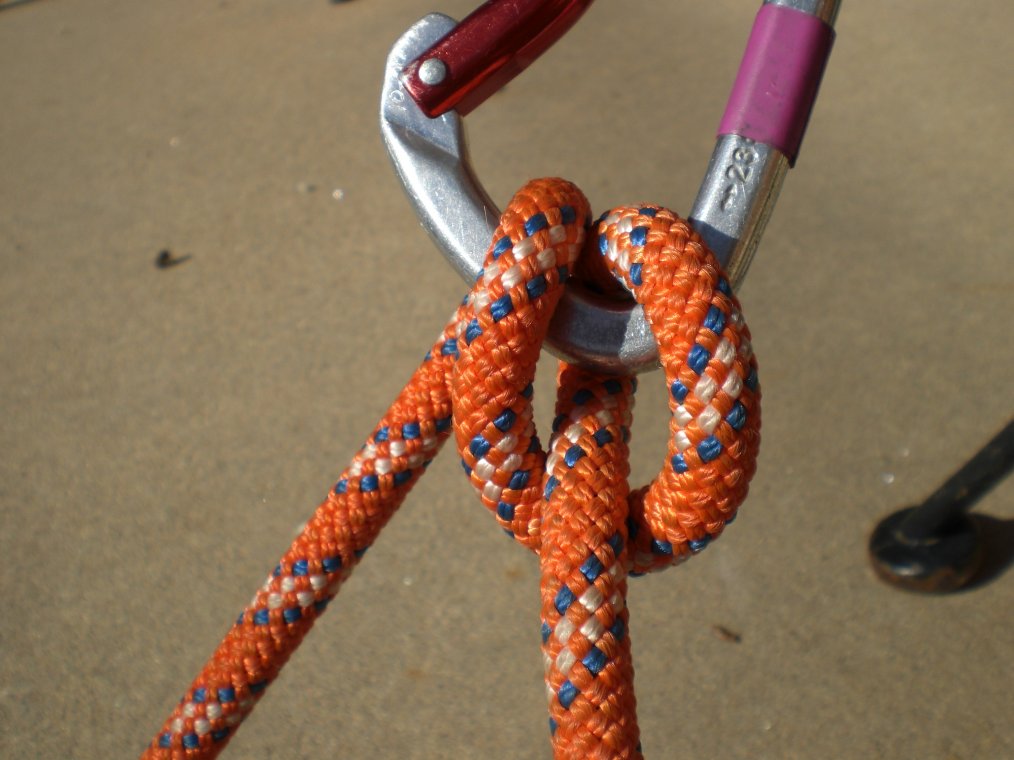
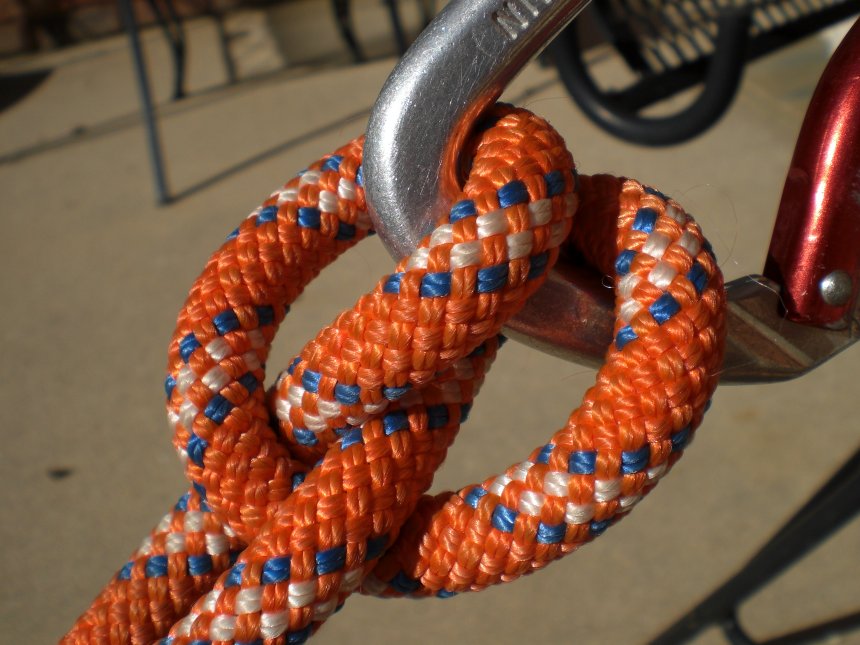
You need to know these!There are six basic knots I believe you really need to know for climbing; Figue-8 Retrace, Clove Hitch, Figure-8-on-a-Bight, Double Fisherman's Knot, Prusik Loop, and the Münter Hitch. In addition to these half dozen I also find the Water Knot, Alpine Butterfly, and Girth Hitch really handy as well. Anyway, the six basic knots, that I first mentioned, are really essential to safe climbing - both technical and mountaineering. The rule-of-thumb for knots is that they should be easy to remember, easy to tie, and easy to check visually. I also try to keep my knots properly "dressed" (nice, neat and with parallel runs when applicable) so that they're a little easier to take apart should I happen to load them my taking a hard fall.*All knots reduce the breaking strength of rope. Another unscientific rule-of-thumb that I go by is that you can figure a knot reduces rope strength by about 50 percent. Of course this is a gross approximation as I've received emails from climbers suggesting certain knots can be within 85 or more percent the strength of a rope. Right. But, the main thing is to remember that knots weaken a rope which goes without saying how important it is to properly care for the rope itself - don't step on it, don't expose it to solvents or corrosives, "retire" it after it's taken a hard fall or it's been in use too long, etc. Another unscientific rule is that a properly "dressed" knot, like mentioned above, is probably slightly stronger than a messy one but I don't have any proof of that at the moment - just keep your knots neat and tidy so they're not only less trouble to undue but it's easier to see if they're being tied and used properly.
Anyway, back to those six basic knots: You need to know 'em "cold" - that is, be able to tie them flawlessly without hesitation. Many climbers (including me) practice tying knots in a cold shower in the dark. Yep, that's right - when you take your next shower turn out the lights, turn off the heat, and drag a rope in there with you! Many times, when either mountaineering or even technical climbing, you'll encounter difficult, wet, cold and dangerous conditions that won't allow for much fumbling around with a knot to save yourself. By practicing your knot tying in the cold, harsh conditions of your home shower you'll be better prepared to handle the rope under difficult conditions out in the real world - not to mention that these knots should be very well committed to memory after a number of shower exercises!
There are many books and websites that'll show you how to properly tie each of these knots - I've placed these pix here for general reference and hope that you'll study the subject even further so as to become an expert with the knots you need for climbing!
-Roger J. Wendell, 2002 * The Figure 8 is my favorite knot for tying into my harness. However, like other climbers I've gotten really frustrated trying to untie and
Golden, Colorado
free myself from a welded-shut figure-eight after falling on it. But, isn't that exactly the kind of knot you want to trust your life with??!!
Helpful Videos:
Prusik Loop
Water Knot
Alpine Butterfly
Double Fisherman's Knot
Double Fisherman's close-up
Figure 8 Retrace
Figure 8 on a Bight
Münter Hitch
Girth Hitch
Clove Hitch
- Double Fisherman's: https://youtu.be/GXG9Xv5eEuA
- Figure 8 Retrace: https://youtu.be/GFlwrvggas0
- Girth Hitch: https://youtu.be/blP6BL05Q34
- Alpine Butterfly: https://youtu.be/gX1dWKg6Ttc
- Clove Hitch: https://youtu.be/shTbWHxYiWk
- Water Knot: https://youtu.be/sO20BG1dkb0
- Rope Coiling: https://youtu.be/ppYanQ5DDPM and https://youtu.be/_5JGcztuf84
- Tying In: https://youtu.be/H1cEWPx2xnA
- PBUS Belay Technique: https://youtu.be/BOIAYx-d4HE
What these knots are used for:
- Prusiks - Always carry along a prusik loop (or two) as they will enable you to climb back up a rope, set a pulley system or belay yourself while rappelling. Use two to three turns depending on conditions (rope size, wet, etc.). The prusik must be a smaller diameter than the rope you're attaching it to.
- Figure Eight (Follow-Through) - used to attach you, your harness and belay loop to the rope you're climnbing on.
- Clove Hitch - used for quickly securing line to a fixed anchor.
- Water Knot - usually used to join two pieces of webbing but can be used to join two ropes.
- Münter Hitch - to improvise a safe belay.
- Double Fisherman's Knot - to tie two ropes together, usually for rappeling longer distances (be sure to pull the rope down from the side with the knot as it won't pull through the other way!)
- Alpine Butterfly - allows you to clip a person, or gear, into the middle of a rope that's already in use. Kind of fun to tie it, once you know how, as the technique is to loop the rope around one had a couple times and then pull it throug itself to creat the "Butterfly."
North Table Mountain
Golden, ColoradoBefore returning to his job in Japan, Roger came home for a few days with a quick stop for some climbing immediately after leaving the airport!
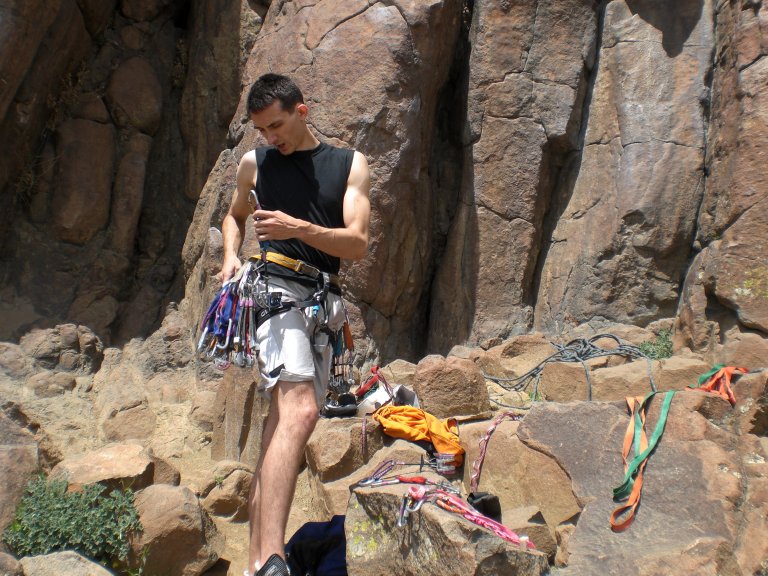
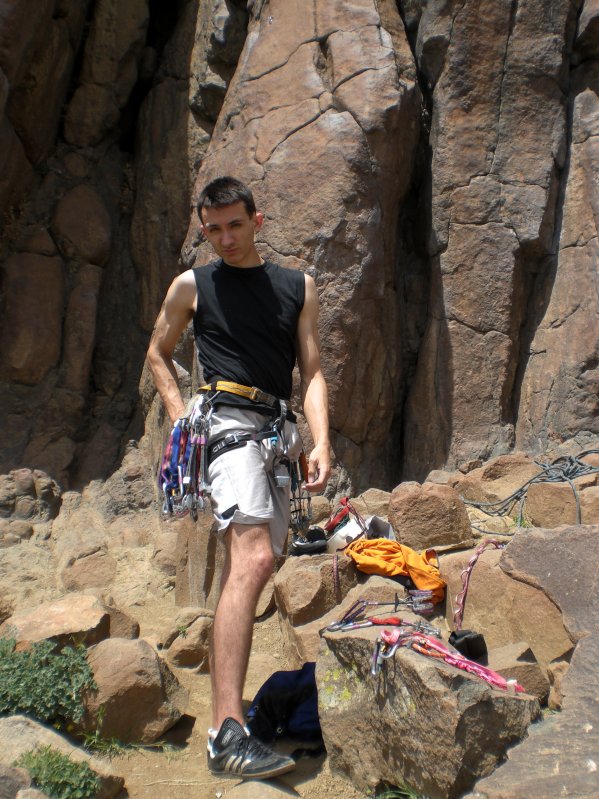
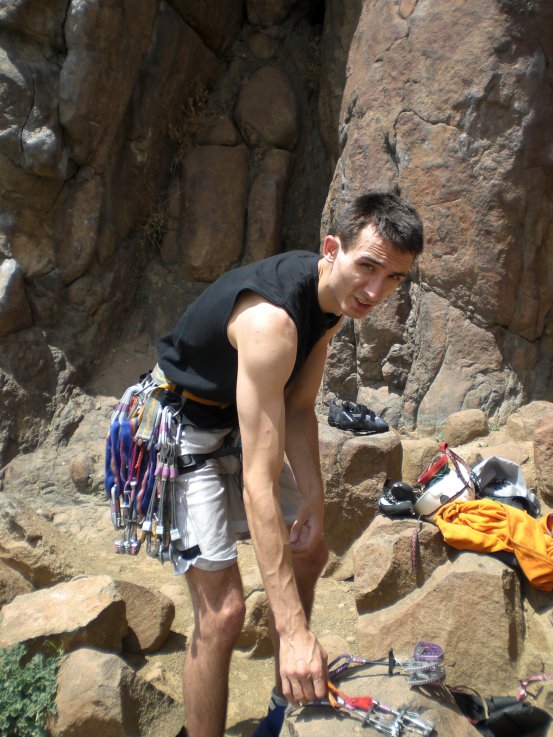
Setting up the rack
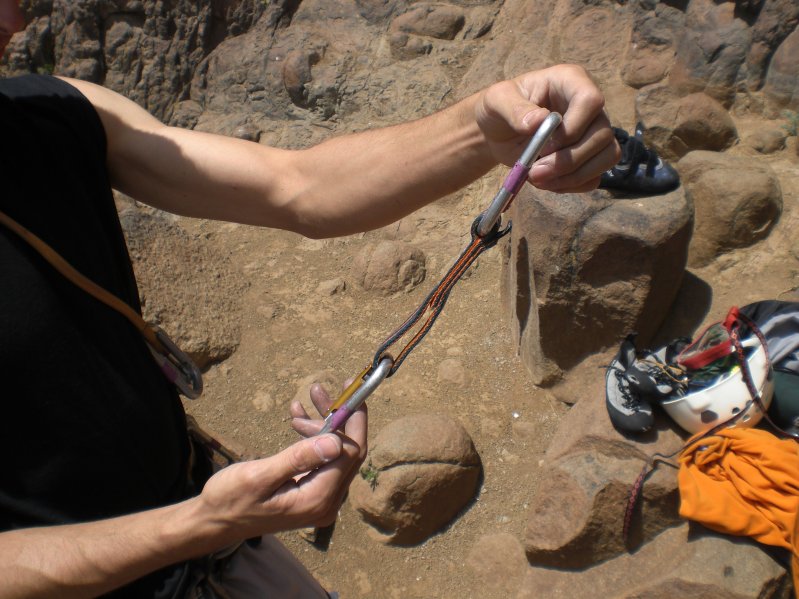
Quickdraw
Smile!
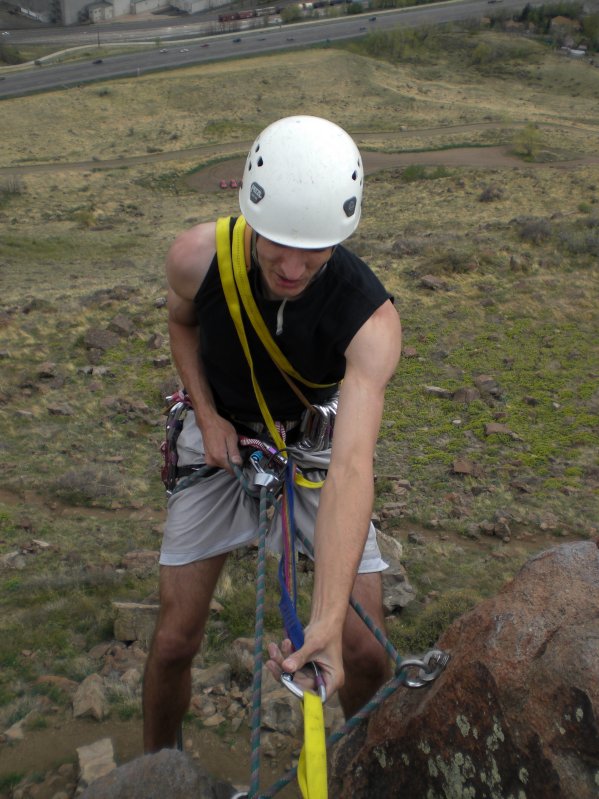
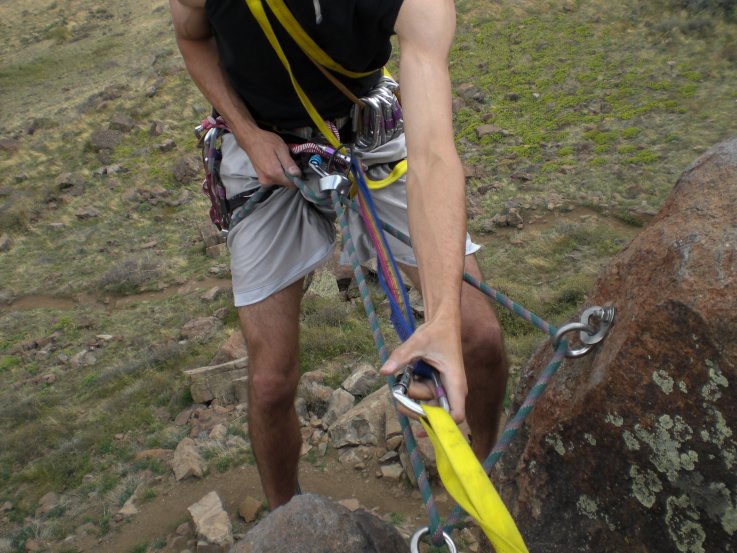
Testing the rappel
On the stupid end...
"Welcome Center"
Leading
Gear everywhere...
Spring loadeds
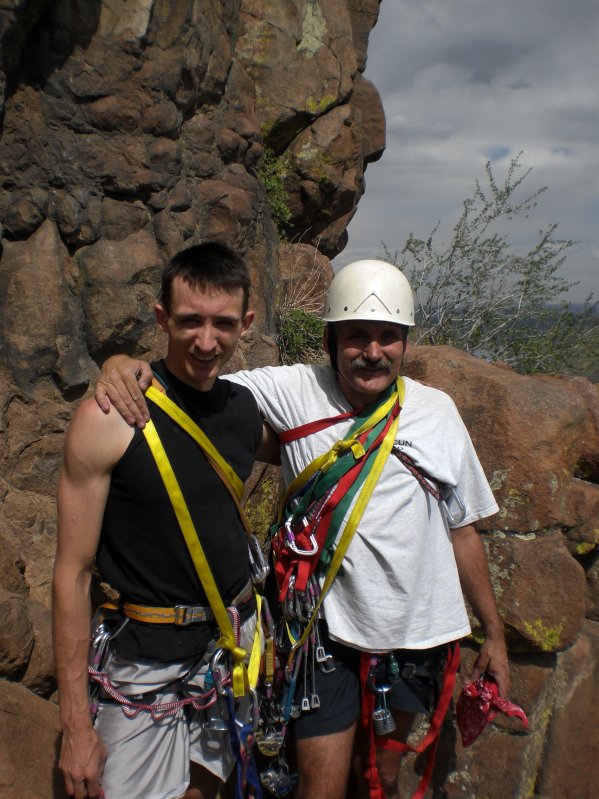
Roger and Roger
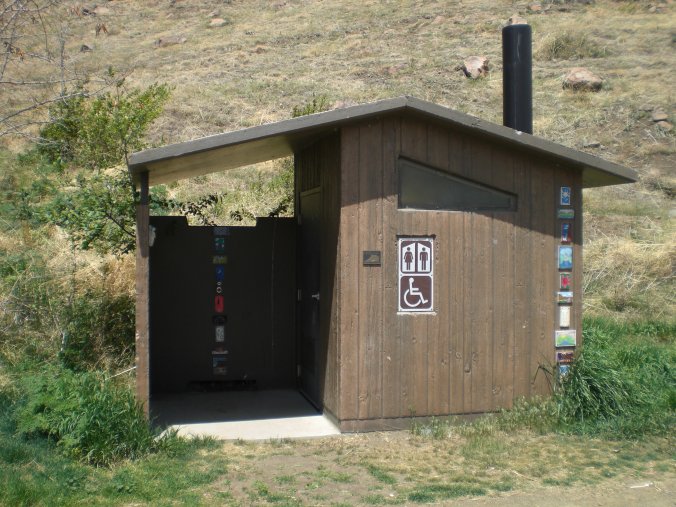
Climbers' Toilet
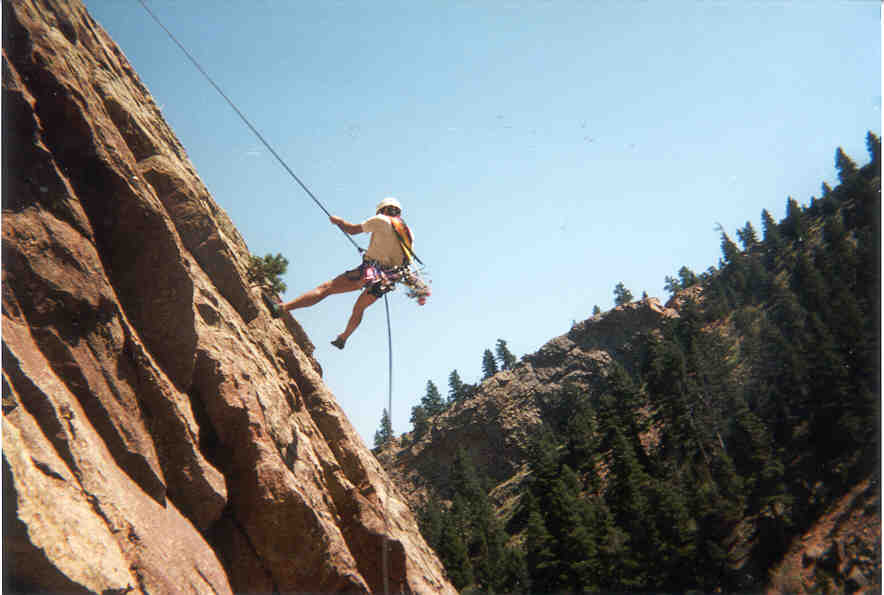
Rappel
Yes, you're right - the rack we used is way too huge for such short routes! But, we carried all the extra pieces to experiment with various anchors and directionals - practice I'd recommend anyone at season's start! You may have noticed the photo of the "Welcome center" - a very different feature than in the "old" days when we had to sneak around Golden neighborhoods to park cars and make our way through various properties to climb...
Click Here for our YouTube video of the North Table Mountain "Welcome Center..."
Via ferrata
(Italian for "iron road")
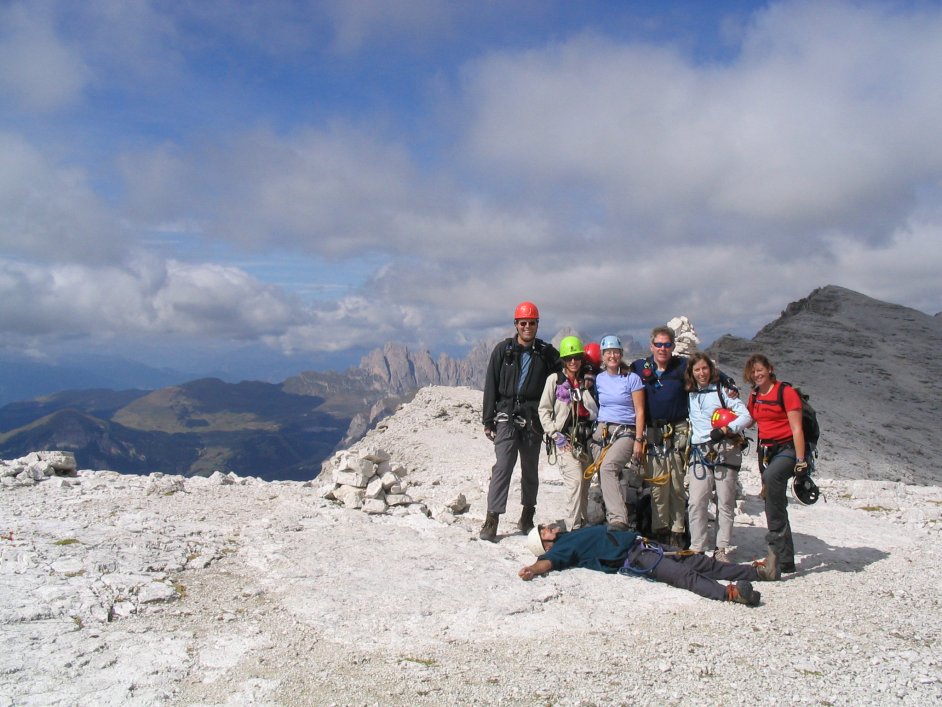
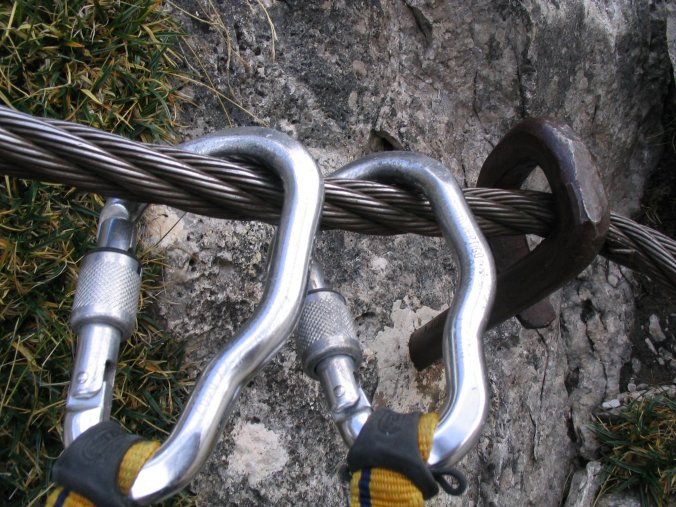
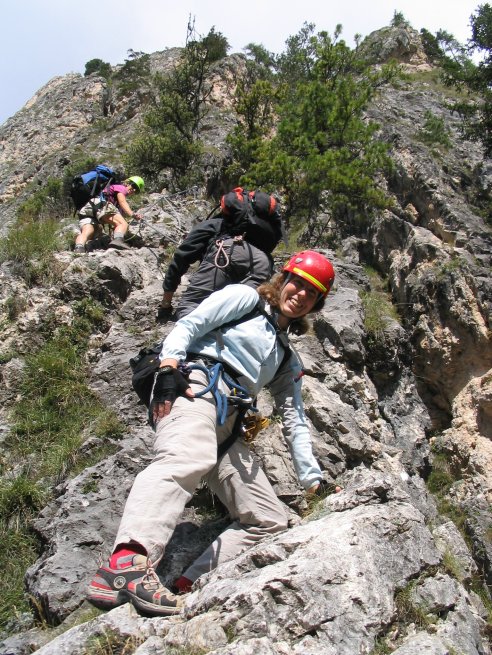
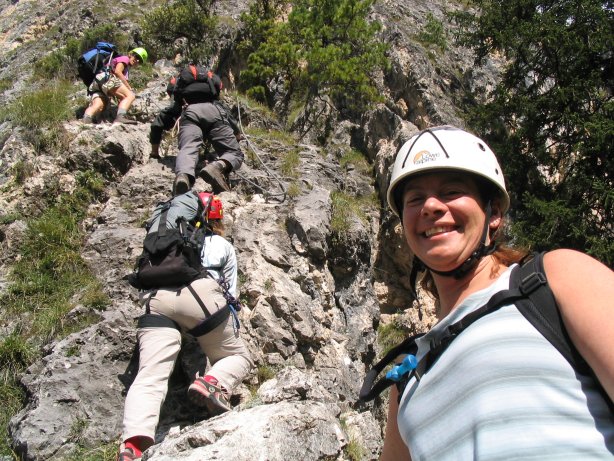
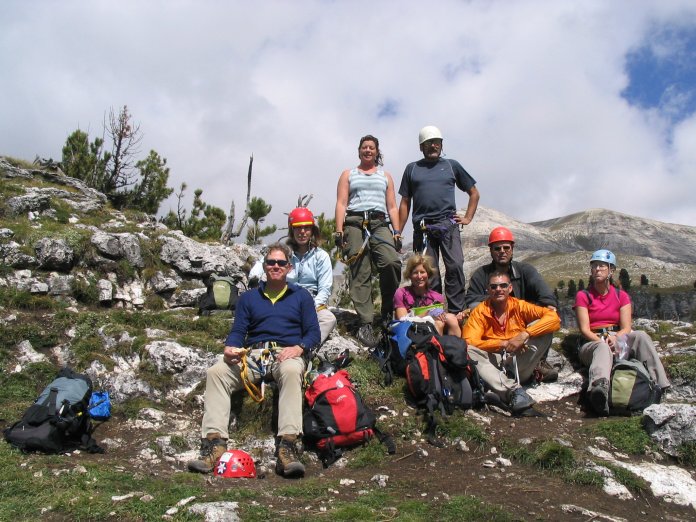
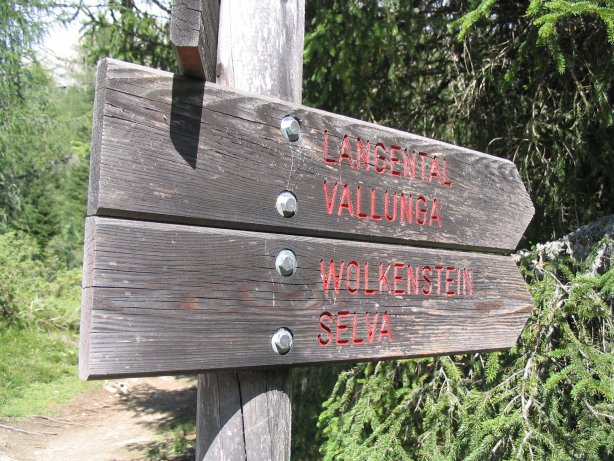
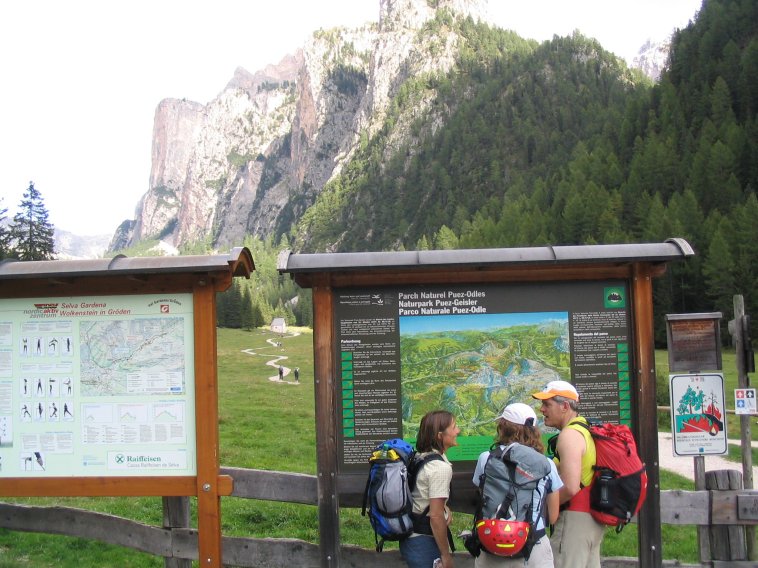
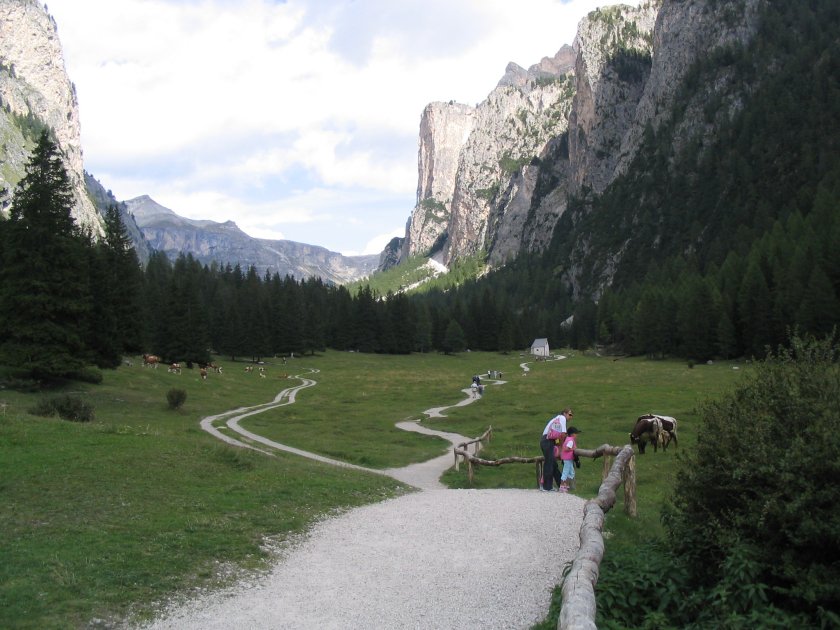
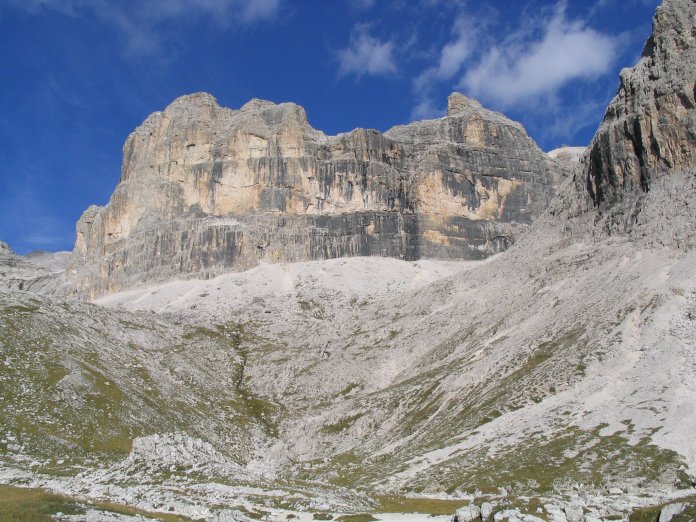
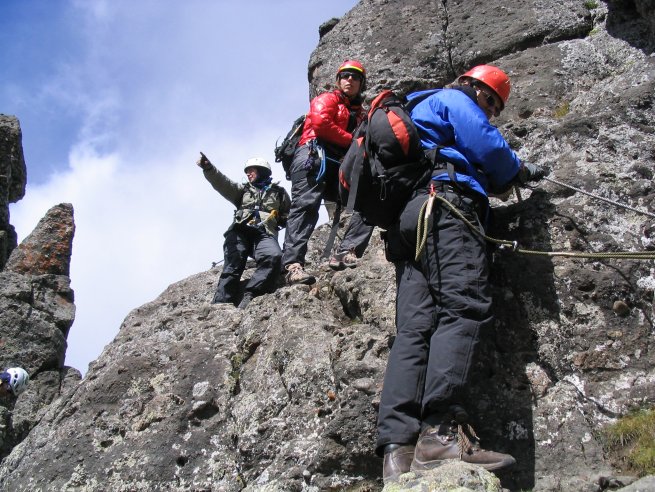
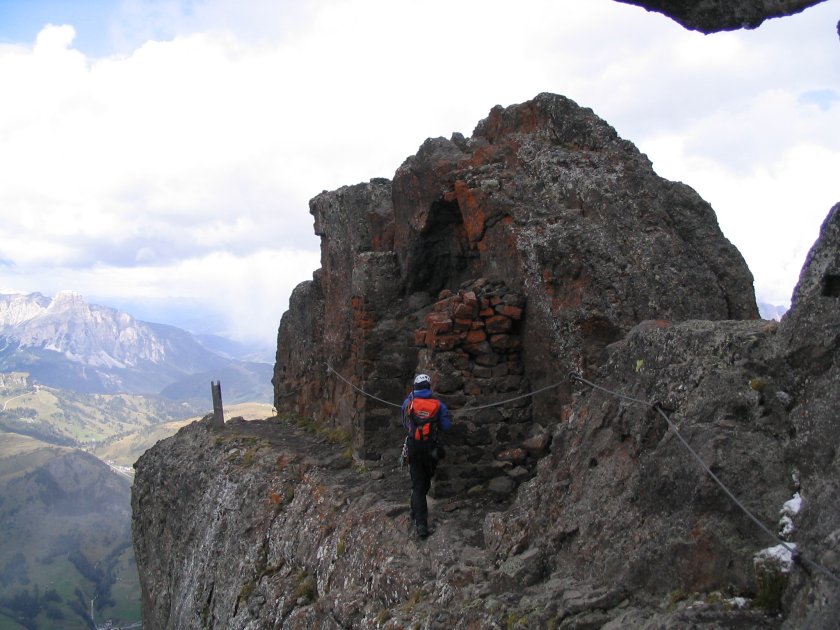
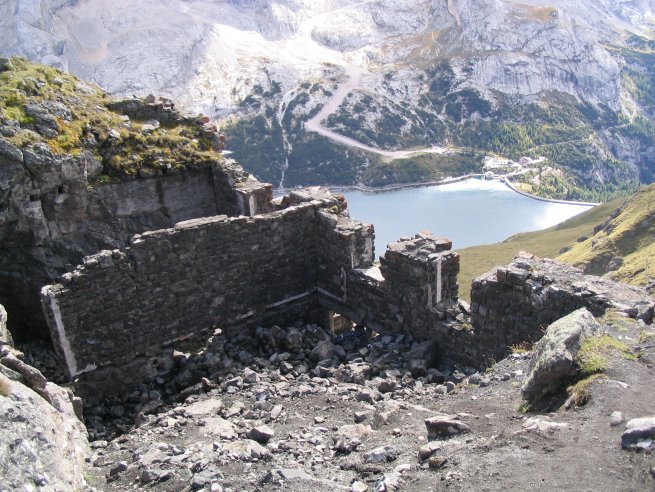
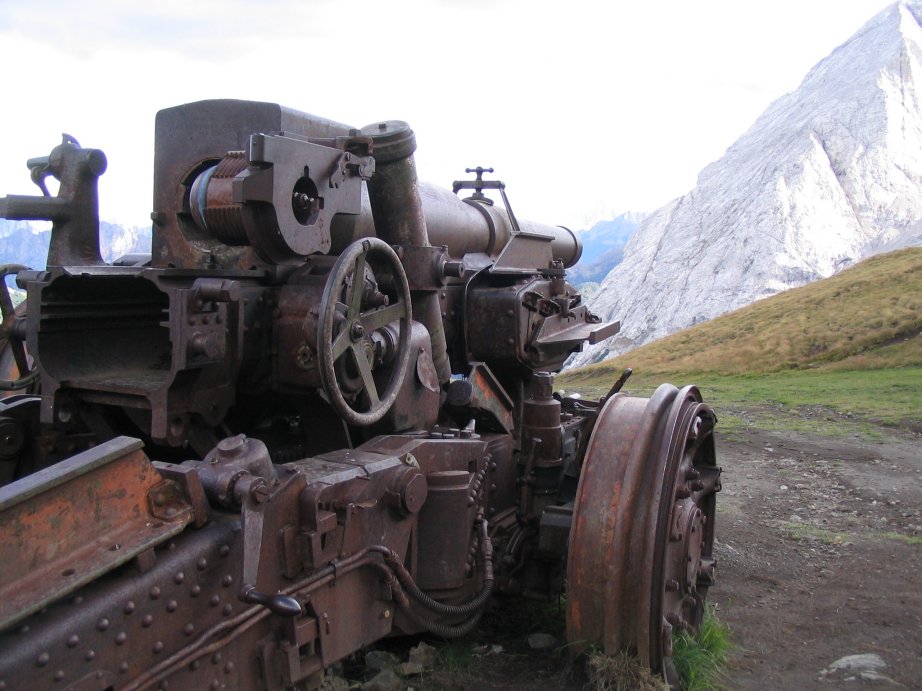
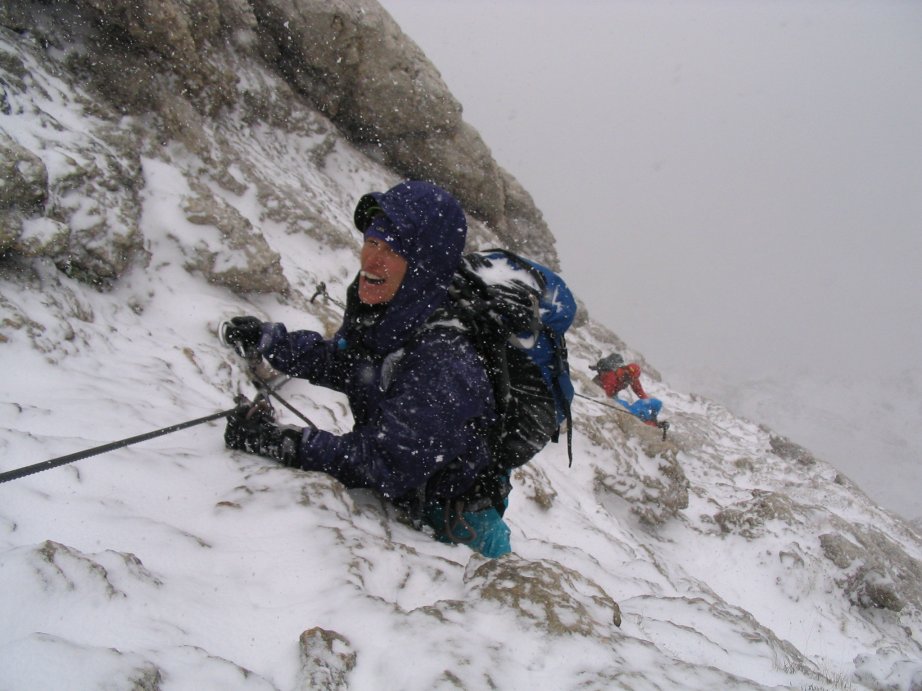
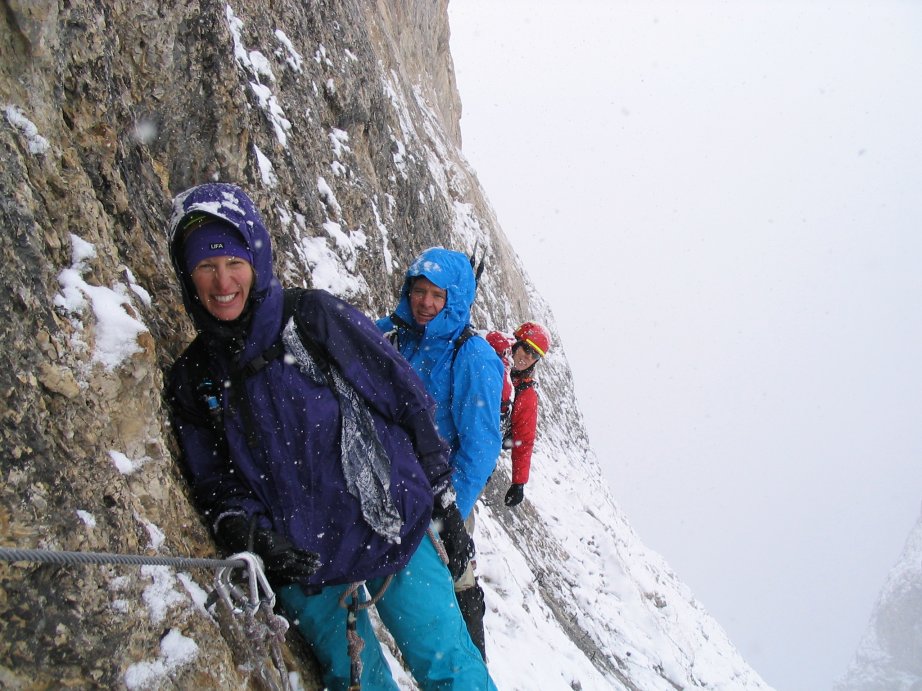
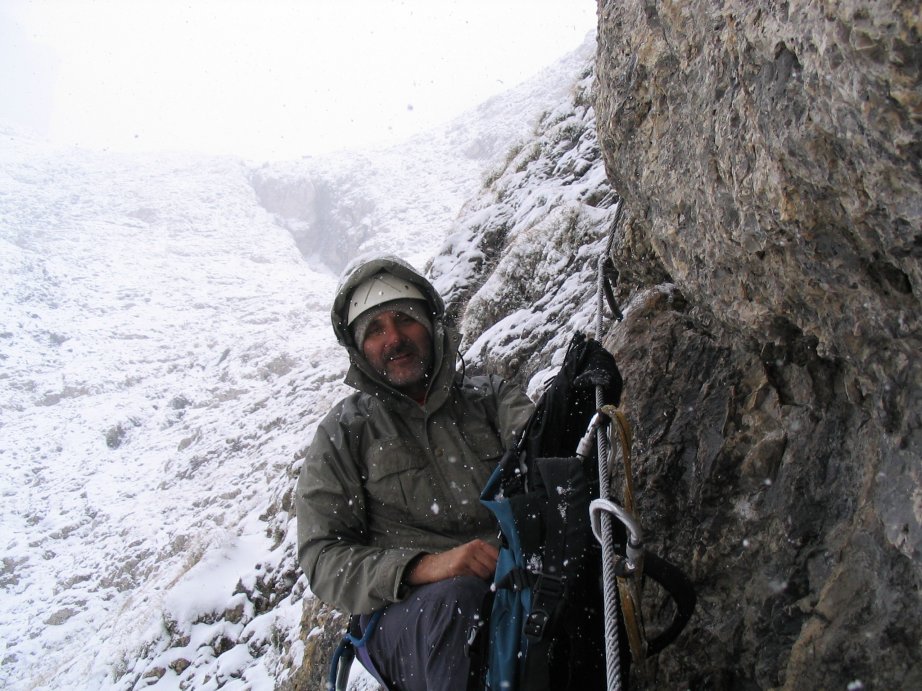
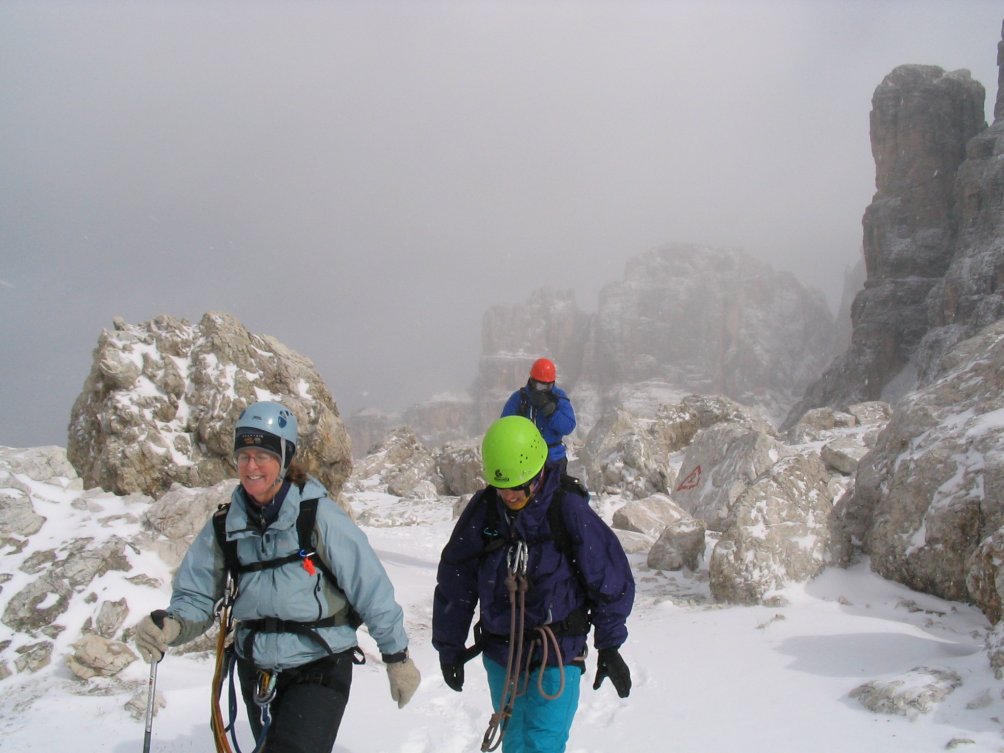
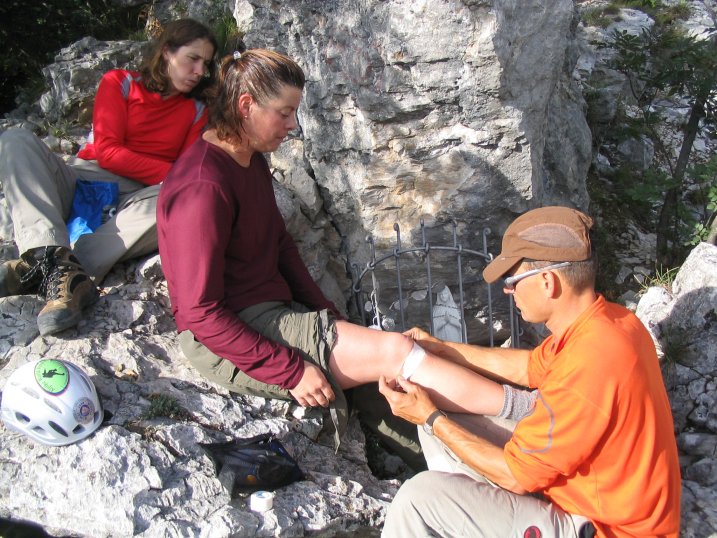
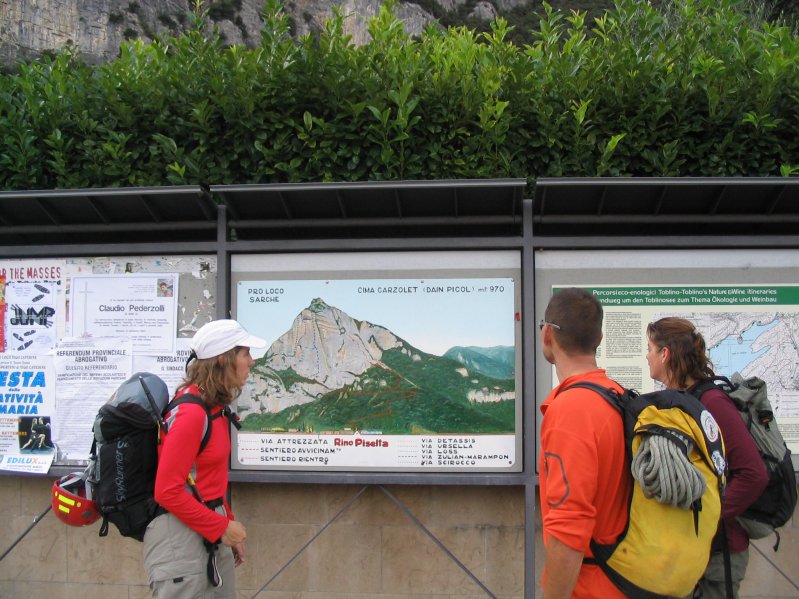
[Plural vie ferrate. In German, klettersteig]Vie ferrate are climbing routes with fixed cables and an occasional ladder or bridge. At the time of my visit to the Dolomites of northern Italy (September '07) there were already well over 1,000 vie ferrate throughout Europe. The first vie ferrate were built in northern Italy throughout the Dolomites. These vie ferrate, when combined with tunnels and rock structures (see below), aided the movement of mountain infantry throughout the first war.Although vie ferrate can be a lot of fun they can also be strenuous as they easily span a few thousand vertical feet of climbing route. Apparently they're becoming popular because of their relative safety (even though the fall factor places more stress on the human body because there's no long length of rope to absorb the shock...) and limited gear requirements. That being said, I hope the idea doesn't catch on too much more in the U.S. as the real appeal to climbing and mountaineering is both an environmental and climbing ethic. We certainly don't want to pound any more bolts into Nature, than necessary, and we certainly don't want to be clinging to anything artificial to make our way up the rock... Nevertheless, I had a lot of fun on the Dolomite's vie ferrate and am glad to have experienced this alternative to traditional climbing!
Seven on top (of me...)
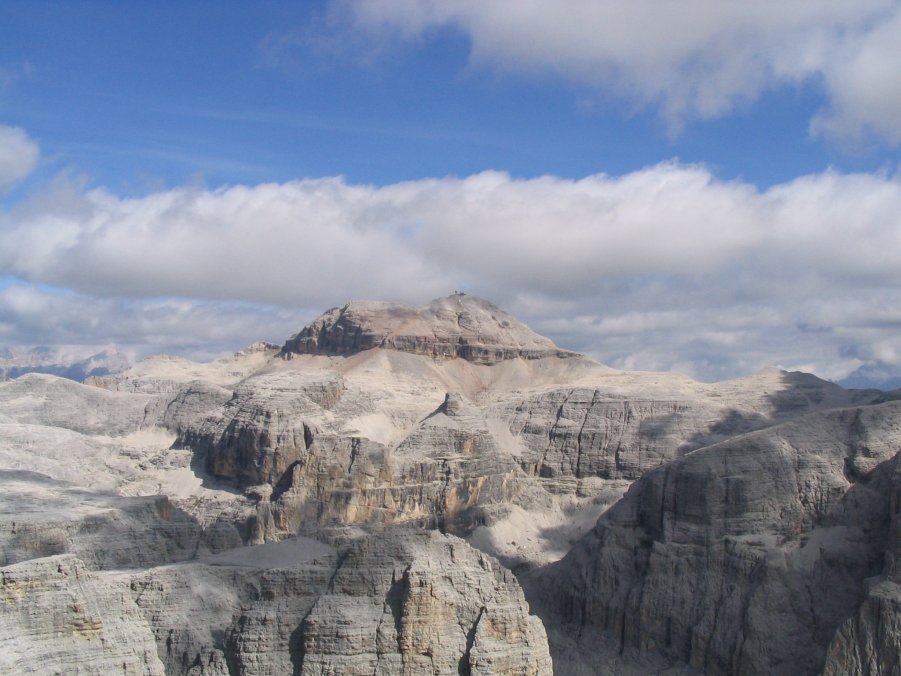
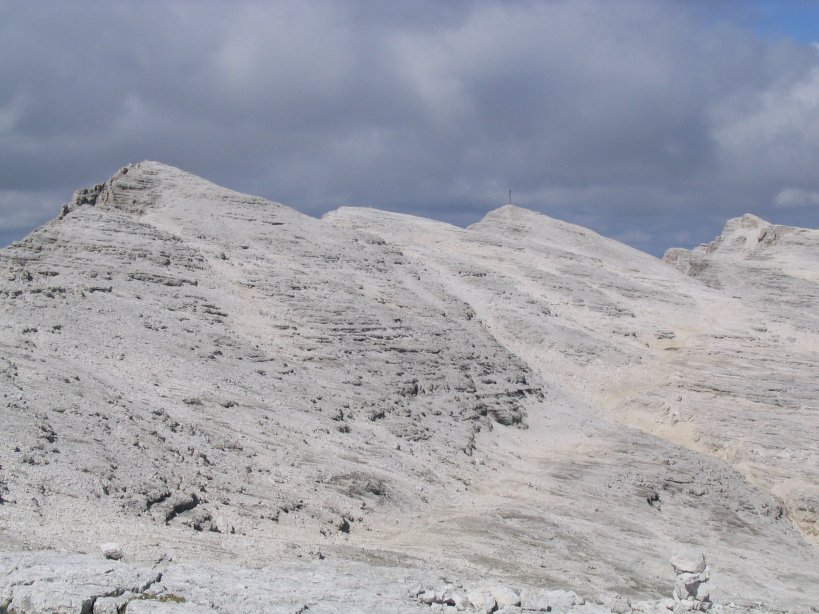
Dolomites
Dolomites
Dolomites
Specialty carabiners for via ferrata
Jill
Tracey
All 8 of us!
Signage
Jill and Robert
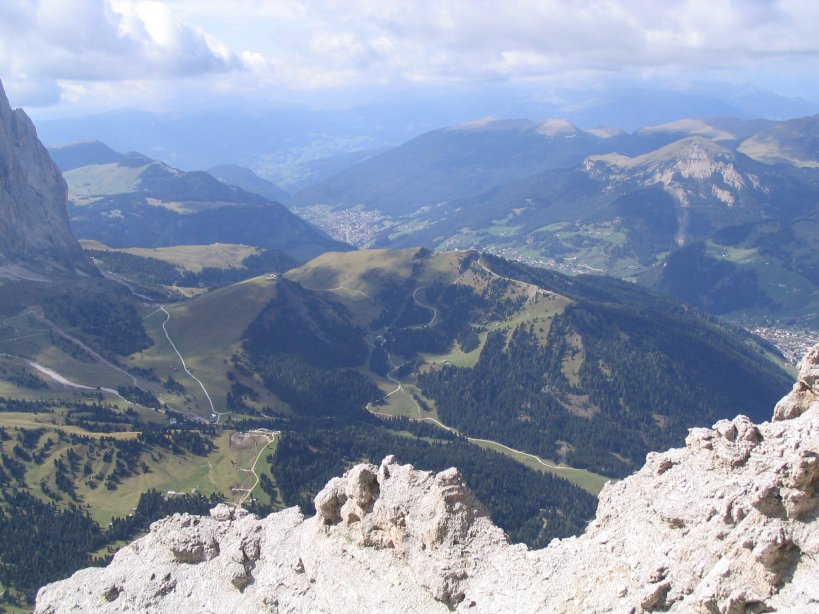
Valley
Dolomites
Tracey, Jill & Robert
World War I fortification
World War I fortification
World War I
Marianne
Marianne, Robert & Jill
Me
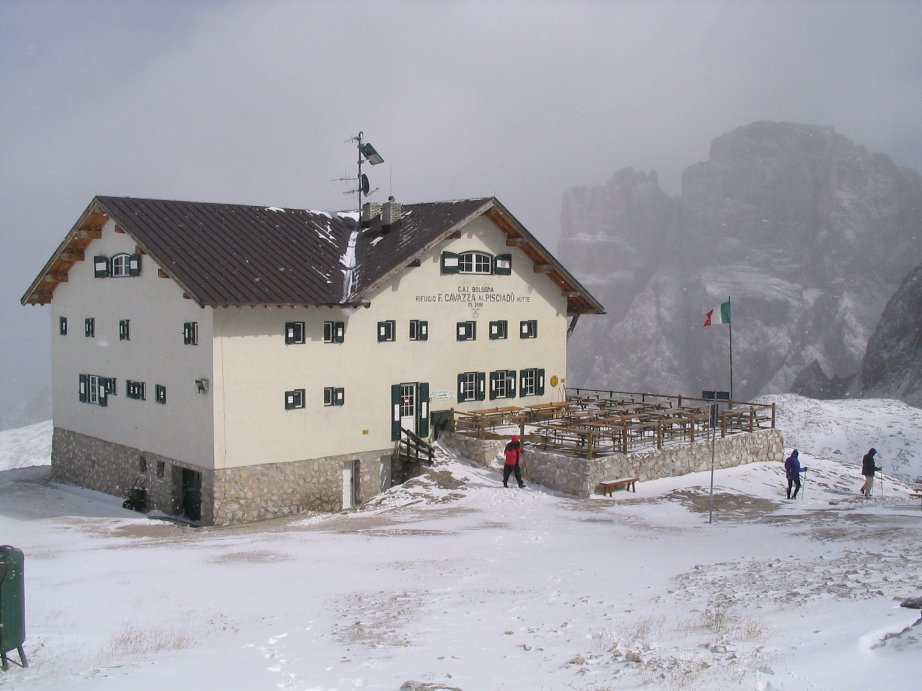
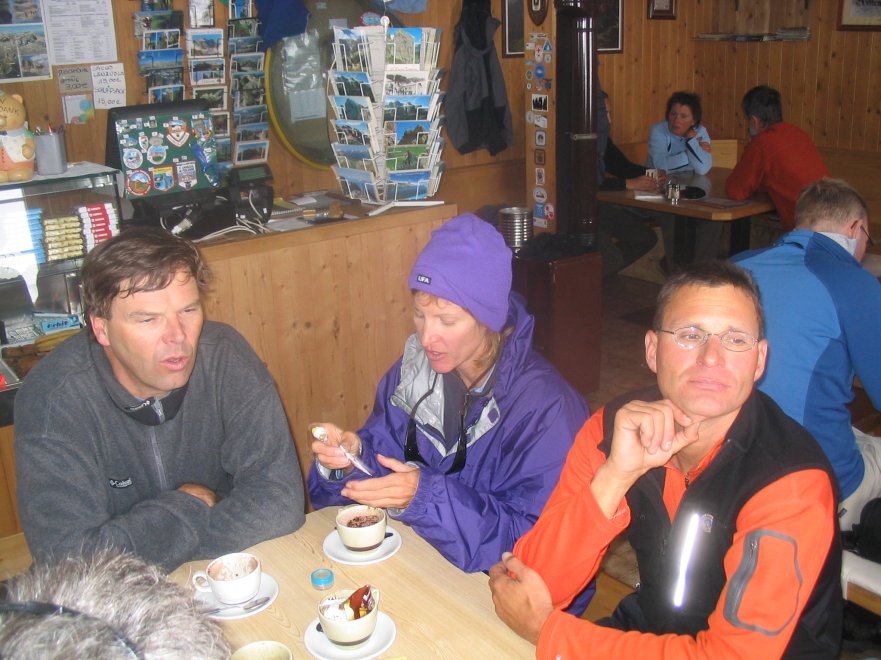
Rifugio Cavazza al Pisciadù Hütte
Harald, Marianne & Markus
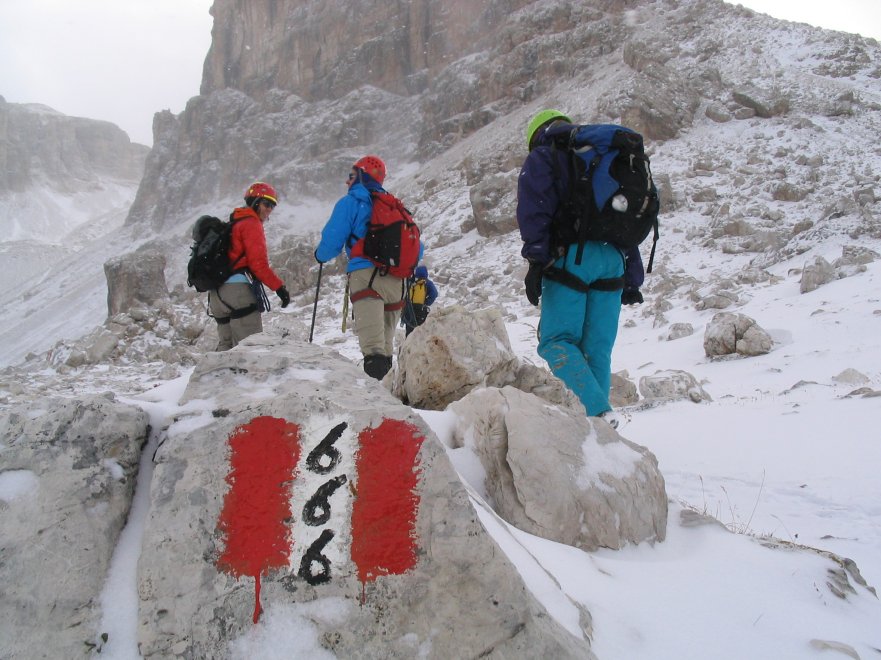
Route 666
Dianne, Marianne & Robert
Jill, Tracey & Markus
Jill, Markus & Tracey
The word "Dolomites" is derived from the name of a famous French mineralogist, Déodat Gratet de Dolomieu. Dolomieu was the first to describe the rock, dolomite, as a type of carbonate rock which is responsible for the characteristic shapes and color of these mountains.Carbonate rocks are a class of sedimentary rocks composed primarily of carbonate minerals. The two major types are limestone dolomite, composed of calcite (CaCO3) and the mineral dolomite (CaMg(CO3)2) respectively. Chalk and tufa are also minor sedimentary carbonates. It's believed that the presence of carbonates in rock is strong evidence for the past presence of liquid water.
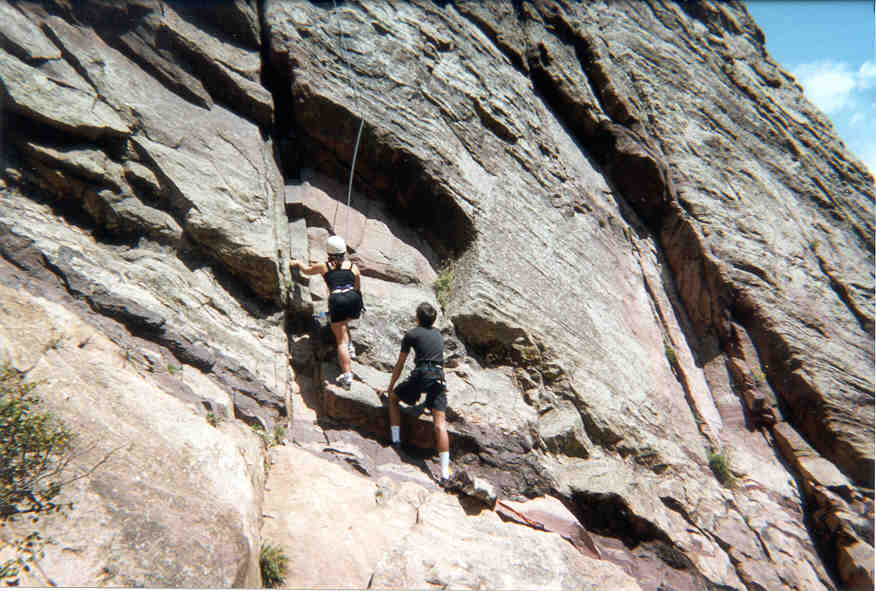
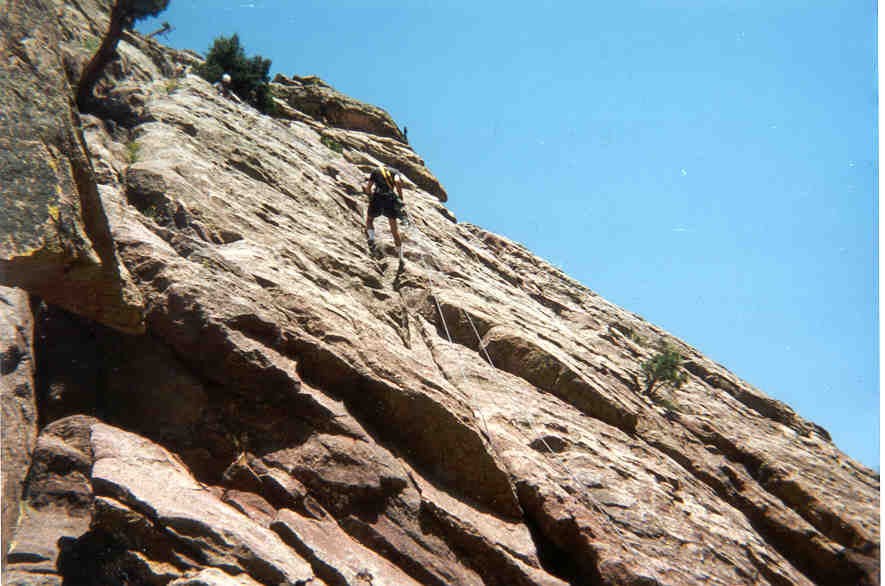
Eldorado Springs Canyon State Park,
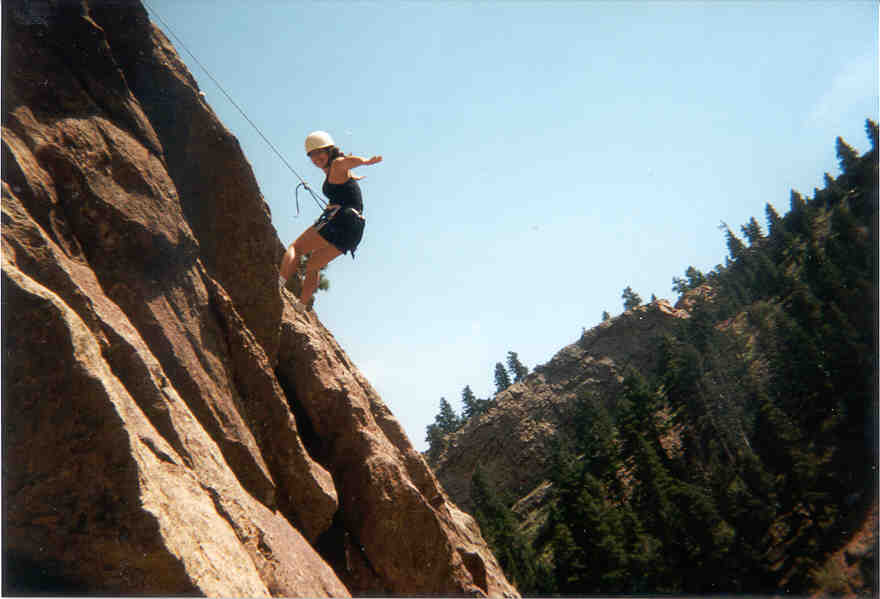
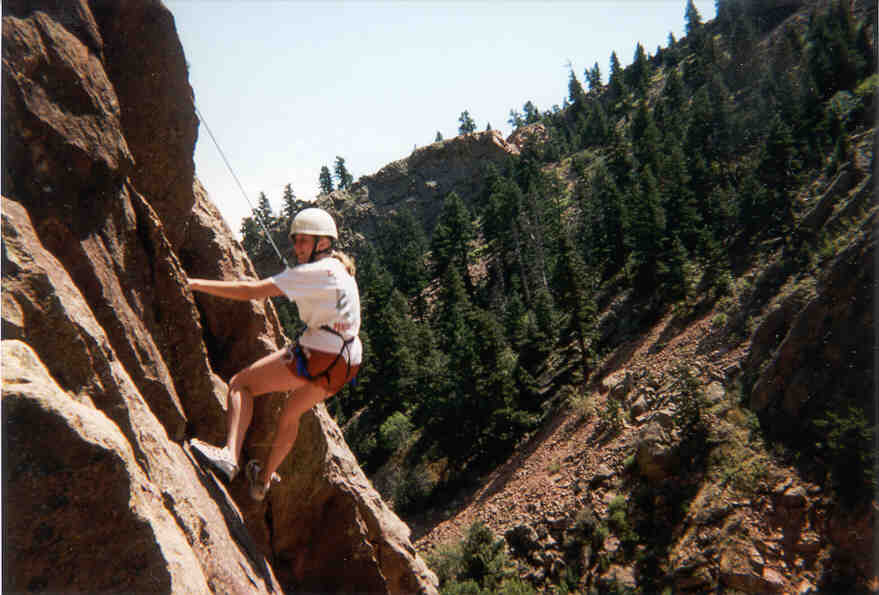
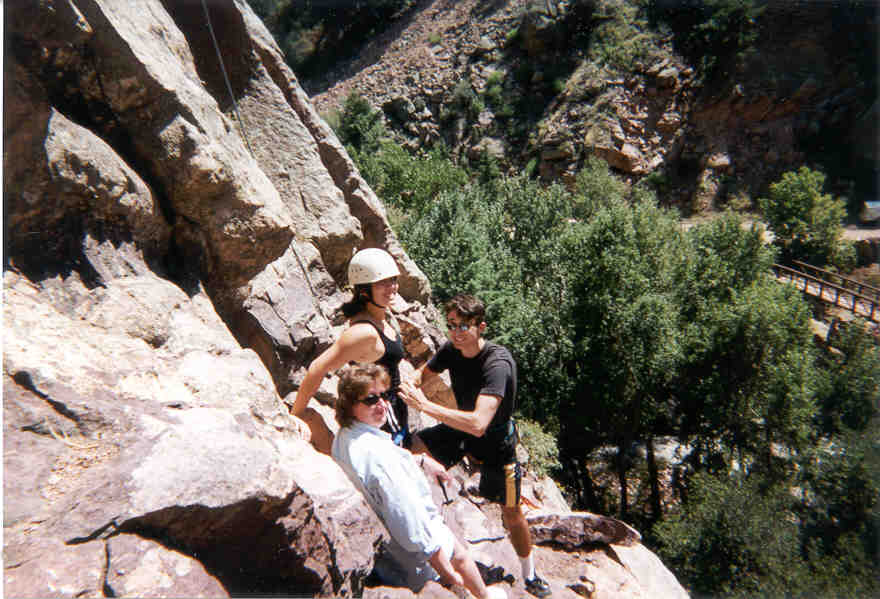
Boulder County, Colorado 08-17-2001 Amber, Rog, Emma and Me (Photos by Tami):
Emma's arms are free!
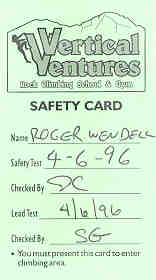
Vertical Ventures (1996)
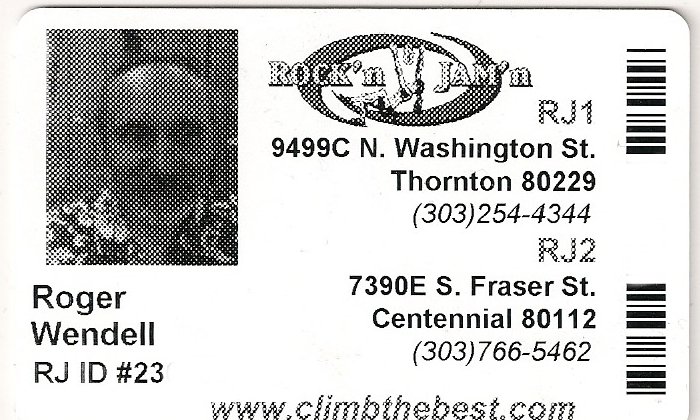
Rock'n & Jam'n 2 [Closed in 2023...]
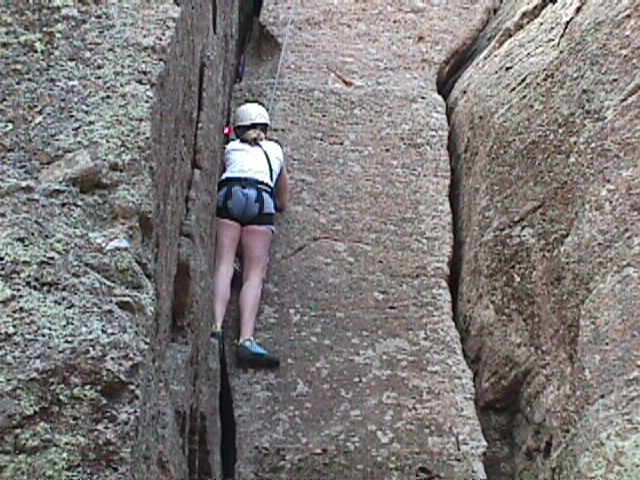
Castlewood Canyon State Park, Colorado 04-29-2001
Amber, Jennifer, and Me (Photos by Tami):
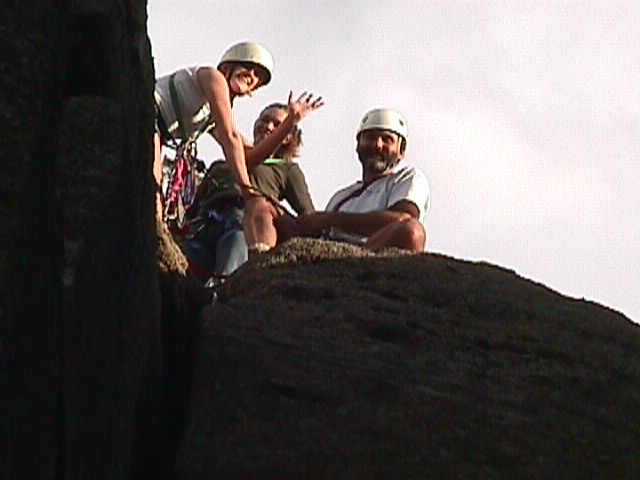 We made it to the top! |
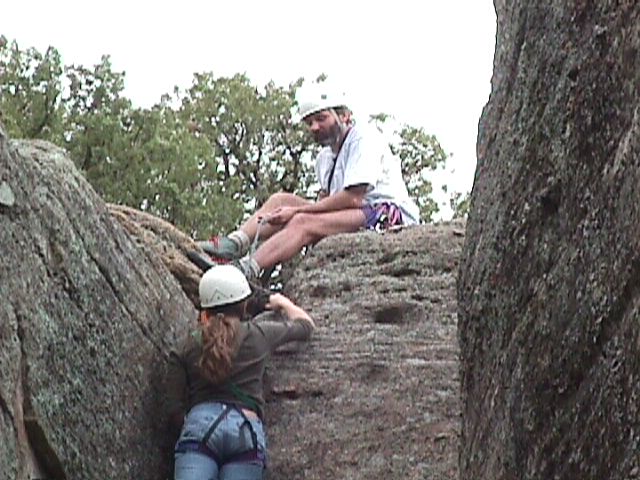
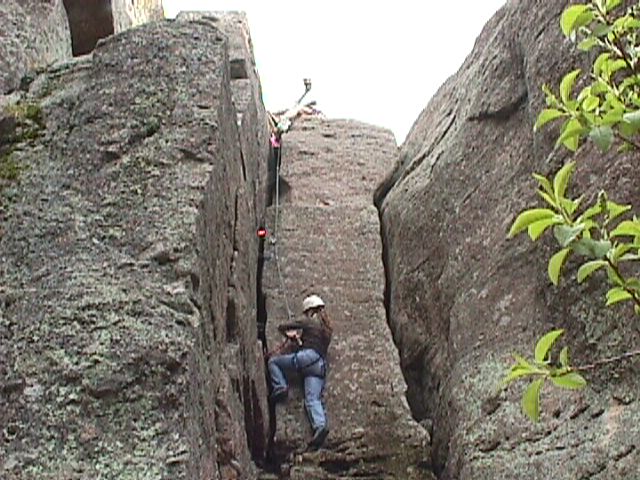
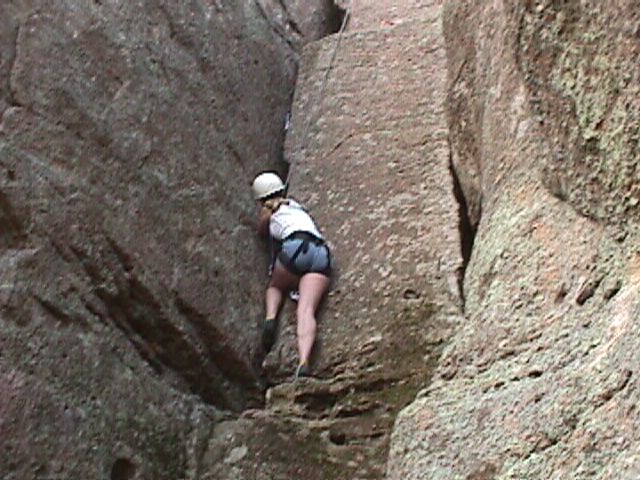
Vedauwoo
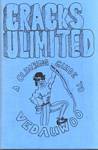
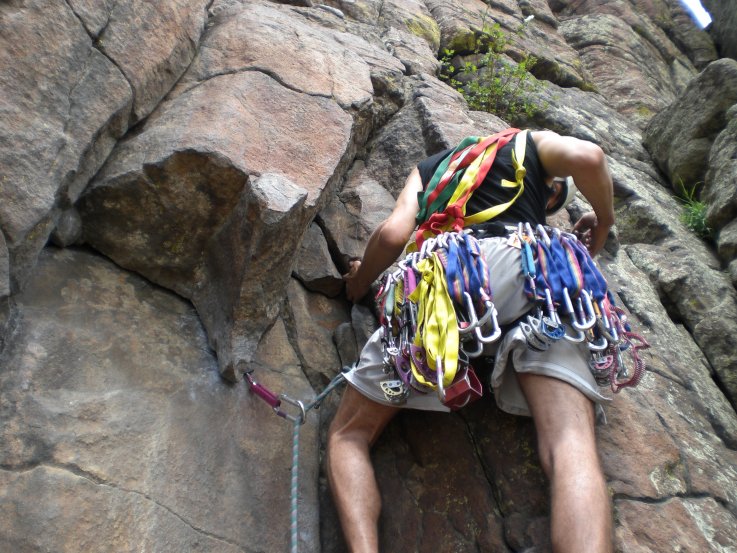
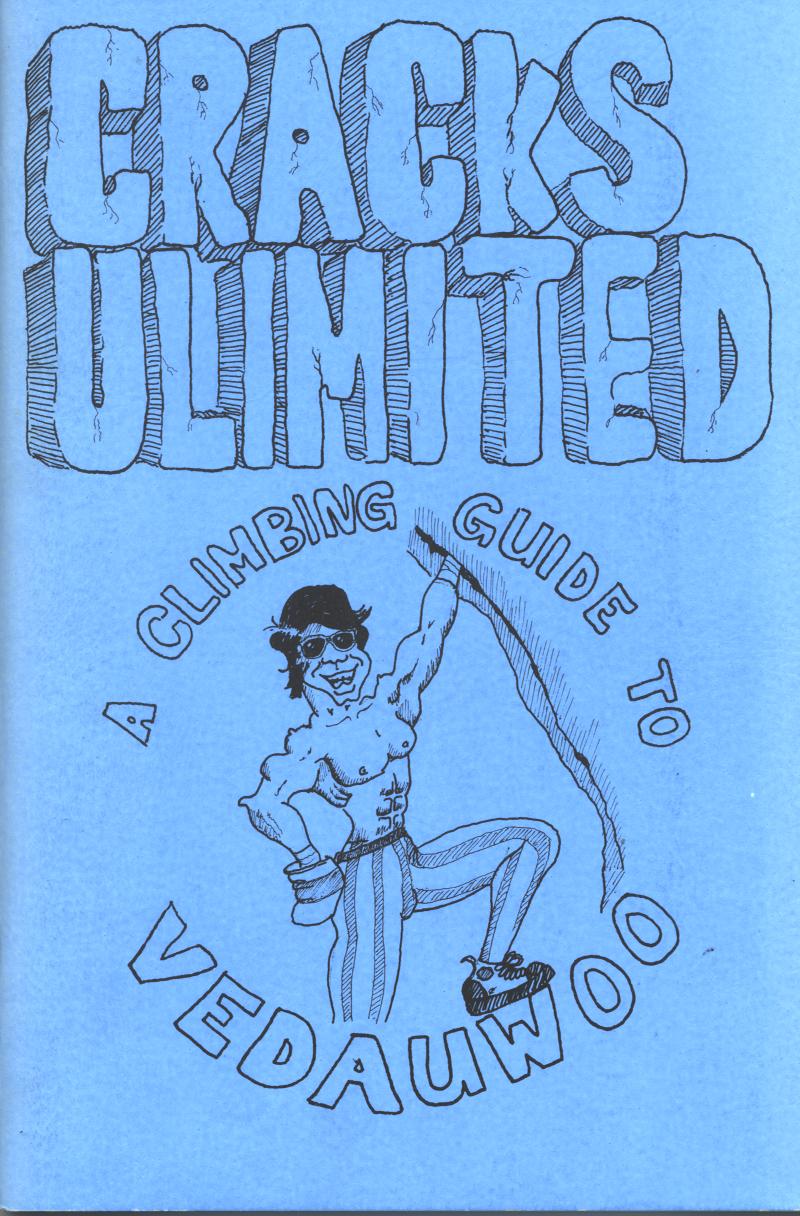
I always loved climbing at Vedauwoo, located in south central Wyoming, and found Layne Kopischka's guide to be a great help. Of course I've used countless other guides for climbing areas all over the region but took delight in Kopischka's "Local Climb Rater" (an insect), "Agony of 'De Feet" (climbers usually wear shoe so tight they're feet hurt and turn colors...) and other drawings. I have Kopischka's autograph, and that of Royal Robbins and Tom Frost on my Autograph page if you're interested. By the way, Vedauwoo is a native American term for "Earth Born Spirit..."
Booty
[Note: Unfortunately, less than a year later, in 2013, Wyoming Bob lost his life on Jagged Mountain]On September 8, 2012, Wyoming Bob had this to say on the 14ers.com Lost and Found Forum:
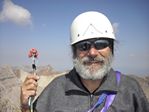
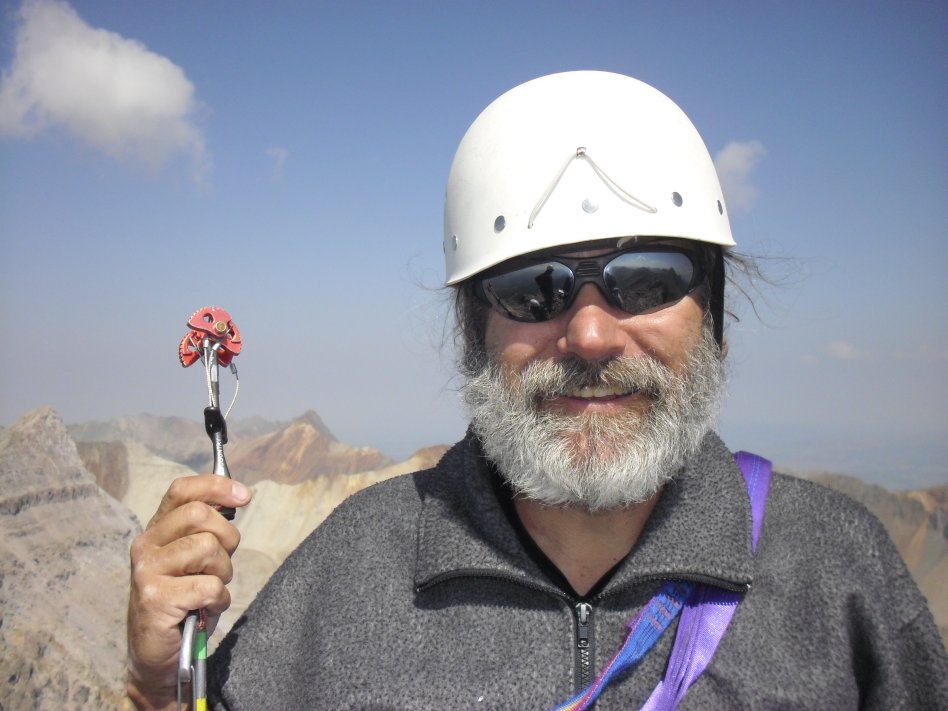
From time to time I've been able to find or retrieve other people's gear from the mountain. It's usually best not to use equipment that you find in the rock as there's no idea of its history and you can't ensure if it's still safe to use, etc. Either way, I do try to return gear when possible. In this photo, I'm on the summit of Dallas Peak (a 13er) after having just recovered "Wyoming Bob's" (14ers.com) #2 Flexible Friend a few metres below. This piece had been abandoned in June, a couple months earlier, after Bob's second (and other people later in the season) wasn't able to remove it. The team I was with, that day, was actually able to get the piece back to Bob.
"A note of appreciation to the forum community in general and a couple climbers in particular. Climbed Dallas Peak back in June and left a cam in place. A bad size selection on my part and my second could not recover it. I chalked it up to poor judgment and accepted the loss, no further thought. I noted the cam in my TR, as I generally note my various screw-ups (forgot boots, forgot map, broke ankle) but did not expect the cam to return home. Over the course of the summer, several 14er.com members contacted me by PM after trying to remove and return the cam or in the last case, removing it and inquiring of my mailing address to return it."
Shattered Air
(A True Account of Catastrophe and Courage on Yosemite's Half Dome)
by Bob Madgic, pp. 107-108
Ken Bokelund had this to say about climbing in Madgic's Shattered Air:'Climbing for me has always been the strength of the body over the weakness of the mind. If you train so that you are very strong physically and you have mastered the techniques, then all that's left is believing. Freeing your mind of fear is the key. This is very difficult to do, but when you can achieve it, then you are in true harmony with the rock. Fear is just one more thing to worry about and is very distracting. It can make you fall.
'What sometimes happens when fear enters the climber's mind is sewing-machine leg - a leg that starts shaking out of control. It happens to all climbers at one time or another and obviously is very dangerous when one is clinging to the side of a rock. But when you know you are strong enough to complete any maneuver, once that level of phyusical confidence is achieved, then you are able to put fear out of your mind. Climbing becomes a very simple pleasure. It's just you and the rock. It's a total clarity of being, a time when nothing matters, you're moving without any thought, you're in a place where time stands still. Even when you're on a wall for days, when you get down, everything seems exactly the same, as though time never passed.'
Eldorado Springs Canyon State Park, Colorado 08-28-2005
Me and KC on the West Overhang (5.7 crux):
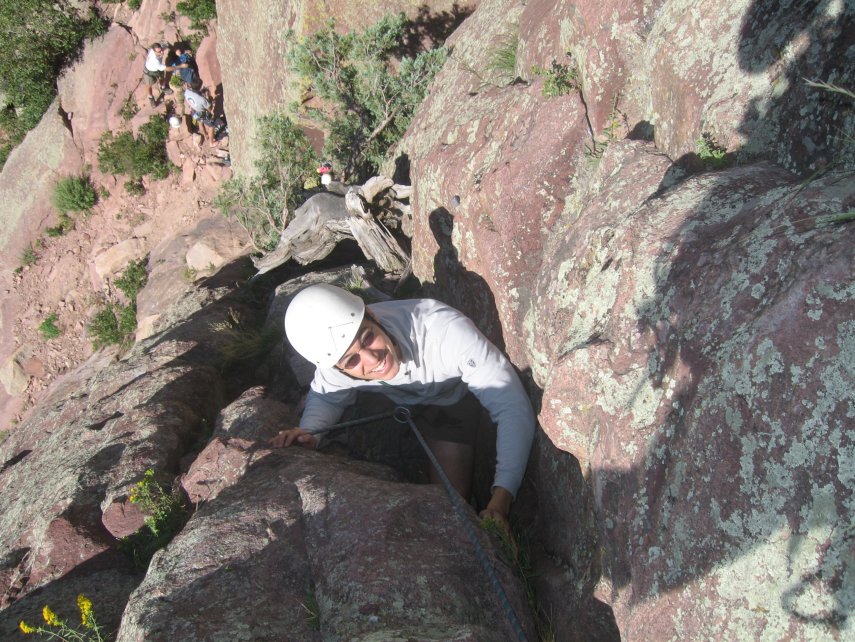 KC in the crack... |
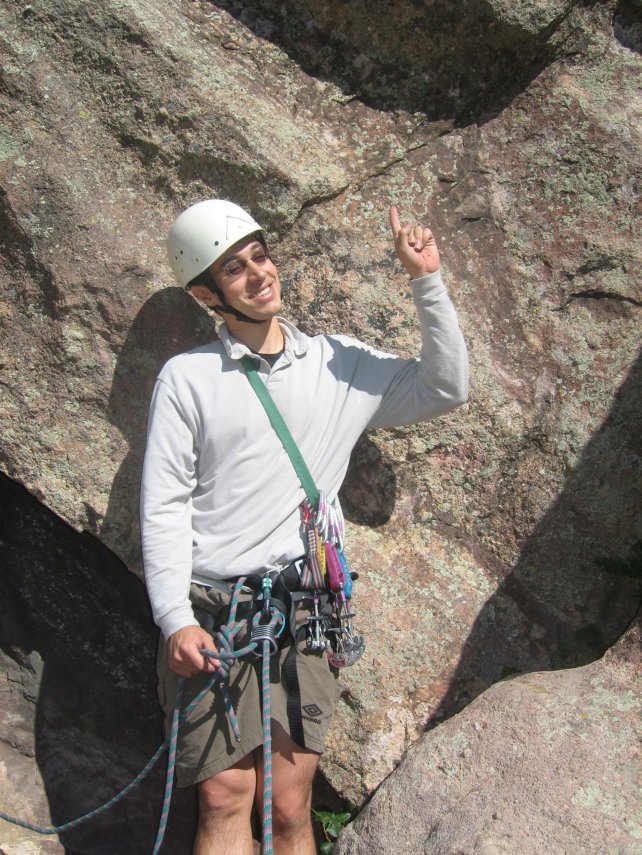 More to go! |
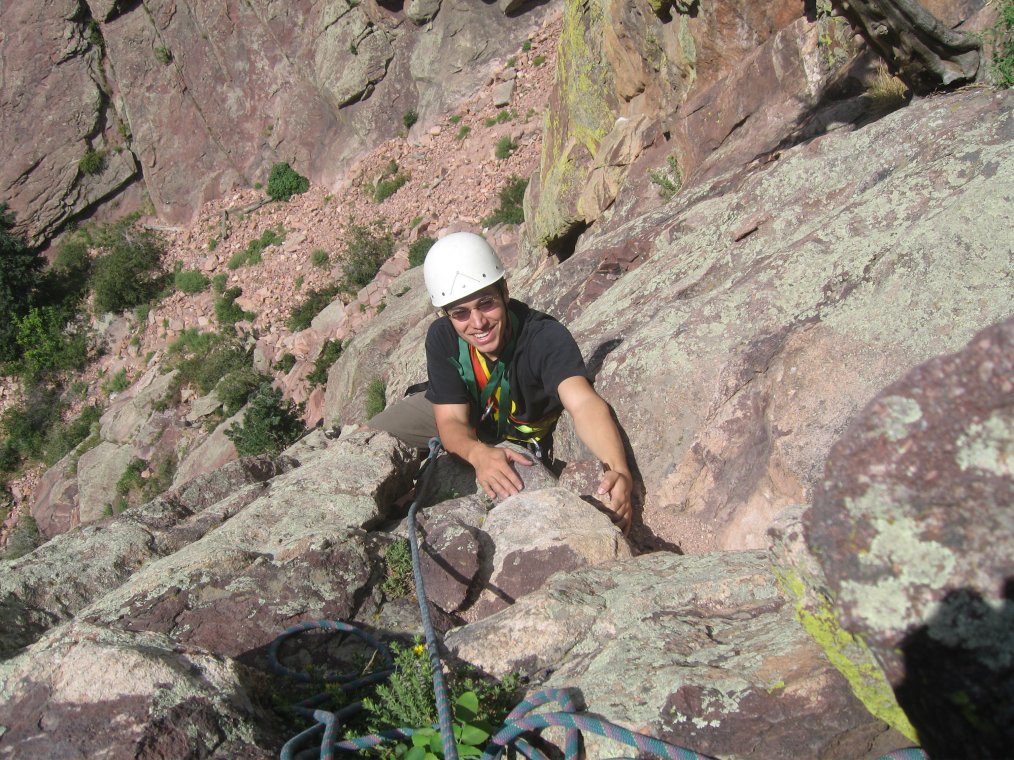 KC near the top. |
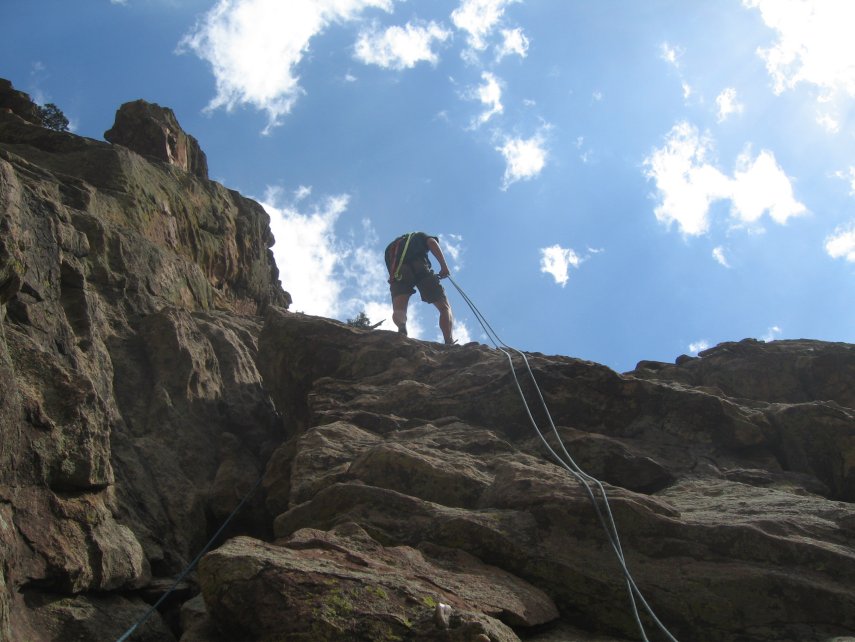 KC on rappel. |
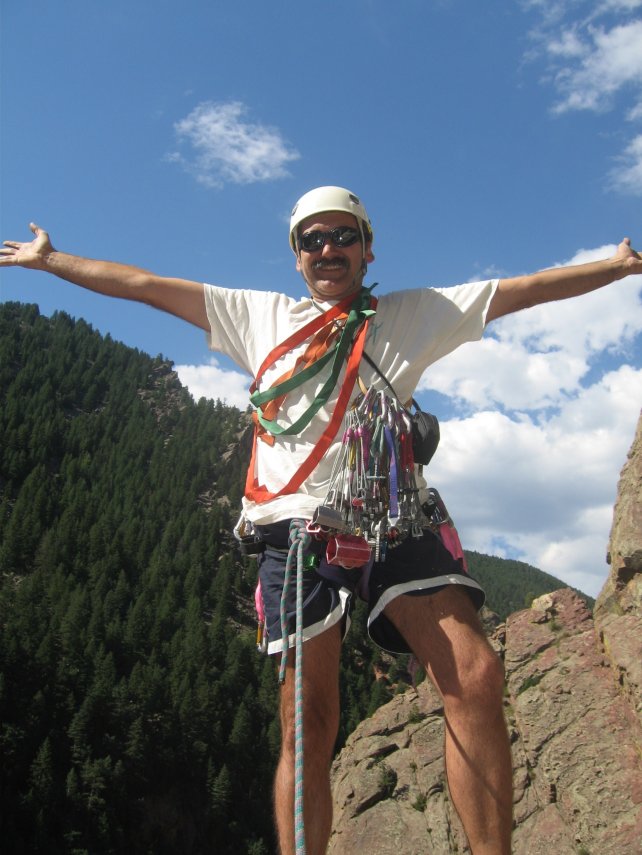 Roger still alive at 49... |
Yvon Chouinard
1966 American Alpine Club Journal, recording his visionary
perceptions on the seventh day of the eight-day first ascent
of The Muir Wall on El Capitan in 1965.
"With the more receptive senses, we now appreciated everything around us. Each individual crystal in the granite stood out in bold relief. The varied shapes of the clouds never ceased to attract our attention. For the first time we noticed tiny bugs that were all over the walls, so tiny they were barely noticeable. While belaying, I stared at one for 15 minutes, watching him move and admiring his brilliant red color. "How could one ever be bored with so many good things to see and feel! This unity with our joyous surroundings, this ultra-penetrating perception gave us a feeling of contentment that we had not had for years."
|
|
Jeff Lowe
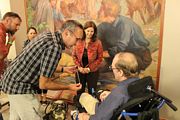
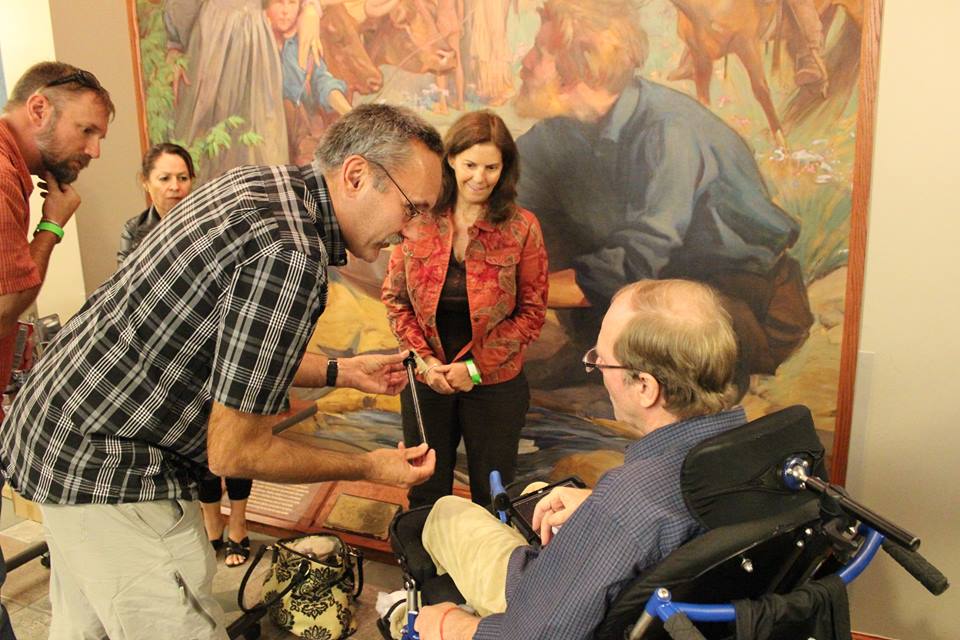
Legendary climber Jeff Lowe explained an antique Russian-style ice piton for me at the American Mountaineering Center in early October, 2014. Unfortunately Jeff has been suffering from a motor-neuron disease similar to ALS that's slowly killing him - but, luckily, he was actually improving a bit the past few months before we met. Shelby Arnold (Bradford Washburn museum director) took this photo after Jeff's appearance at the museum sponsored event.
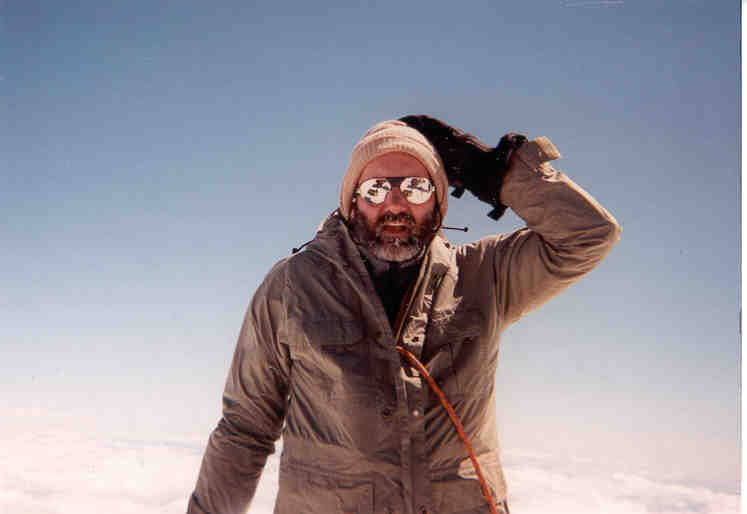 Me on top Mt. Rainier - July 2nd, 2000 |

|
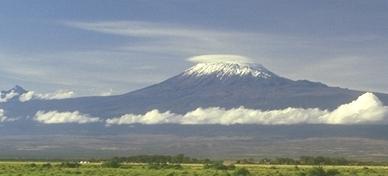 Photos and information on our 2003 CMC trip to Kilimanjaro are posted Here. |
More Mountaineering Photos:
|
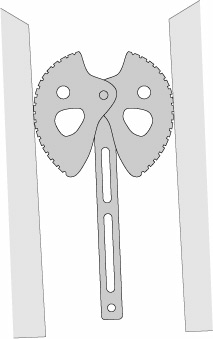
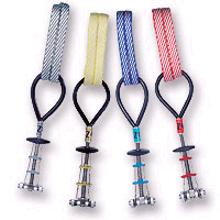 Spring Loaded Camming Devices |
|
From Wild Country Friends & Technical Friends
ownership instructions FO89/QA/1/Feb.1998:
"Climbing and mountaineering are hazardous. Even correct selection, maintenance and use of correct equipment cannot eliminate the potential for danger, serious injury or death." |
Yosemite Decimal System
The Yosemite Decimal System (YDS) is a three-part system used for rating the difficulty of hikes and climbs. YDS is primarily used by mountaineers in the United States and Canada. However, there are many different rating systems used around the world. Examples include the British trad grade, the French sport grade, and the International Climbing and Mountaineering Federation's (UIAA) alpine grade. As for the YDS, it was first devised by members of the Sierra Club in Southern California in the 1950s. YDS was a refinement of earlier systems, particularly those developed in Yosemite Valley.Class 1: Hiking on a trail.
Classification of climbs can vary quite a bit depending on location and history. Indoor gym ratings tend to be inflated compared to outdoor ratings. Ratings tend to be lower in outdoor areas where climbing routes were developed in earlier years. Guidebooks have often raised the ratings on older climbs to make them more comparable to newer ratings. The YDS grade system also involves an optional Roman numeral grade that indicates the length and seriousness of the route. The grades are:
| Grade | Duration |
|---|---|
| I | One to two hours of climbing |
| II | Less than half a day |
| III | Half a day climb |
| IV | Full day climb |
| V | A climb lasting 2–3 days |
| VI | A climb lasting 4–6 days |
| VII | A climb lasting a week or longer |
Other Related Links:
|
|
| Warning! Climbing, mountaineering, and backcountry skiing are dangerous and can seriously injure or kill you. By further exploring this website you acknowledge that the information presented here may be out of date or incorrect, and you agree not to hold the author responsible for any damages, injuries, or death arising from any use of this resource. Please thoroughly investigate any mountain before attempting to climb it, and do not substitute this website for experience, training, and recognizing your limitations! |
 Back to Roger J. Wendell's Home Page...

Abbey |
About |
Blog |
Contacting
Me |
Copyright |
Disclaimer |
Donate |
Guest
Book |
Home |
Links |
Site
Index |
Solutions |
Terms,
Conditions
and
Fair
Use |
What's
Changed
or
New?
Copyright
© 1955 -