Roger J. Wendell
Defending 3.8 Billion Years of Organic EvolutionSM

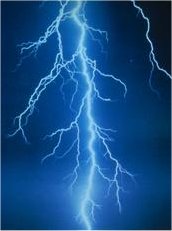
Lightning Safety
|
I created this page to help others (and remind myself)
of not only how dangerous lightning can be, but what we can do to
protect ourselves - especially those of us who spend a lot of
time outdoors. I, myself, have been caught in a thunderstorm at
over 14,000 feet (4,267 metres) and greatly regretted it. I hope this page serves as a good
reminder for me and all the others out there who enjoy being in Nature! - R. Wendell
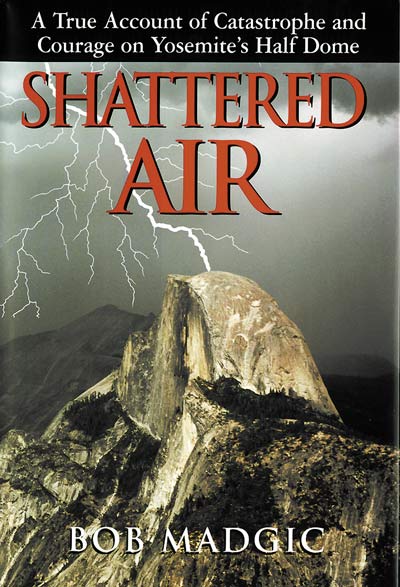
In his book, Shattered Air, Bob Madgic reminds us that; "One hundred lightning bolts strike the earth every second, or more than 8.6 million a day. Annually, twenty million lightning bolts strike the ground in the United States. A lightning bolt can contain an electrical potential of one hundred million volts and reach a temperature of fifty-five thousand degrees Fahrenheit [30,500 Celsius, ed.], which is five times hotter than the sun. The average flash is brighter than ten million, hundred-watt lightbulbs. A single strike can generate more energy than all U.S. power plants combined at that instant. Theoretically, a thunderstorm could meet the nation's electricity needs for four days." |

|
Click Here for the Ten Essentials - Don't leave home without 'em! |

|
Click Here for my page on Backcountry Survival... |
|
|
Click Here for my page on Bear Safety... |
If Thunderstorms Are Forecast
- Do not camp or climb in a narrow valley or gully.
- Do not plan to climb or hike in high, exposed areas.
- Watch small cumulus clouds for strong, upward growth; this may signal a coming thunderstorm.
- Keep track of weather reports.
If You Spot a Thunderstorm
- Get away from water.
- Seek low ground in an open valley or meadow.
- Move immediately if your hair stands on end.
- Do not stand under trees, especially in open areas.
- Do not remain near or on rocky pinnacles or peaks.
- Do not remain near metal or graphite equipment, such as ice axes, crampons, climbing devices and frame packs.
- Insulate yourself from the ground if possible; sit on a soft pack or foam pad.
- Crouch to minimize your profile.
- Do not lie down.
- Gauge the movement of the thunderstorm.

|
"As for the last point, how do you gauge the movement of a thunderstorm? It's easy if you have a watch. The moment you see lightning, start counting the seconds. Stop timing once you hear thunder. Divide the number of seconds by five; the result is the distance of the thunderstorm from you in miles." [or divide by 3 for kilometres - ed.]
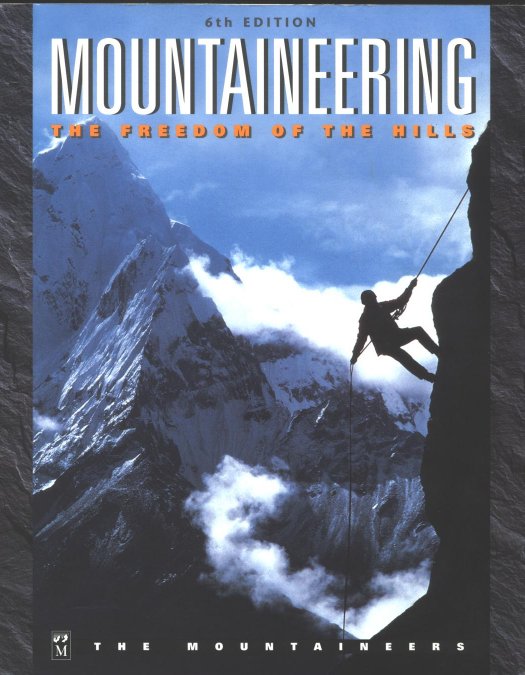
from Mountaineering The Mountaineers also state; "Thunderstorms in the mountains can and do kill. An average of 200 people die from lightning strikes in the United States each year, some in the mountains." |

|
"At my observation point on a sandstone monolith the sun is blazing down as intensely as ever, the air crackling with dry heat. But the storm clouds continue to spread, gradually taking over more and more of the sky, and as they approach the battle breaks out.
"Lightning streaks like gunfire through the clouds, volleys of thunder shake the air. A smell of ozone. While the clouds exchange their bolts with one another no rain falls, but now they begin bombarding the buttes and pinnacles below. Forks of lightning - illuminated nerves - join heaven and earth. "The wind is rising. For anyone with sense enough to get out of the rain now is the time to seek shelter. A lash of lightning flickers over Wilson Mesa, scorching the brush, splitting a pine tree. Northeast over the Yellowcat area rain is already sweeping down, falling not vertically but in a graceful curve, like a beaded curtain drawn lightly across the desert. Between the rain and the mountains, among the tumbled masses of vapor, floats a segment of a rainbow - sunlight divided. But where I stand the storm is only begning."
Desert Solitaire, p. 136 |
Lightning Precautions for Hikers
by Frank R. Leslie
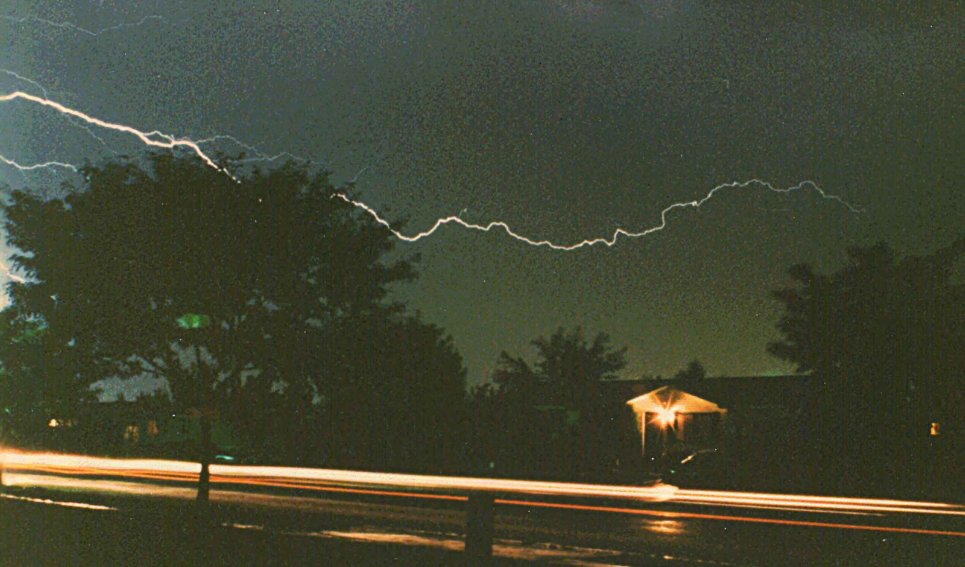 (Timed exposure/headlamps) |
In the late 90s Frank gave me permission to post this on the Sierra Club's "outings" web pages where I was webmaster. In early 2005 he gave me permission to post it here on my own page as well. |
Introduction
(Frank R. Leslie)
Disclaimer: There are no guarantees with lightning, as unpredictable effects
may occur.
Travel at your own risk.
Trail crews often work in alpine areas (open grassy meadows) well above the treeline. In these open meadows, workers are at risk from lightning strikes. Lightning is the #2 killer from weather, second only from drowning, more than from hurricanes and tornadoes combined. However, only 5% of those struck die. The National loss impact is $6 billion annually. One insurance claim is filed for an average of 57 strikes. In Florida, the Nation's leading lightning state, there are two measured hot spots near Tampa and Titusville, where the lightning density exceeds 10 flashes per square kilometer per year.Lightning strikes only one victim 91% of the time, and more than one only 9% of the time. A Lightning Safety Group of the American Meteorological Society has been formed from researchers at a recent convention [In this portion of the original text Frank referenced William Roeder, a military Staff Meteorologist whose web link is no longer active... - Ed.]. In populated areas, 2.4% of lightning victims are struck while talking on a corded telephone. Think of this as a miles-long, lightning-catching antenna system that is attached to your head.
An interesting photo by Krider and Ladd (1975) shows a golf green with burns in the grass radiating from the hole flagpole. These burns are about two to four inches wide, and show travel of perhaps thirty feet before the current dissipated enough to no longer kill the grass. Near a primary lightning strike, sympathetic streamers may form, rising upwards some 30 feet but not connected with the strike. If one rises from your head ....
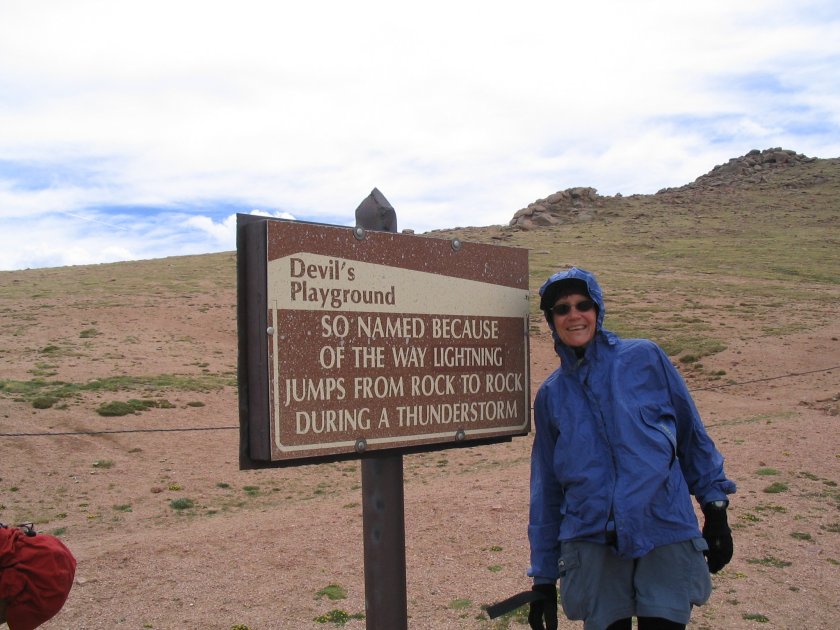
Lightning doesn't always strike the highest point. A photo of the Mt. Lemon strike near Tucson AZ shows a side strike to the mountain far down from the peak. I have witnessed this effect near Wind River Peak WY, where a strike bypassed a rounded 1000 foot-high peak to hit a pine tree several hundred feet down the side of the rocky slope. The tree burst into impressive yellow flame.
In high mountain passes, there is little shelter, and the best precaution is the rapid descent to a lower, heavily treed forest. Within a heavily forested area, there are many trees that spread the risk of a lightning strike near you. Strikes are erratic and a matter of chance.
|
Dodging Lightning Dangers |
I recommend a position crouching with your feet next to each other and your arms wrapped around your legs. Avoid contact between hands and ground. In forested areas, stay at least 8 ft away from the trunk of an average height tree. Do not stand near a tall tree that projects above its companions.After lightning current flows down a tree, it dissipates through the roots and wet soil. This current is closer to the surface if the soil is dry except in the top rain-soaked area. In these conditions, the current flow is concentrated in perhaps the top six inches of soil. As if flows away from the tree, there is a voltage drop across the wet soil. Cattle and horses are especially likely to be shocked, as their hooves are far apart. So by keeping our feet together, we limit the voltage dirfference that might cause current to flow up one foot and down the other. The risk of taking a strike to the head or shorulder is reduced by crouching.
Members of a party should stay separated by at least ten feet, as if one person is struck, the others will likely survive, and then provide CPR for the struck person. This is about the only time that CPR in the wilderness is worth doing, as it is impractical to do CPR for several hours. Lightning strike victims have a very good chance of resuscitation when they are immediately given CPR. They are not electrically charged; after all, they are lying on the ground, and the lightning has stopped.
An obvious warning is when the electrical field strength in the air is so high that your hair stands on end. In a memorable videotape, some three smiling hikers were standing there with their hair rising, and a moment later, two were struck and killed by lightning. A nondestructive test of this is to put your arm near your TV screen. You will feel the hairs being attracted to the screen. If you should feel a similar effect on a mountain peak, it's time to run fast to lower protection.
Frequently Asked Questions
Q: How far can one hear thunder?
A: About twelve miles in quiet winds. If a storm is moving towards you at thirty miles an hour, you have about 20 minutes to get to a safer location before it reaches you.Q: What is the Schumann resonance? (OK, no one would ever ask this.)
A: The Schumann resonance effect exists between the Earth and clouds. The variations in electrical field strength reflect the global variations in lightning activity. Distant storms can be detected with sensitive receivers of these oscillations.
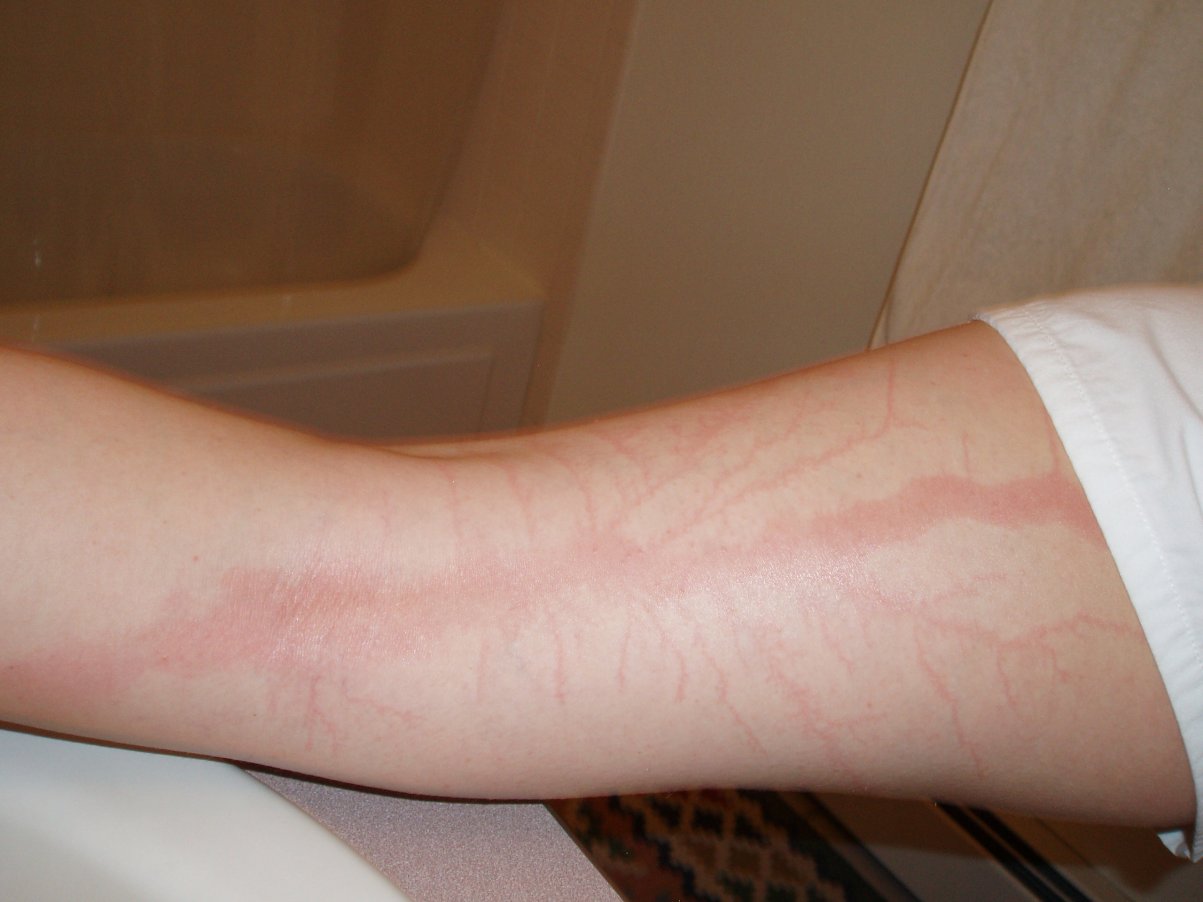 Leg burnt from lightning strike |
On June 25, 2008 (Wednesday) Brooke Bagwell was directly hit by a lighting strike that traveled down the rope she was tied into as a belayer. The group she was climbing with was on Lookout Mountain near Denver, Colorado. I (your humble webmaster) know of some of the parties involved so have attempted to protect everyone's privacy although I've received permission to post this story and Brooke's name. The reason I've posted this report is because I believe it to be very valuable information that we can all learn from. Finally, I've only seen a few brief comments from the leader - I'll consider posting anything he sends me related to this incident if he decides to contact me. - Roger J. Wendell |
In her own words, Brooke Bagwell reported the following after being hit by lightning:
"On Wednesday, June 25, 2008, I went on a [club] rock climb, led by [R.P.]. The weather was fair, and I'd heard two forecasters say that no rain was expected that day. As often happens along the Front Range, however, an afternoon storm developed. We felt the wind, and it became cloudy overhead, but it did not appear threatening. I signed [RP's] waiver when I met the group at Lookout Mountain.""Around 7:15 p.m., [MS] and I, were belaying climbers, and noticed lightning. [MS] announced the lightning, and I confirmed. [MS's] climber, [R], immediately descended. My climber, [RP], continued to climb until he finished several minutes later. It made me nervous that he was still climbing, and I wished he'd come down. It seemed like we should be away from the rock, and find shelter if possible. During the time that [R] descended, and [RP] continued to climb, [MS] and I noticed more lightning, and counted the time between the lightning and the thunder. We realized that the storm was right overhead, and both of us voiced our concerns. [MS] and [R] untied, and were away from the rock. [MS] said, 'I'm through.' He was not planning to climb again, and took off his harness and climbing shoes. I said, 'I think I'm done, too,' and looked for my backpack to leave. We discussed heading up to the cars. It seemed risky to go higher, though.
[RP] thought that the storm would pass. Another climber, [P], was either climbing, or about to climb, on [MS's] blue rope. [MS] decided not to bring down his rope, so that [P] could climb. [RP] asked me if I wanted to climb the route that he had just completed. I said that I'd only done two climbs so far that day, and had hoped to do more. 'But', I said, 'I'm honestly happy with any climbing that I got in today.' I was thinking about [J], who had just arrived. I'd asked him if he was going to climb, and he'd said, 'I don't know. I want to wait and see what this lightning does.' I agreed, 'I don't know about that lightning. It kind of freaks me out.' [RP] shrugged off my concern with something like, 'Oh, come on, why don't you give it a try? Don't you want to try the roof?' I thought, 'If [RP] doesn't think it's a big deal, it must not be.' 'Okay, I'll climb,' I said, and went to tie in.
"As I tied in, I didn't like the first knot that I tied. I was in the process of retying it, and making small talk, when suddenly, there was a flash. I simultaneously saw, heard, felt, and smelled the strike. I had the split sensation of trying to get it off of me, but my hands could only push at the rope as I was thrown down. I felt the heat push through my body down to my feet, and heard myself say, 'OH, GOD!' as I was slammed to the ground. I smelled something burning, like clothing or rubber, and wondered if I was on fire. Someone yelled, 'Rock! Rock!' I looked up, and saw a shower of dust and rock, and closed my eyes, trying to avert my head. I couldn't move.
"Lightning was still flashing overhead. People yelled to get the rope and harnesses off. [MS's] was the first voice that I recognized, as he said, 'Brooke, you've got to get the rope off!' I screamed, 'I can't move! I can't move! I can't feel my legs!' I heard [RP] say that he'd felt a charge in his leg, too. His right leg had some numbness, but he was standing by that point. [J] and [A] had felt it in their hands, they said. I don't know about [R] and [R]. No one seemed to realize that I'd been hit. There was a sense of awe among the group, but more urgency on [MS's] part, as he realized that I lay still and confused. I heard him say, 'She's paralyzed!' I realized that I could move from above my waist, however. I tried to sit up, but was unable. My hands didn't seem to work either, as I tried to untie the rope.
"Then, [MS] was next to me, untying the rope, and trying to get me to my feet. I was grateful for his help, because everything felt slow and dull. I worried that he would get hit helping me, though. Someone said, 'The feeling will start to come back.' I told [MS], 'I can feel my right leg a little.' It was tingling. My left leg was completely dead, and I wondered if my foot was burned inside my shoe. [MS], [P], and [M], helped drag me toward lower ground. I tried to put weight on my left leg, but it rolled under me, and I collapsed. I slightly twisted my left ankle in the process.
"Three sets of hands were helping me. [P] was lifting me by the harness, [M] had my right hand, and [MS] told me to put my left arm over his shoulders, and around his neck. [J] was behind, spotting me. We were trying to get to lower ground. I worried about their exposure, as they helped me. I was afraid that they would get hit, too. I suggested that some of them go ahead, and go further down the mountain. 'Go on, we shouldn't all be together. I don't want you to get hit helping me. Some of you go on ahead.' Still standing behind us, [RP] said that the people who knew CPR shouldn't all be together in case they were hit. Still, the others continued to help me, and moved away from him downhill. [MS] said something over his shoulder, like, 'We shouldn't have fucking been here, [RP]!' And, [RP] replied, 'No shit!' I remember thinking, 'Why isn't he doing anything? Why isn't he helping us?'
"We slid the mountain as far as we could go. [RP] urged us to be calm, telling us that lightning 'never strikes twice.' He chided us, 'Don't stand between two tall trees!' But, we could not go farther. We were as low as we could get, but we were stuck between the trees. I noticed that my left leg was still useless. It was scraped either from falling down when the lighting hit, or from dragging its numb, dead weight over rocks as we tried to get lower.
"Someone suggested going up to the cars, but we didn't think that the threat was over, and didn't want to be further exposed. I wondered if I could get up the hill. Looking up, we saw that the clouds had passed, though. It had probably been five minutes since the strike. I don't remember where [R], [R], and [A] were during this ordeal. I think that [A] was with us. I don't know if [R] and [R] were with [RP], who seemed to be working on pulling the ropes and gathering gear. I remember thinking, 'To hell with the gear.' It seemed more prudent to get to safety. We decided that we could make the scramble up to the cars. [A] was one of the first ones to the top.
"I could limp on my numb left leg and tingling right leg. My instinct was to flee. I began scrambling up toward the parked cars. [J] was either in front or behind of me as we made the scramble, telling me that I needed to slow down. I was panicked. I wanted to get out of there, and get to my car. When I reached the top, [A] was coming toward us, asking if we wanted to call 911. She'd flagged down a motorist. I remember thinking, 'Why hasn't someone used their cell phone to call?' I couldn't think clearly. I just wanted to get to the safety of my car, and told her, no, that I thought I was ok.
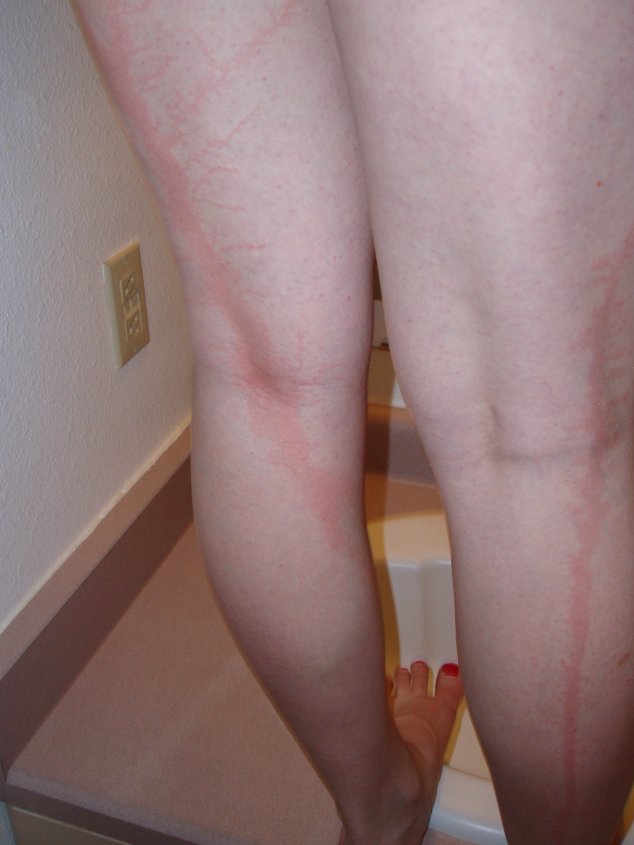
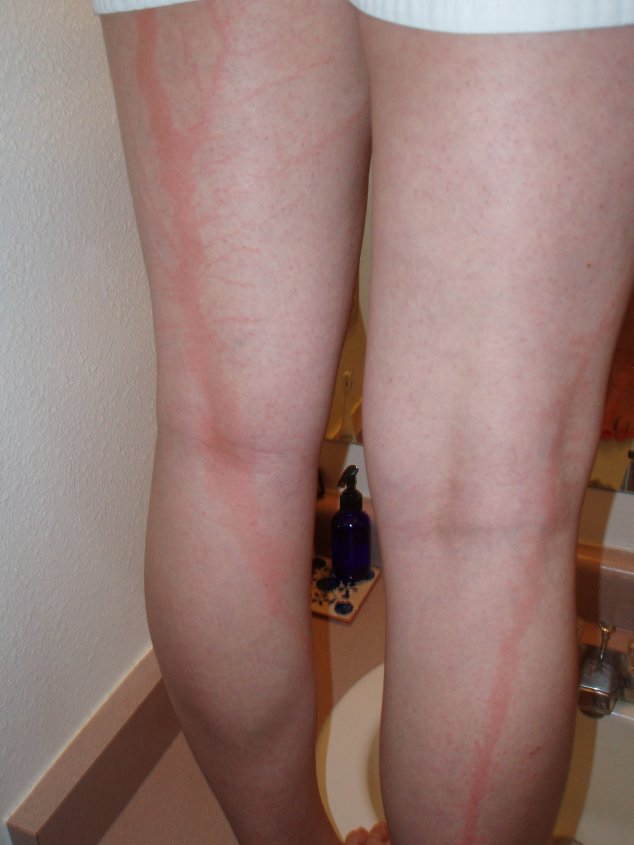
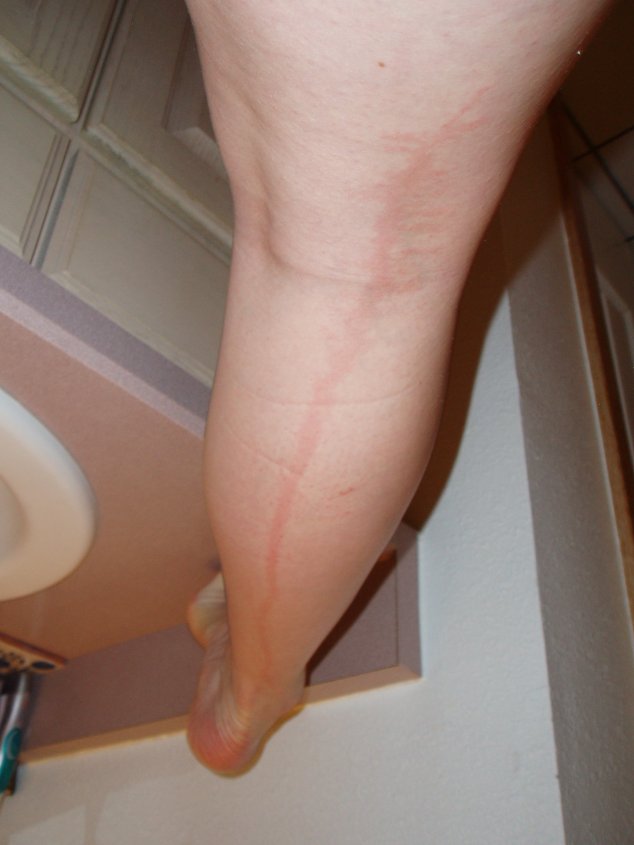
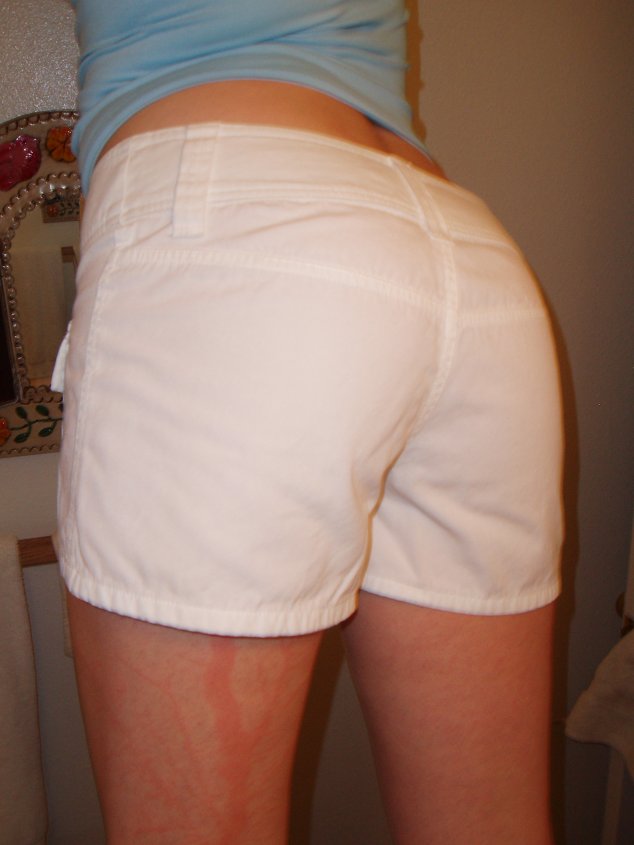
"I reached my car, and took off my shoes, looking to see if the bottom of my feet were burned. They were not, although I noticed burn-like marks on my calves, and my shoe smelled of burned rubber. I could see where the lightning exited my left foot. It looked like a part of the rope had lain against my leg, and the current had passed over and around it, outlining it on my leg. I showed it to [J] and someone else. We commented on the strong smell of the burned rubber, and someone took a picture of my leg.
"Everyone was at the top by that point. I noticed that [MS] and [RP] were not at the cars. I realized they were pulling ropes and clearing gear. [MS] appeared and threw his rope in the back of his truck. He got in his car without speaking to anyone, and someone said, 'He's mad.' I thought, 'Shouldn't we all be?' It wasn't right. It shouldn't have happened. I was thankful that he understood how wrong it was. I heard [RP] marvel 'That's the closest I've ever come to lightning in 50 years,' as he headed toward his car with ropes and gear. [MS] wheeled his truck around to leave. He drove alongside me, to check on me, and asked if I was okay. 'Yeah, I think I'm okay. I'm just thanking God that we're all alright.' I was sitting in my car with the door open, my shoes off, staring blankly at my legs and saying over and over in my head, 'Thank you, God. Thank you, God. Thank you God that I'm alive.'
"I heard [MS] tell [RP] that he would never climb with him again. I didn't hear [RP's] reply. But, [MS] responded to him, 'No, because you're fucking reckless. Somebody could have died out there today.' I thought, 'Yeah, ME.' I knew that if I'd been climbing that crack, I could have died. At the very least, the lightning could have entered my body through my hands, and stopped my heart. It also could have thrown me off the rock, or my belayer could have involuntarily let go of the rope. I could have died from the fall.
"[MS] drove away. He probably assumed that our trip leader would take care of me. But, I felt slightly fearful and abandoned, because he was the only person who seemed to understand how serious it was, he'd been our true leader that I trusted, and in my state of shock, I was looking to him for direction. I felt like he'd saved me.
"Yet, I understood why he needed to leave. I couldn't think of anything other than my desire to get away from the scene. I didn't want to talk to [RP], and didn't trust the nonsense he'd been saying. It wasn't even registering anymore. I knew I couldn't blame him entirely. I knew I was responsible for tying myself in. But, he was acting like the lightning strike was no big deal. I remember thinking, 'He doesn't get it. He doesn't even care.' He had not expressed any regret or apology. He just kept indicating that it was a freak incident that would make a good story. It didn't seem like an accident to me. I knew we shouldn't have been there by the time that the lightning struck, and I should have listened to the instinct that was telling me it was a bad idea.
"I put on my other shoes, and prepared to leave. People gathered around my car, asking if I was okay to drive. Someone asked how far I had to drive. I said to Boulder. [A] suggested that she drive me home. I declined, because I already felt badly about having made the bad decision that got me struck by lightning, which paralyzed me for several minutes, and exposed the people who attended to me. Everyone seemed to think I was ok and, amazingly, let me drive away.
"I needed to call someone and make sure that I was ok. The first person I called was [TF], my [climbing school] instructor, because I knew he was nearby, climbing at North Table. I thought he would know about lightning, and if I needed to go to the emergency room. I left him a message that I had to record several times, because I couldn't seem to say something coherent. I tried calling two other friends, but was unable to reach them. I finally thought, 'This is ridiculous. I don't know anything about lightning, and what it does to your body.' I called 911. The woman I spoke with said that, yes, absolutely, I should get checked out. I couldn't think of any hospitals other than Boulder Community Hospital near where I live in North Boulder. So, I drove the entire 40 minutes in silence, trying to concentrate, and praying that I would make it there.
"I made it alright to the hospital, but could barely stand to walk in. My legs were cramping and tingling. The doctor told me that the most dangerous part was past. 'The most dangerous thing you could have done was to drive from Golden to Boulder.' I could have gone into cardiopulmonary arrest, because an electrical charge of that magnitude can short-circuit the body's electrical systems, like the heart, or the respiratory center of the brain.
"They tested my blood and did a urinalysis. There was protein breakdown in my blood and urine. They did an EKG on my heart, and monitored me for 3.5 hours. The tests showed that my organs did not appear burned, and my heart did not exhibit dysrhythmia. They discharged me sometime after 11:00 p.m. with a referral to a neurologist. It was only when I got home, and removed my climbing pants that I saw the remarkable lines where the lightning had flashed over my legs. It seems that the lightning traveled down the rope to my harness. On the small of my back, there was a 'burn' mark that looked like a hook. Holding up my harness, I saw that there was a carabiner hooked on the back. The charge must have gone through the metal and down my legs.
"I saw the neurologist on Friday. He determined that there are no reflexes in my legs, and said that nerve damage is likely. He believes that I will recover in the coming weeks or months, and will continue to follow me for the next year. He confirmed the ER doctor's prognosis that I could expect fatigue, headaches, loss of concentration, swings in emotion or irritability, sleep disturbances, possibly depression, or Post Traumatic Stress Disorder. However, since I didn't lose consciousness, severe secondary issues are unlikely."
Brooke Bagwell
June, 2008
All photos of Brooke Bagwell's legs were taken by Brooke Bagwell herself:
|
|
|
|
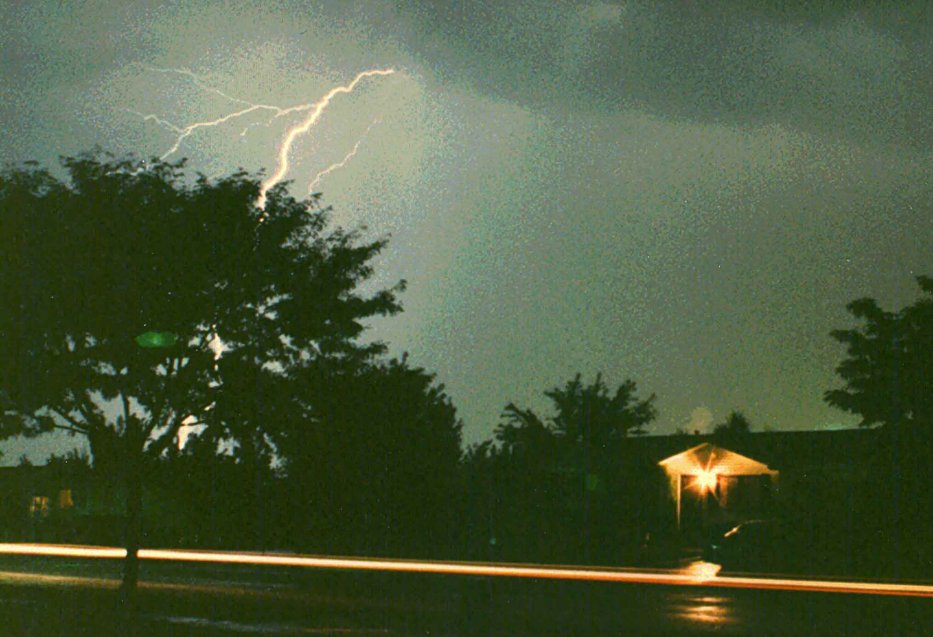 (Timed exposure/headlamps) |
In a separate email, [M.S.] stated, "[R.P.] made at least five nearly fatal mistakes that any trip leader should not:" |
- After being notified of lightning, he continued to climb. He not only placed himself at risk, he forced Brooke to take the same, if not bigger risk (since he was near the top and was more protected by the crag roof) by forcing her to stay on belay.
- He dismissed and downplayed the risks due to the weather, which, despite our obligation to make our own decisions regarding risk, certainly influenced the rest of the group.
- He continued to suggest to Brooke that she climb, despite her clear apprehension. The first time he suggested she climb, she politely declined, citing her fear of the lightning. I heard it loud and clear, and he must have as well, because we were both standing right next to her. But he persisted, asking her a second time, again downplaying the weather's significance, which ultimately resulted in her tying into the rope. Without his persistent comments, I have no doubt Brooke would not have been tied into the rope.
- After the lightning struck, he did not organize the group and instruct us to get to lower ground. Instead he stated that 'we're ok, lightning never strikes twice in the same place'. He is of course, flat out wrong. Lightning can and does strike the same place multiple times.
- After the immediate threat was over, he did not call, or instruct anyone to call, 911. After clearing all of the ropes, gear, etc, and loading them into his car, he came over to check on her. But as soon as the threat passed, he should have focused on getting her medical attention, not clearing the ropes and gear.
[MS]
June, 2008
Shattered Air
by Bob Madgic
|
Safety Guidelines for Lightning Appendix pp. 261 - 262 Of all the weather-related phenomena, lightning kills and injures more people than any other, with the exception of floods. As seen in the tragedies on Half Dome and in Kings Canyon on July 27, 1985, persons tend to seek shelter when caught in a thunderstorm and driving rains. They may also believe it's safer to be under some cover, such as rock enclosures or a tree, than out in the open if lightning strikes. (Golfers are particularly prone to do this.) but small caves, tall trees, rock enclosures and outcroppings, "chimneys" located on rock walls - each can become a death trap if lightning strikes in the vicinity. (A large cave can offer safety but only if you stay in the middle, away from the walls.) It's far safer to stay out in the open and get wet. |
All thunderstorms produce lightning and are dangerous.*These principles of Lightning Safety are mainly those of the National Weather Service (NWS).The outdoors is the most dangerous place to be during a lightning storm. At the first indication of an impending storm, go inside to a completely enclosed building (not a carport, open garage, or covered patio) or into a hard-topped vehicle.
If you hear thunder, you are in danger from lightning.
If the air starts buzzing and your hair bristles, you are in immediate danger and should adhere to the principles below.
If caught outdoors, seek the lowest point and be the lowest point. Do not be the tallest or second tallest object during a lightning storm. Avoid tall trees (be at least twice as far from a tall tree as the height of the tree). If in an open area, crouch down on the balls of your feet.
Avoid being near or touching any metal.
If you're with a group, stay several yards away from other people.
Get out of water, and out of small boats and canoes. If you're caught in a boat, crouch down in the center of the boat away from metal hardware. Don't stand in or near puddles of water.
Wait at least thirty minutes after the last clap of thunder before leaving shelter, even with blue sky and sunshine.
The safest measures to follow with lightning are awareness and prevention. Avoid being caught in precarious circumstance.
Mountaineering
The Freedom of the Hills
by The Mountaineers
|
Lightning Injuries pp. 454 - 455 The high-mountain environment receives five times as many thunderstorms each year as coastal areas do, according to at least one study. Summer afternoons are the most likely time for thunderstorms, and therefore lightning to present danger to the mountaineer. Lightning strikes can emanate from several miles away toward high points ahead of or, less frequently, behind the main thunderhead cloud formation ("out of a clear blue sky"). Therefore, you can be in danger of a lightning strike at times other than when the storm is directly overhead. |
There are various ways for lightning strikes to injure a person: direct strike of the mountaineer in the open who could not find shelter; splash strike, where the lightning current jumps from an object it initially hit onto the mountaineer who had sought shelter nearby; contact injury, from holding an object that lightning hits; step voltage transmitted along the ground or an object nearby to the mountaineer; and blunt trauma, created by the shock wave from a nearby strike.The most immediate danger from being struck by lightning is cardiopulmonary arrest. After the lightning is strike, the victim does not present an electrical hazard to rescuers, and first aid should proceed promptly with assessment of airway, breathing, and circulation. CPR must be initiated if these functions have been interrupted. It's important to get the lightning victim to a medical facility, because vital body functions may remain unstable for a considerable time after resuscitation. Lightning burns often take several hours to develop after the strike. These burns don't usually require treatment, because of their superficial location on the body. The eyes, however, are a vulnerable port of entry for electrical current and can be damaged in a lightning strike. Ear damage also may occur; a person might not respond to a first-aider's questions because of a loss of hearing caused by the strike. You can help prevent lightning injury by checking, before your trip, into anticipated weather conditions, so that you can avoid climbing in high-risk situations. If you are caught out in the open during a thunderstorm, try to seek shelter. Unfortunately, tents are poor protection. Metal tent poles may function as lightning rods; stay away from poles and wet items inside the tent. Do not touch metal objects, such as an ice ax or carabiners, and don't wear metal items, such as crampons. Avoid standing near lone tall trees, on ridge tops, or at lookout structures. Do not stand in the middle of a clearing; you'll be a lightning rod. In forested areas, shelter yourself by crouching down or kneeling in lower, dry areas amid clumps of smaller trees or bushes. Crouching on top of your pack may provide added protection against step-voltage transfer of the lightning strike from the ground.
Summits To Reach
Report on the Topography of the San Juan Country
By Franklin Rhoda, Assistant Topographer
(1874 Lightning storm atop Colorado's Sunshine Peak)
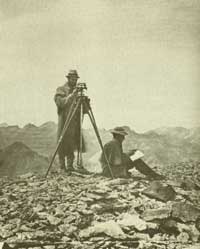 A.D. Wilson and Franklin Rhoda (National Archives) |
"On arriving at the summit, Mr. Wilson hastily made a rough sketch of the surrounding drainage, and then set up the instrument, while I proceeded to make a profile sketch of the mountains south and west of us. We had scarcely got started to work when we both began to feel a peculiar tickling sensation along the roots of our hair, just at the edge of our hats, caused by the electricity in the air. At first this sensation was only perceptible and not at all troublesome; still its strength surprised us, since the cloud causing it was yet several miles distant to the southwest of us. In the early part of the storm the tension of the electricity increased quite slowly, as indicated by the effect on our hair. By holding up our hands above our heads a tickling sound was produced, which was still louder if we held a hammer or other instrument in our hand. The tickling sensation above mentioned increased quite regularly at first, and presently was accompanied by a peculiar sound almost exactly like that produced by the frying of bacon. This latter phenomenon, when continued for any length of time, becomes highly monotonous and disagreeable. Although the clouds were yet distant, we saw that they were fast spreading and already veiled many degrees of the horizon. As they approached nearer, the tension of the electricity increased more rapidly, and the extent of our horizon obscured by them increased in nearly the same ratio; so that the rapid increase in the electric tension marked also an increased velocity in recording angles and making sketches. We felt that we could not stop, though the frying of our hair became louder and more disagreeable, for certain parts of the drainage of this region could not be seen from any other peak, and we did not want to ascend this one a second time. |
"As the force of the electricity increased, and the rate of increase became greater and greater, the instrument on the tripod began to click like a telegraph-machine when it is made to work rapidly; at the same time we noticed that the pencils in our fingers made a similar but finer sound whenever we let them lie back so as to touch the flesh of the hand between the thumb and forefinger. This sound is at first nothing but a continuous series of clicks, distinctly separable one from the other, but the intervals becoming less and less, till finally a musical sound results. The effect on our hair became more and more marked, till, ten or fifteen minutes after its first appearance, there was sudden and instantaneous relief, as if all the electricity had been suddenly drawn from us. After the lapse of a few seconds the cause became apparent, as a peal of thunder reached our ears. The lightning had struck a neighboring peak, and the electricity in the air had been discharged. Almost before the sound reached us the tickling and frying in our hair began again, and the same series of phenomena were repeated, but in quicker succession, at the same time the sounds becoming louder."The clouds now began to settle into the Great Cañon of the Lake Fork, and boiled about in a curious manager; here and there a patch of cloud would separate from the main mass and move about by itself. In passing over a thick cluster of pines down near the bed of the cañon, the lower parts would get caught and drag through with the greatest seeming difficulty. The different parts seemed to be affected by different currents in the air, and at times two little masses of cloud would pass each other less than a mile apart, but would soon turn aside, or rise up, or lose themselves in the great cloud that pretty nearly filled the Great Cañon and its branches. At times a portion of the mass, moved by an upward current, would rise several hundred feet above the general level, and, the force ceasing, would topple over and slowly fall back and lose itself in the general mass. The whole moved about in a chaotic manner, producing a curious effect. When you consider that the top of the cloud was not less than 2,000 feet below us, you can form some idea of the strange scene that presented itself to our eyes in those exciting times.
"The clouds soon began to rise up and approach us. As they did so, the electricity became stronger and stronger, till another stroke of lightning afforded instantaneous relief; but now the relief was only for an instant, and the tension increased faster and faster till the next stroke. By this time the work was getting exciting. We were electrified, and our notes were taken and recorded with lightning speed, in keeping with the terrible tension of the stormcloud's electricity. The cloud reached us, coming on like a fog, looking thin and light near us, but densely white at a short distance. All the phenomena before mentioned increased in force after each succeeding stroke of lightning, while the intervals between strokes became less and less. When we raised our hats our hair stood on end, the sharp points of the hundreds of stones about us each emitted a continuous sound, while the instrument outsang everything else, and even at this high elevation could be heard distinctly at the distance of fifty yards. The points of the angular stones being of different degrees of sharpness, each produced a sound peculiar to itself. The general effect of all was as if a heavy breeze were blowing across the mountain. The air was quite still, so that the wind could have played no part in this strange natural concert, nor was the intervention of a mythological Orpheus necessary to give to these trachytic stones a voice."
Lightning Links:
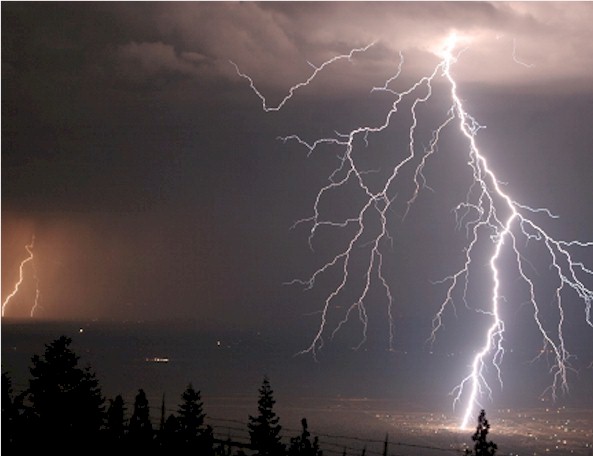 Photograph by James W. Young: JPL/NASA/Table Mountain |
|
 |
Other Links: |
|
|
| Warning! Climbing, mountaineering, and backcountry skiing are dangerous and can seriously injure or kill you. By further exploring this web site you acknowledge that the information presented here may be out of date or incorrect, and you agree not to hold the author responsible for any damages, injuries, or death arising from any use of this resource. Please thoroughly investigate any mountain before attempting to climb it, and do not substitute this web site for experience, training, and recognizing your limitations! |
 Back to Roger J. Wendell's Home Page...

Abbey |
About |
Blog |
Contacting
Me |
Copyright |
Disclaimer |
Donate |
Guest
Book |
Home |
Links |
Site
Index |
Solutions |
Terms,
Conditions
and
Fair
Use |
What's
Changed
or
New?
Copyright
© 1955 -