Roger J. Wendell
Defending 3.8 Billion Years of Organic EvolutionSM

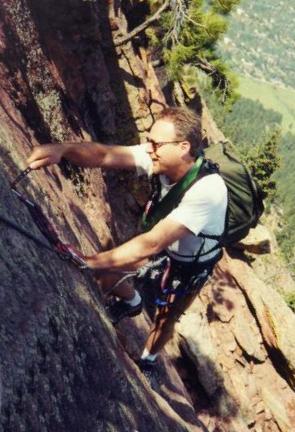
Brian on the Flatirons"DESPITE THE DANGERS and discomforts, climbing is for many an all-consuming passion. They interrupt, end, or never start their careers, focusing exclusively on completing the next climb. Climber Todd Skinner said free climbing means 'going right to the edge' of your capabilities. For many climbers, this closeness to death - the risk of dying - produces an adrenaline rush that most other life experiences simply can't. It is what keeps many of them married to the sport. Probably no other sport creates such a feeling of oneness with Mother Nature. Attached to a mountainside by fingertips and toes, the climber necessarily becomes part of the rock - or else. One climber says that while scaling a granite face, she felt close to God, so intense was her relationship with the natural world. "Climbers speak of 'floating' or 'performing ballet' over the rock, each placement of foot and each reach into a crack creating unity with the mountain. The sport is one of total engagement with the here-and-now, which frees the mind from everything else. Climbers' concentration is complete and focused. Their only thought is executing the next move.
"Rock climbing has been called the King of Sports, not only because of the skills, courage, and mental conditioning it demands but also because it takes place in the grandest of places. There is no stadium, court, diamond, gym, field, or track that can rival nature's arena."
- Bob Madgic in his book, Shattered Air
(A True Account of Catastrophe and
Courage on Yosemite's Half Dome) pp. 106-107

|
Click Here for my main climbing page... |
|
|
Click Here for my 14ers page... |

|
Click Here for the Ten Essentials - Don't leave home without 'em! |
|
|
Click Here for my 13ers page... |
|
|
Click Here for my 12ers page... |
|
|
Click Here for other peaks and mountaintops that I've summited... |
Click on any of this page's "Thumbnail" images for a larger view
|
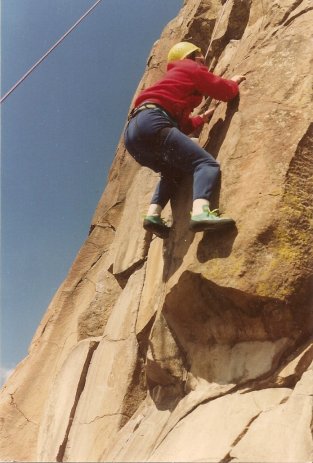
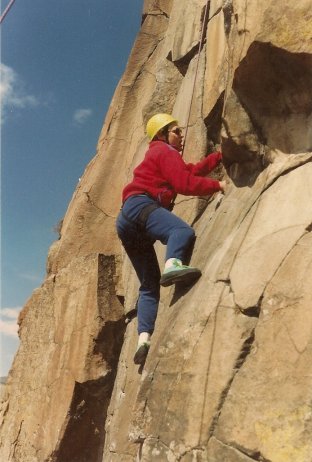
The John Roskelly Show or Polyvinyl Chloride (5.9) North Table Mountain, Golden, Colorado - March 18, 1994 Roger J. Wendell, Dan Howell, and Kevin Fiesen |
 1. Dan |
 2. Dan |
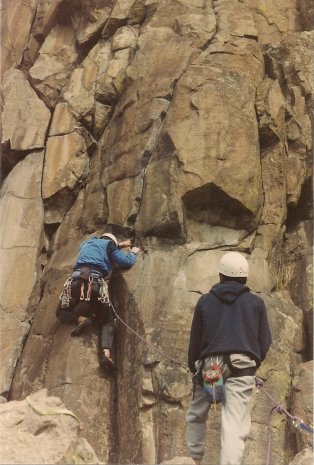 3. Roger & Kevin |
 4. Roger & Kevin |
 5. Kevin |
 6. Kevin |
Champ Camp
In July, '11 (and again in later years) I had the distinct pleasure of helping out at as a belayer (and other duties)
for "Champ Camp" - the American Lung Association's summer program for kids with Asthma. The camp, located at
Glacier View Ranch near Ward, Colorado, featured all kinds of activities with climbing one of at least a dozen
options for the kids. Click Here for my full-blown Champ Camp page with videos and links to the official site, etc.
 1. Selena |
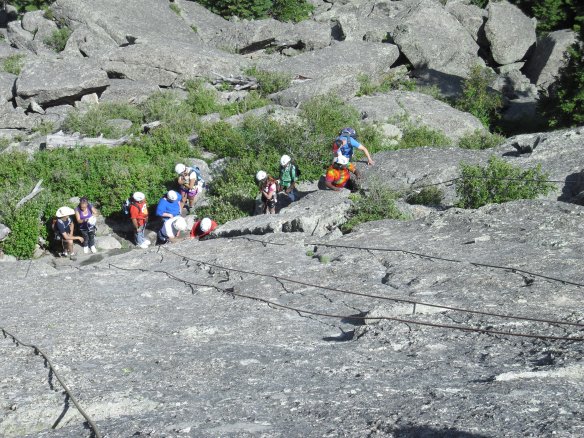 2. Waiting to climb |
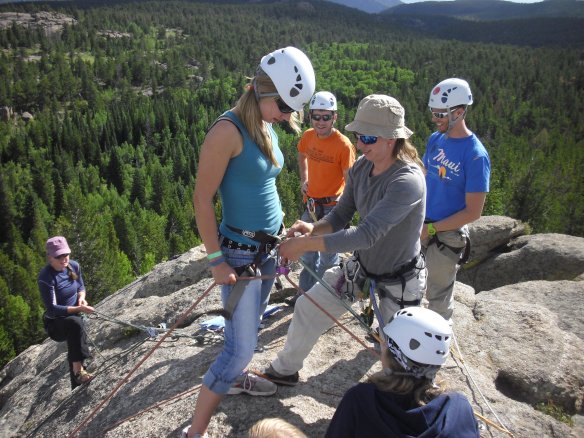 3. Deb does a safety check |
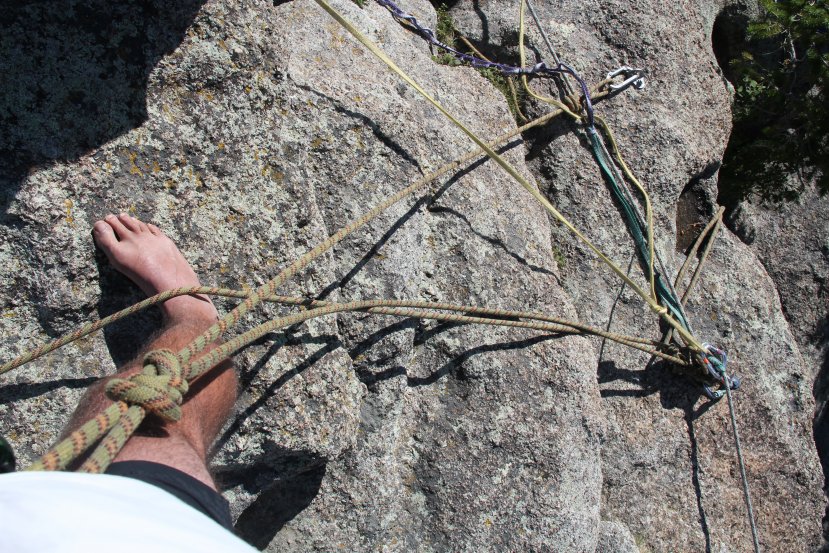 4. Barefoot belayer |
 5. Me, the kids, and lots of wind! |
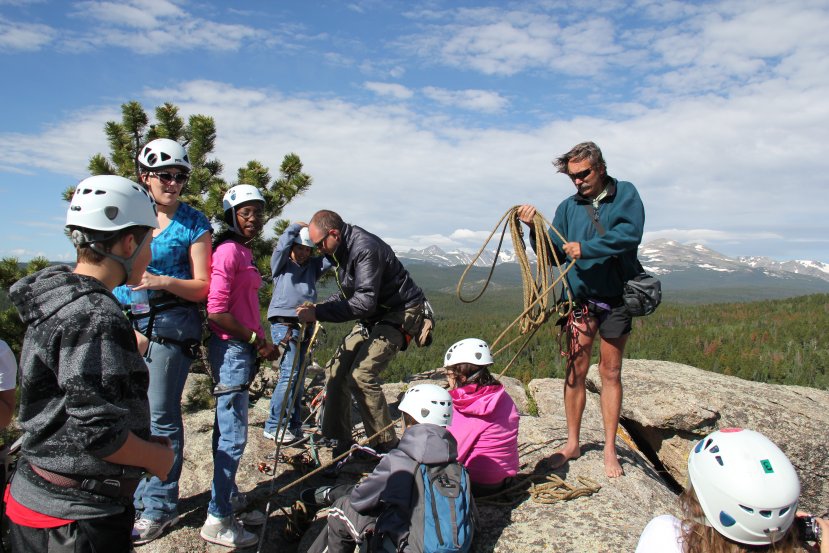 6. Rope management |
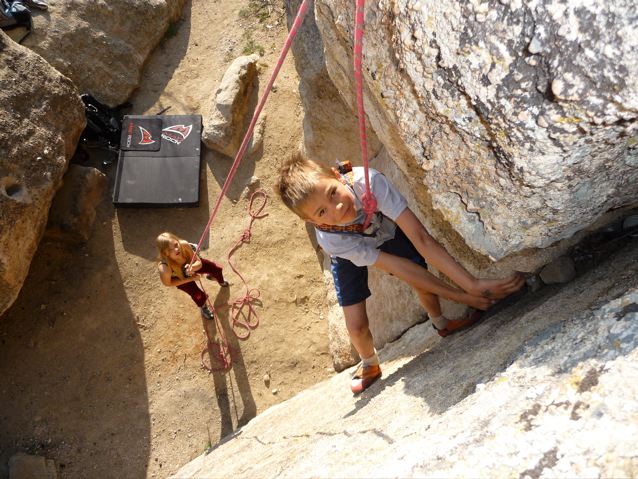
Top-roping offers the rock climbing experience with all the rewards but minimal risks. Top-roping, or Top-rope climbing, is climbing a rock face with the rope always anchored above you. If you fall, you usually only fall about a metre (3 feet), at most (if you're doing it properly!), until the rope catches you - reducing your risk of injury.
Athena and ConradIn this photo Athena and Conrad demonstrate how top-roping is a great way to learn the basics of climbing. With top-roping they're learning how to set up anchor, how to belay, and how to have lots of fun on the rock! Top-roping is ideal for beginners since it allows them to concentrate on techniques rather than worrying about falling. Advanced climbers use top-roping as way to work on new techniques or to just build strength and endurance. Top-roping doesn't require a lot of equipment but does need attention to safety - you can easily get hurt on a top-rope if you're not setup properly or aren't paying attention!
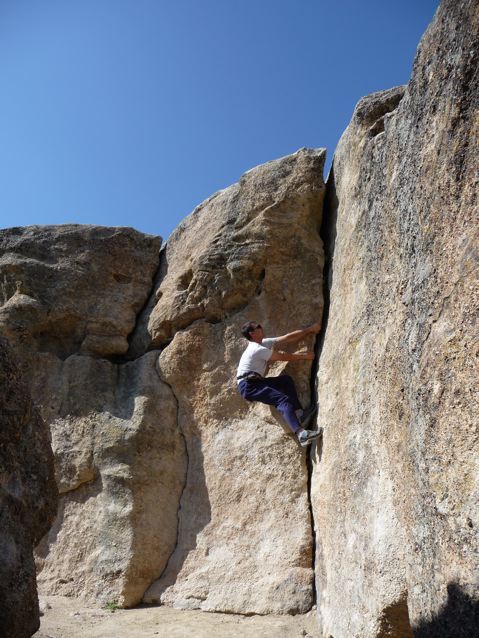
Bouldering is a form of practice climbing that emphasizes power, strength, and dynamics - focusing on individual moves or a short sequence of moves. Bouldering routes, usually very short in nature, are sometimes referred to as "problems" as in "problem solving."
Bouldering has increased in popularity because it's quick, relatively easy, and takes almost no gear (other than a pair of suitable climbing shoes and maybe some chalk for your hands!). "Buildering" is a variation of the bouldering theme but practiced on the sides of large walls, buildings, and other structures. I do not recommend buildering at all - it's even more dangerous, for a variety of reasons!
Scott in Daniels ParkBouldering's focus is on individual moves or short sequences of moves, unlike traditional climbing or sport climbing, which generally demand more endurance over longer stretches of rock where the difficulty of individual moves is not as great. Boulder routesare commonly referred to as problems (a British appellation) because the nature of the climb is often short, curious, and much like problem solving. Sometimes these problems are eliminates, meaning certain artificial restrictions are imposed. To reduce the risk of injury from a fall, climbers rarely go higher than 3-5 meters (10 to 16 feet) above the ground when bouldering. Anything higher than that, without the use of ropes and protective climbing equipment, is considered to be "free-soloing." For additional protection some climber place a protective athletic mat ("crash pad") beneath their route to catch them during a fall. My personal rule-of-thumb, whenever I'm bouldering, is not to go any higher than I can safely fall or jump without njuring myself.
Wind Tower
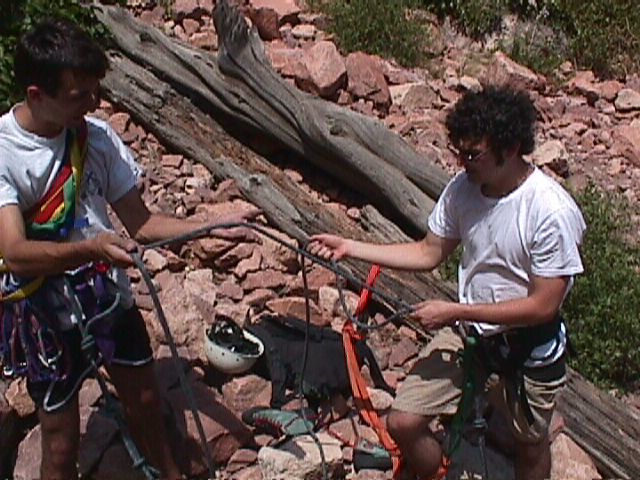
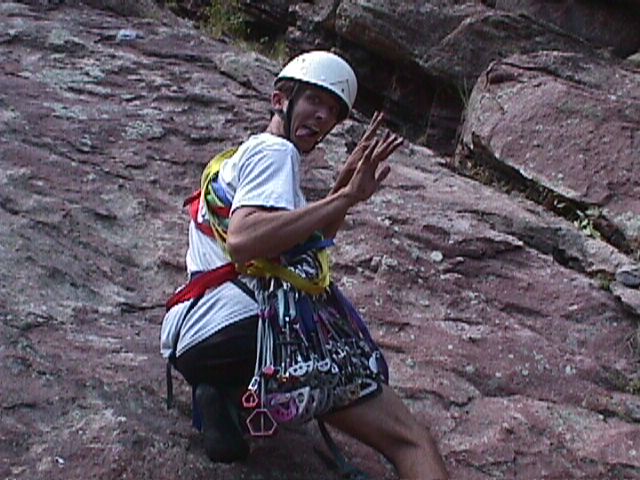
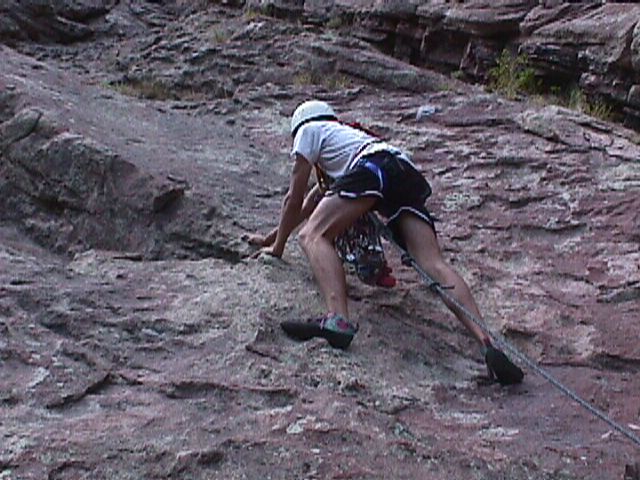
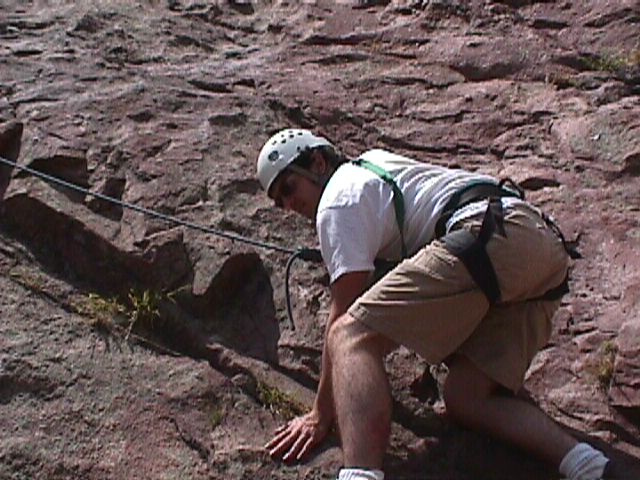
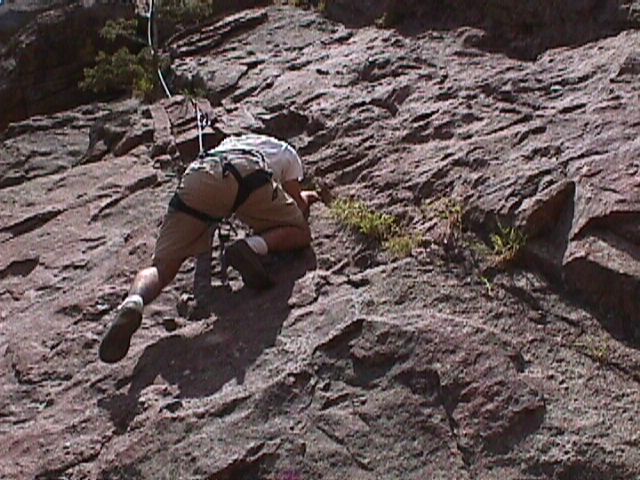
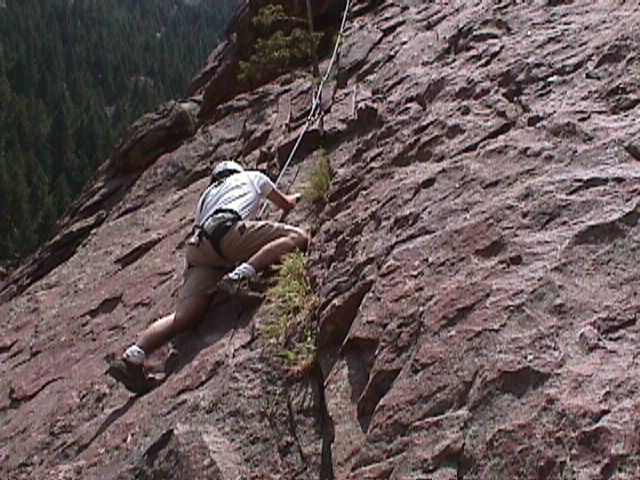
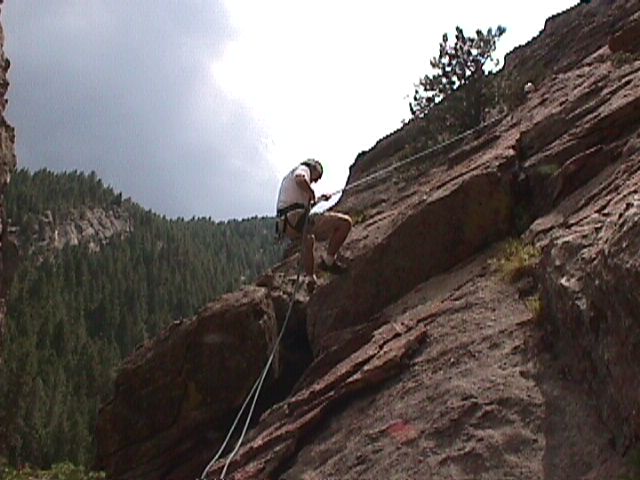
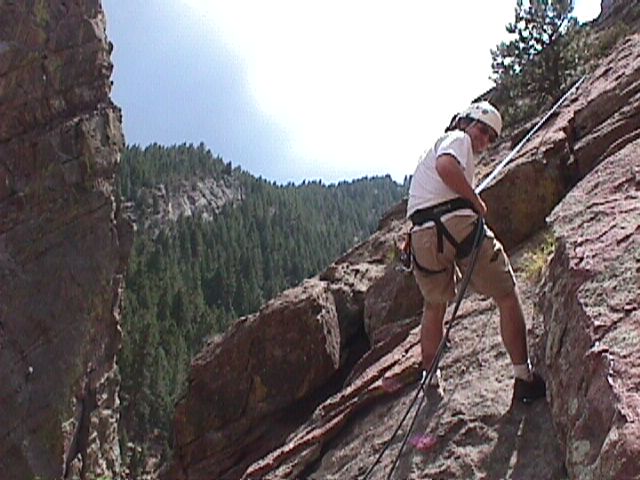
Roger A. Wendell and Jonathan V. P. Toups - July 21, 2002
"Eldo" - Eldorado Springs Canyon State Park, Boulder, Colorado
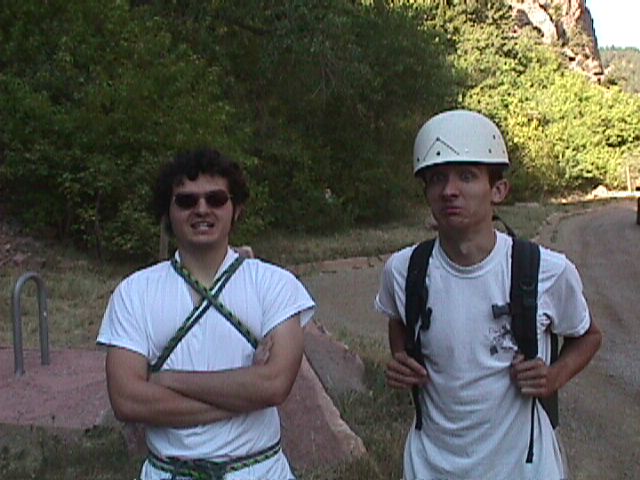 1 |
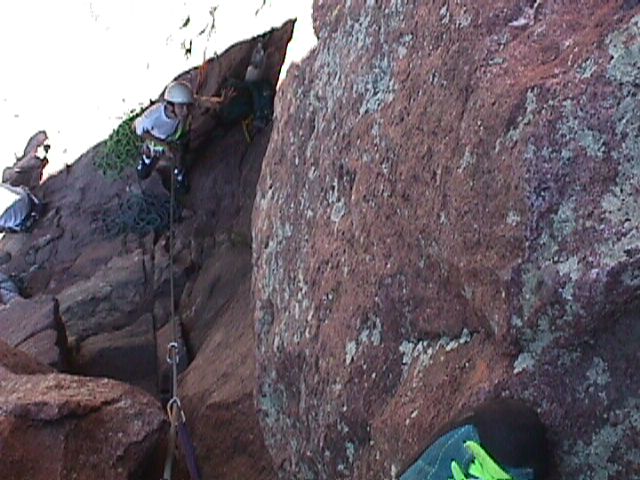 2 |
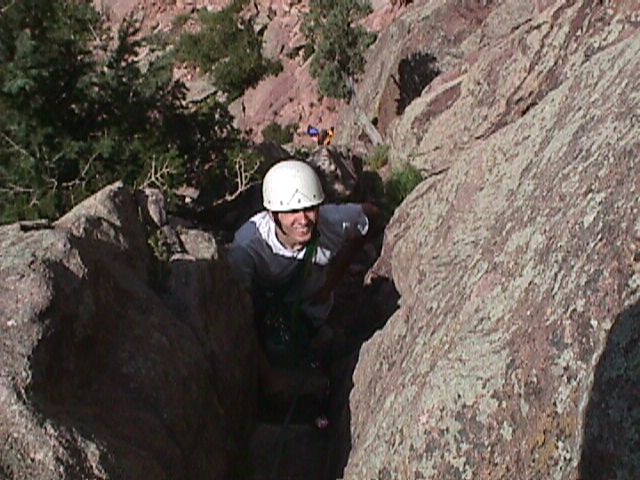 3 |
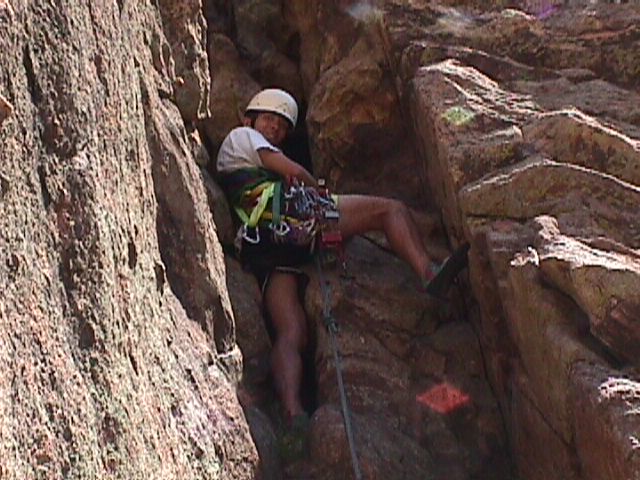 4 |
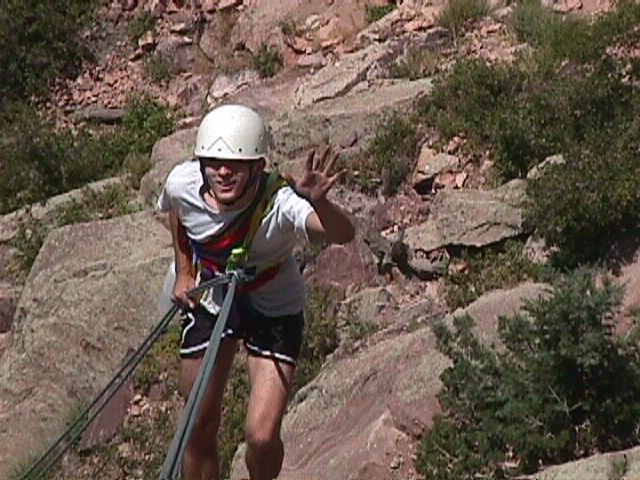 5 |
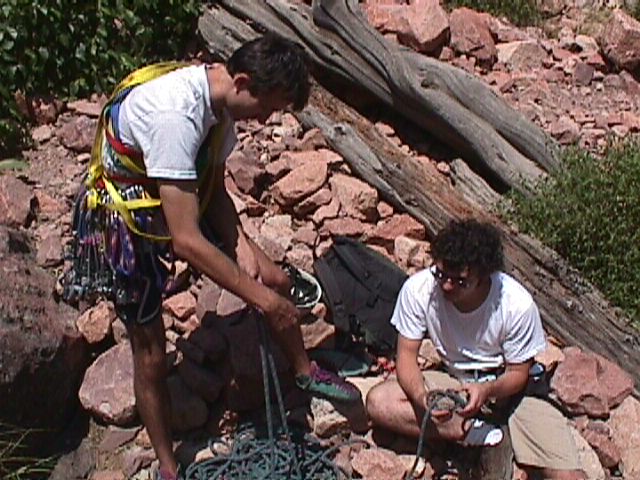 6 |
 7 |
 8 |
 9 |
 10 |
 11 |
 12 |
 13 |
 14 |
 15 |
 16 |
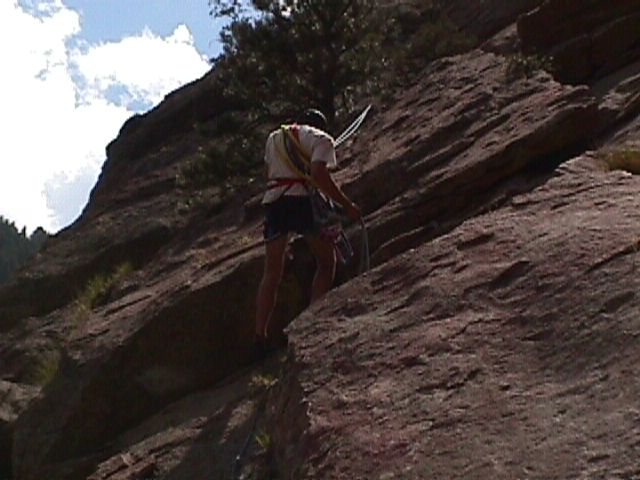
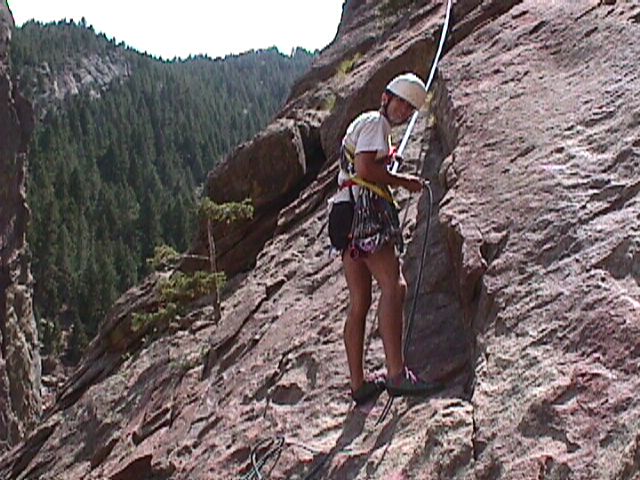
Note that in photos 4 & 8 Roger is leading different routes.
My friends Larry DeSaules and John Schaphorst often refer to
leading as being on the stupid end of the rope...
Links:
|
|
| Warning! Climbing, mountaineering, and backcountry skiing are dangerous and can seriously injure or kill you. By further exploring this website you acknowledge that the information presented here may be out of date or incorrect, and you agree not to hold the author responsible for any damages, injuries, or death arising from any use of this resource. Please thoroughly investigate any mountain before attempting to climb it, and do not substitute this website for experience, training, and recognizing your limitations! |
 Back to Roger J. Wendell's Home Page...

Abbey |
About |
Blog |
Contacting
Me |
Copyright |
Disclaimer |
Donate |
Guest
Book |
Home |
Links |
Site
Index |
Solutions |
Terms,
Conditions
and
Fair
Use |
What's
Changed
or
New?
Copyright
© 1955 -