Roger J. Wendell
Defending 3.8 Billion Years of Organic EvolutionSM


Welcome to my:
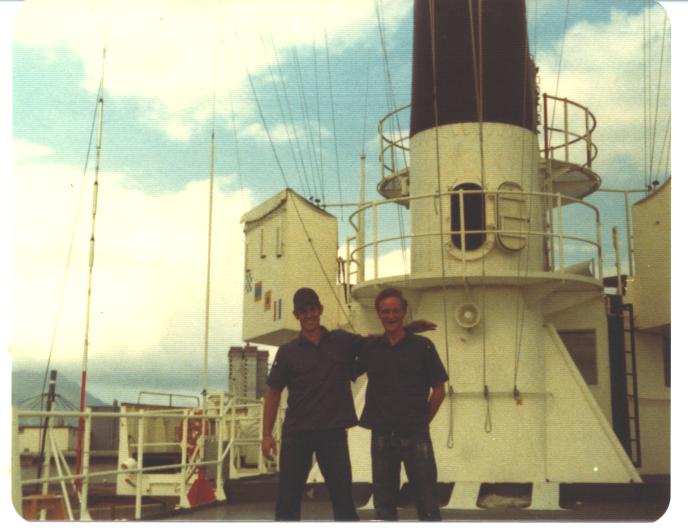
Mike Bell & Carl Koch on CG Cutter Mellon in Honolulu, Hawai'i (1976)I, myself, served on active duty from January, 1975 through January, 1979.
(I also served in the active reserves for a short time around 1980)

|
Click Here for notes, stories and thoughts from "Coasties" who've stopped by this page! |
|
|
Click Here for my main Coast Guard page... |
A note and pix from Dave Buehler:
Ocean Station Bravo and the Cutter Campbell - 1972
USCGC Campbell
Ocean Station Bravo
Bruce Heiber/TT2, Peter Maxwell/ET2,
Mark McCardle/QM3, Dave Buehler/RM2Hey Roger, Wanted to let you know what a trip down memory lane it was for me to read your web page on the Coast Guard and being a radioman. Thanks for taking the time to record it and post it. I joined the Coast Guard in 1971 with the Army in hot pursuit because I had a draft number of either 19 or 26 (the buddy I joined with had the other number - either way we were going in to the military). My Dad was an Air Force lifer and so I originally was going to join the AF but the recruiter told me a bunch of bald faced lies (ala Private Benjamin they didn't know we were military brats).
It was my buddy that suggested joining the Coast Guard. We eliminated the Navy because they had the same Book of Lies that the AF had and we knew that Marines and Army were bad choices with Vietnam in full swing. Like you I went to Boot Camp at Government Island. When I graduated I was accepted to Radioman A school but it was being transferred to Petaluma and so I swabbed the deck of the Enlisted Man's Club twice a day till that opened. I was part of the first class through. What a great CG base that was!! I reported on board the Campbell for the remainder of my enlistment and served two years on the east coast (did all the Ocean Stations) and one on the west coast (did an Alaska Fisheries Patrol and got in trouble for stealing OBS and Amvers from the landies - but what's a Sparks to do when bored on board?). I pulled two OS Bravos and both were in the winter so we saw some big seas.
Congrats on being the record holder for CW. I was definitely pedestrian on Morse Code. But my typing got blazing and I was always overtyping the speed of the RATT and RATTY machines (limited to 75 WPM). I did one Gitmo and one cadet cruise during my time (Hawaii - woo hoo). We got to transit the Panama Canal and I stole the radio card that was supposed to be returned at the end of the transit. It was supposed to be a souvenir and I have no idea where that ended up. I got out in 1975 and so our paths never crossed but the picture of the Centerfold was one that seemed to be everywhere on my ship - so we shared a common time.
Thanks again for your fun web site.
David E. Buehler, PMP
April 09, 2013
Former Recruit Barracks:
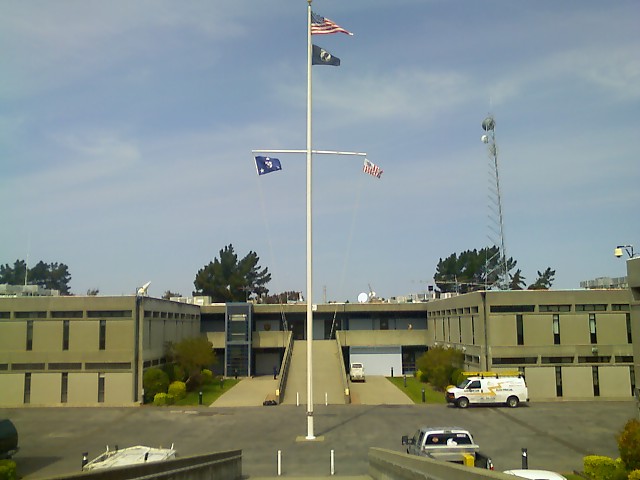
Government Island, Alameda, California - April 2009
Note: The "Grinder" was the parade, exercise and training area immediately adjacent the barracks for those of use who went through boot camp on Government Island. This is a more recent photo, since the barracks were converted to office space, but surprisingly it is almost exactly the same as it was during my stay way back in January 1975! - Roger J. Wendell
Roger, I recently retired as a Chief and I am now working as a Spectrum (Frequency) Management consultant for CG District Eleven. I'm out on the island. I saw your pictures from your boot camp days and noted the "Grinder". The area still exists, but all the barracks rooms have been converted to office space. I occupy the SW upper corner. Attached is a picture of how the "Grinder" appears today. The flagpole is at least 50' tall or more.
73 de Eric Simmons, KB6YNO
More on TRACEN Alameda:
In July, 2010 John Flores wrote me in response to some of the text and pix he saw, on my Coast Guard pages, related to boot camp on Government Island in California. His original boot camp note is posted next to his picture on my regular Coast Guard page. Below is some good history that John has given me permission to reproduce here as well:
Roger: Well, I was not as resourceful and clandestine as you were so did not get any boot camp photos at all. We did not even have a graduation photo that I knew of, as the other services do. Maybe we did but I just didn't know about it. I cannot say for sure but I believe we called our "D.I" people company commanders--the top guy--and assistant company commanders. The assistant was the one who yelled all the time and got in my face. He'd tell me to "drop and give me 50!" We did so many pushups--they called them "cranks"--it's amazing. We also had an obstacle course just like the ones you always see in movies of Army boot camp or Marine Corps. You had to run, crawl, leap and climb and then sprint to the finish. I was just 19 but it tired me out I do remember.We had swim training, and then some boat training and fire fighting training on an island in the Bay. Got to go into San Francisco by the BART for a one day pass during boot camp. Wow, that was an eye-opener for me. Had never been to a big city before. Another fellow boot took me into one of those nude dancing places in downtown SF, and that was pretty wild indeed. A first for me. The guy kept looking at my face and laughing for some reason. Guess I looked overwhelmed by the whole thing.
Punishment for us was galley duty, or just running laps on the grinder--endlessly it seemed. Around 1 a.m. is when the assistant company commander would drop by for a little loud visit, turning on the lights to the barracks and yelling. We had about one minute to get dressed and assemble on the grinder in formation. Then we'd run! Big surprise.
One time we were doing rifle drills out there during the afternoon and somebody marched us right into the water--completely off the grinder. We just barely went in but we were all looking at each other like "that guy is nuts." I wasn't going to keep going but some of those guys were just retards or something.
And then of course was the famous OOD Shack, where you would have to knock real loud and report every time you passed by. Those guys loved to get in your face too.
Then we had X-Ray Company, near our barracks in another area where all the wash-outs went while waiting to get processed out of the service. Those were mental cases, or bedwetters, or whatever. We had to stand guard at night and one of the duties was checking the X-Ray barracks and doing a count of people in their racks. Once I counted and one was missing! Had to report that immediately to the OOD. They tried to blame ME for that guy splitting. Can't recall if he was ever found.
Here's something funny. When we were in forming company, still wearing our civilian clothes and civilian hair, we had a guy named Bobby Sanspree, from Bowling Green, Kentucky. And he had the accent to prove it. A good guy and a friend of mine when we were there. Well, he was a little slow in moving on the day we all stood at attention in a room to receive all our military issue clothes. The people in charge would say: "You have one minute to stencil your name into your underwear and clear your desks completely!" This guy stenciled his but forgot to clear his desk of the plastic wrapper and so the assistant company commander--a guy named Mercer--walked over and ordered him to roll the plastic up, open his mouth, place it in his mouth, and close his mouth and to keep that plastic in his mouth until further notice. So for the next day or so, every time I saw him running around--and we had to run, double-time, everywhere we went--he had that plastic in his mouth sticking out. We all had to laugh every time we saw him.
And I remember that every time we even caught a glimpse from a long way off of anybody in command, we had to hit the deck and start doing cranks.
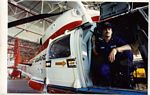
Here is a photo of a friend of mine in a helo when I was already discharged and the Coast Guard was experimenting with these new Dolphins. He got me a ride in this one when I was working as a reporter for the Corpus Christi Caller-Times years ago. He told me the pilots used to love flying low over the beaches to check out the girls in bikinis. They even did that the day I rode with them. A fun ride.
Tell me about your experiences there. You are the first person I've ever been in contact with who went to TRACEN at that time-frame. Never have seen or heard from any of the old crowd I graduated with in 78.
And yes, I'd be glad for you to use my stories! I am a writer and for a long time have been collecting memories as best I can to write a book about those days--four years of adventure for a young man. A lot of it was boring and tedious, but a lot was fun and exciting too and dangerous. Wouldn't do it again but wouldn't trade anything for those memories and experiences.
John Flores
Albuquerque
John McMahon:
January 2009
Roger:
Yes that's me at NMB Charleston SC. fall-winter of 68-69.The pic of me in whites was taken in Hati, 1970? Officer with me is Ltjg Carney nice guy. Back in those days we dressed like SAILORS hi hi.Yes post the pics if u want. I am also sending along a great shot of a 65' wave taken on Ocean Station Charlie. What a ride that was, we got so beat up we had to leave station an head for St, Johns Nfd. for repair. I used my GI bill to attend nursing school, so I consider my self a BM,HM,RM.DC hi hi . Retired from the Oneida FD, in upstate NY. 73 John
[ed note: John's first email to me]
Roger: Name here is John McMahon, I'm 59, a retired fireman and live in upstate NY. Today I surfed into a site which led me to your CW site. From 68-72 I was also in the USCG, Cape May, NMB Charleston SC, RM school and on CGC Bibb almost 3 yrs. Believe it or not I got booted from RM school Class 3-69, I loved radio but hated Governors Island and school it was like boot camp two hi hi. I came to RM school from NMB where I was a SN and had it made in the shade...To make a long story short, I regretted leaving RM school every day after that. Made BM3 and spent almost 3 years, tired, hungry, seasick and covered in white paint. The CW was not the problem, the SCHOOL was hi hi. Got into ham radio after retiring from the FD, and even after 40 yrs the code was still there in my head. I enjoyed your site very much. and agree with your opinion of the FCC dropping CW. " another dumb down of a long standing requirement " I must say your 40 WPM title in something to brag about, 25-28 is tops for me. At least you never had to stand watch in a shack where the operator chairs had seat belts !!! hope to catch u on the air some time for an QSO, 73 John KC2JAJ
 John McMahon at NMB |
 John McMahon at NMB |
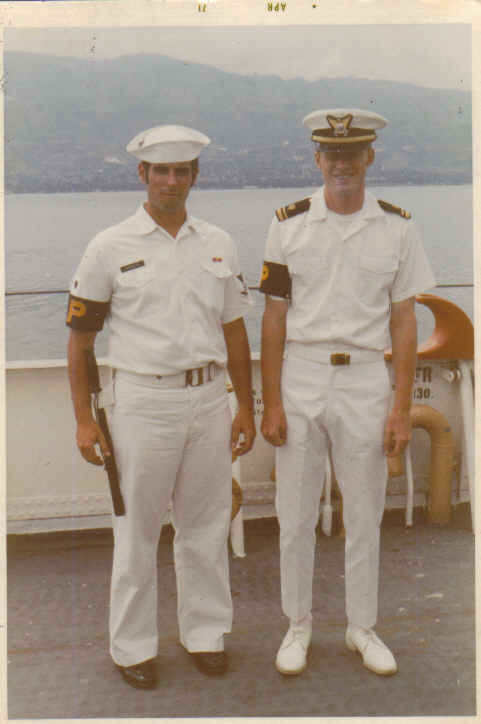 John & Ltjg Carney |
 Ocean Station Charlie |
 Ocean Station Charlie |
In July, 2005 Ernest Ritzmann wrote me:
[ed note: I was saddened to learn, from one of his family members, that Ernie passed away on March 07, 2008...]
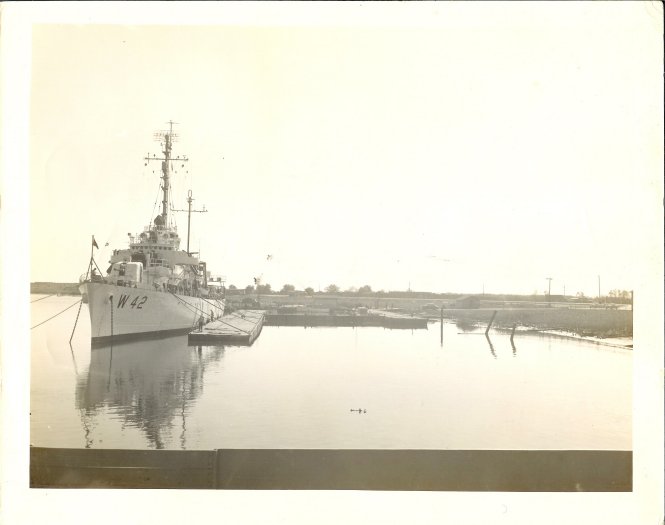
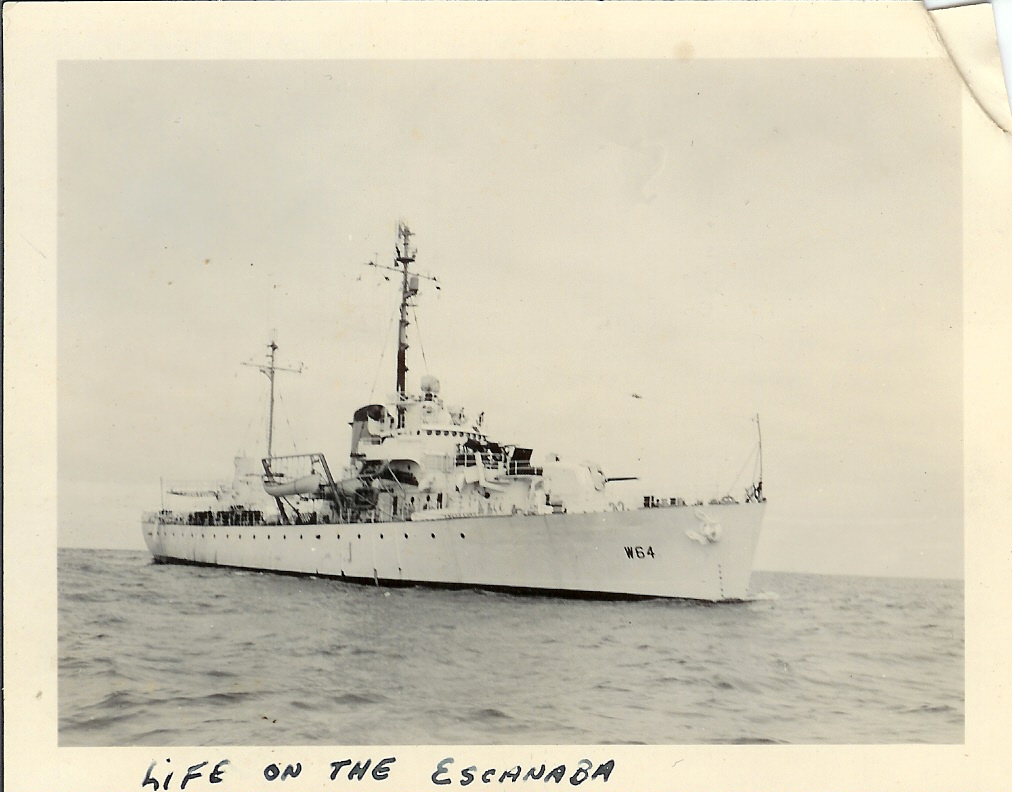
Ex-Coastie Tom Kirk gave me your web site and I found it very interesting. Kirk and I both served on the CGC Blackthorn out of Mobile in the early sixty's. He was an ET and I was an RM1. I am sending you a few pictures of the CGC Sebago when it was in Mobile... I went in the CG in August of 1952, Radio School Groton. I also have several pictures of the Escanaba, Ewing and Blackthorn. I was stationed at NMC 1955-56. Lots of memories. Also stationed at NMG. My name is Ernie Ritzmann (EJR) I was discharged in March of 1965. (My E-Mail address is ritzm at cox.net) I have my ZUT card number 31... I remember joining when I was at the commcen NMG1 New Orleans...
If you're interested in some picture let me know and 73's...
 1 |
 2 |
 3 |
 4 |
 5 |
 6 |
 7 |
RMCM David L. DeGeorge Sr
Provided this nice letter and clarification on February 22, 2009:
Dear Roger,Congratulations on your excellent website. The letters and comments, as well as the pictures diplayed, bring back many fond memories of my Coast Guard days.
I was especially impressed by the article submitted by RM2 Lynn C. Smith. Coincidentally, I was stationed in the USCGC Sebago (WPG-42)/NRUF on/about June 1959, but must have just missed Lynn who was leaving for Radsta Galveston (NOY) about the same time. However, on April 15, 1960, I was transferred to NOY, and would soon catch up to him there. I served with Lynn at NOY until I left for the USCGC Cahoone (WPG-131)/NRLG, in July 1961.
Lynn's account of our experiences at NOY were portrayed as I remember, except for one slight, but obviously unintenional, mistake. The photo of the operator sitting at the CW console, was indeed Calvin J. Lanford (now deceased). However, the person standing in the other photo taken at NOY, across from the ORAD/Beacon console, was not other than myself as an RM2.
In addition to RM2 Smith, RM3 Lanford, and myself, also there were: LT Hood, Chrele Calimer, RMCS Byrd, RM1 Callies, RM1 Roesing, RM1 Bauer, and RM3 parker.
Lynn also mentioned hurricane Carla. I certainly recall hurricane Carla and the ravages of her wwrath over Galveston island. Although the Cahoone was at safe mooring within the Houston ship channel, the aftermath of wind damage and flooding left many of our familes stranded in evacuation centers on the island for many days without our knowing of their well being or lcoation. An unforgettable experience.
Thank you for providing such a fine contribution to the proud history and traitions of our Coast Guard family.
Semper Paratus,
David L. DeGeorge Sr
RMCM, USCG (Ret)/KFNMA/ZUT1282
North Port, Florida
Lynn C. Smith, of Houston, Texas, provided these scans of
photographs he took himself during 1958 and 1960. The text
beneath each photo is from Lynn as well with additional info
from Roger Brown (KL7Q) added below the four pix:
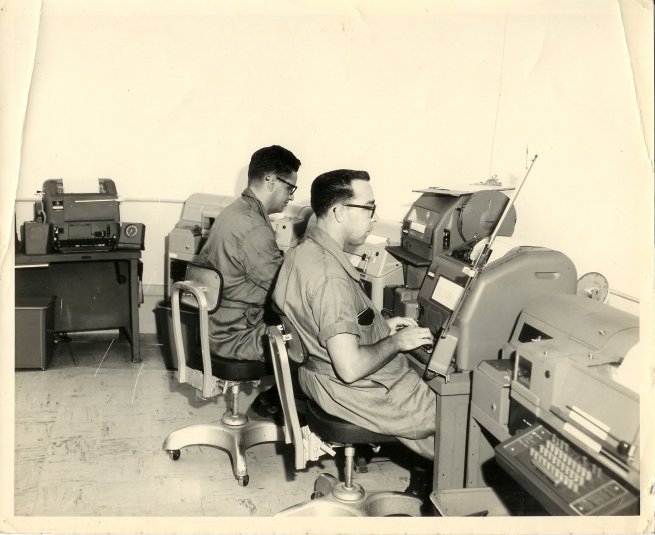
 Coast Guard Group Station Galveston, Texas (Radio call sign "NOY") On the left is the cw position for 500/457. That was about the only cw se did at NOY and it was all with commericial shipping doing AMVER msgs. We were a little pipsqueak power station compared to NMG [ed note; NMG was the Coast Guard's Radio Station in New Orleans], but we used to love to try and steal amvers from them when we could answer quickly. It was great fun to get a msg from a ship just coming out of the Miss delta area (their back yard) and send it to NY from Galveston - haha. The 2 xmitters in the pic are an an/frt23 on the left and the one we used for 500/457 on the right (small black one). I am sorry I can't remember the type, but for a long while we would have to get up and change the freq from 500 to 457 kcs manually to contact ships sending us amvers. Later in 61 we got another xmitter so we could just flip a switch to change freqs. That array you see above the xmitters is the antenna switch panel we had to use to change what antenna we watned to use to the current xmitter (I know this sounds real antiqueish to you, but thats the way it was for the poor coastie rms's back then). |
 Coast Guard Group Station Galveston Again shown is the cw position on the left. In the middle of the pic is the teletypes. We used on to send amvers to NY headquarters every 2 hours. Not shown on the right is one voice position. We monitored 2182 and 2686 which was the CG voice operating freq for that area. We ran several 40 footers and one 83 footer, one 125 footer and one buoy tender out of base Galveston. This was actually great duty for me because we worked 48 on/48 off and could wear civies on and off the base. I think in the 2 years I was there I wore my dress uniform twice. We also had a/c in our quarters which were separate from the great unwashed ratings - lol. Of course the fact that I lived only 50 miles away, in Houston, didn't hurt either... [Ed note: Lynn advised me that the person in both photos was RM3 Langford but he didn't have additional info because that was a note he had written on the side of the photos when they were taken at NOY in mid 1960] [Ed note: RMCM DeGeorge, in his letter posted above, clarified that the NOY photo on the left was of RM3 Calvin J. Lanford and that the one on the right (directly above this entry) is of himself, RM2 David L. DeGeorge, Sr!] |
 Coast Guard Cutter Sebago (255 Footer out of Mobile, Alabama) Here is the an/frt23 xmitter. We had that for everything but 500 kcs, for which we had another xmitter and I can't remember what it was. At sea we monitored 500, 2182, 6383 (cw daytime) and 4337 (cw nites) and 2686 (voice CG freq). Of course we were under control of NMG.
[Ed note: Lynn advised me that these Sebago pics were taken by him in about November, 1958. Lynn's original letter to me is posted on my "Coast Guard" comments page Here]
|
 Coast Guard Cutter Sebago This was the standard radio position on the Sebago of which there were 3. There were usually 2 rm's on duty except the midnight-4 and 4 - 8am watches. We had a lot of rm's just out of radschool (like me) so we would stand watch with an experienced (3 months) rm till we got our bearings. I can't remember the names of the receivers shown there, but the "bug" in the pic belonged to me me. I got my ticket a couple of months out of school. You can see the plug sockets were we put the headfones for various frequencies to monitor. We also monitored around 8 and 12 mg ranges for commercial traffic. The little black box to the right of the typewritter was a remote control pane to switch transmitters if needed. At this time we had absolutly no gear to monitor aircraft tfc at all. When we went out on patrol to CCampeche we took a civilian wx man with us to take obs info and then we sent it in to NMG. |
(From Roger Brown, July 2004)
Hi Rog:
I have been reading coast guard (radioman) related stuff from your nice web site. Regarding Lynn Smith's photographs depicting equipment, I would like to mention that the black transmitter in the right corner is a Westinghouse tdE. They were common onboard coast guard ships and certain shore stations from WWII (when they were manufactured and installed) up into the late 60's (when I left the coast guard - I don't know when they started getting rid of them).
They were a 125 watt A1, A2, A3 (CW, MCW, AM) transmitter consisting of two separate RF decks (side by side in the same enclosure). The left side was MF (as I recall 300-600 Khz) and the right side was HF (3-18.1 Mhz). Of course it was Kcs and Mcs in those days. When I was a radioman (1963-67) the tdE, TAJ, TAB, TBL and the newer AN/FRT-23B and URT-12 were the mainstays on land and sea. Marine VHF had not come along yet. Everything was 2182 and 2670 for civilian to CG comms, and 2678 for inter-CG AM. AM voice traffic was handled on the URC-7 transmitter/Receiver which was located in the radio shack but usually remoted to the bridge. URC-7's were also to be found at all lifeboat stations, light stations, and on small floating units (like 40 footers, etc) All other traffic was CW on 2, 4, 6, 8, 12, or 16 Mhz. working frequencies.
RATT, RTTY, TTY or what ever you want to call it, was just being introduced, and as yet, not being used very much within the CG. The receivers which Smith couldn't name are of the RCA RBA, RBB and RBC series. They were also introduced just prior to WWII. We trained with them (as well as the venerable Coast Guard manufactured R-100 MF receiver) during radio school at Groton. When I entered the Coast Guard they were already slowly being phased out. The primary receivers of my day were the: R-100 (mentioned before), R-388 (Collins 51-J series), RCA SRR-11 and SRR-13A (11 being MF and 13A being HF), R-XXX? (National HRO-60), R-390 (RCA, etc - just starting to appear) and even a few SP-600's (Hammerlund).
For communications with military aircraft we had UHF AM gear (TED-7 transmitter and URR-35 Receiver). On shore duty (NMJ, NOU and NMW43) we utilized land line teletype and, of course, some of the previously mentioned radio equipment. When I entered the CG they were still using Model 15, and Model 19 teletype equipment. NMJ converted to Model 28KSR and 28ASR teletype equipment in about 64-65. As I think about it, in 65 NMJ was just getting a new electro-mechanical tuning device to retro-fit some of its 51J-3 receivers for scanning 8 mc (Amver, OBS, etc). The device consisted of a box attached to the front (in place of the main tuning knob) of the receiver. On the front of the box was a large knob which could be pushed in (to engage) or pulled out (to disengage-engage) the automatic scanning process. Inside the box was a gear-train which, when turned on, would turn the tuning knob so many slow revolutions to the right, automatically stop, reverse it's self, and do the same to the left, repeating it's self over and over again. I remember it seemed pretty high tech at the time.
On ships we used LM-18 Frequency Meters, at primary/secondary Radsta's we used the large FR-4U Frequency meters (w/small 2 in. scope for interpolation using lissajous pattern resolution). I'm starting to ramble on - sorry. It's fun to think back and recall all this stuff. I haven't mentioned this radioman stuff for all these years (nobody really interested). At any rate, there it is. Hope it's of some historical interest to someone - now that RM's and their proudly worn Sparks are no more. Actually, I'm glad that they retired the sparks. I'd hate to see them worn by anyone or stand for anything but what they were originally intended (sorry TC's).
73's and Semper Paratus
Roger Brown, Ex RM2, CWO-3 Ret., KL7Q, ZUT-982
NODX, NODH, NMJ, NOU, NMW-43
Wasilla, Alaska
Ken Yarcho, friend and a climbing leader in the Colorado
Mountain Club (CMC), gave me permission to post these
QSL cards from his father's collection:
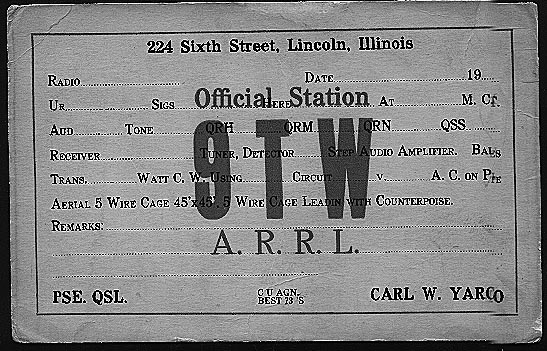 9TW's 1920s QSL card - Ken's father, Carl, was a Ham in Illinois, operating later out of Colorado as WØTW. |
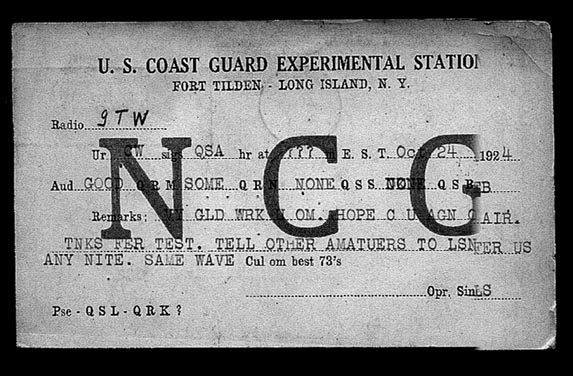 9TW worked the Coast Guard's experimental station in 1924. |
Coast Guard Related Links:
 World War II Coast Guard Poster |
|
Other Related Links:
|
|
 Back to Roger J. Wendell's Main Coast Guard Page...
Back to Roger J. Wendell's Home Page...

Abbey |
About |
Blog |
Contacting
Me |
Copyright |
Disclaimer |
Donate |
Guest
Book |
Home |
Links |
Site
Index |
Solutions |
Terms,
Conditions
and
Fair
Use |
What's
Changed
or
New?
Copyright
© 1955 -