Roger J. Wendell
Defending 3.8 Billion Years of Organic EvolutionSM

QRPp
Low Power Amateur Radio
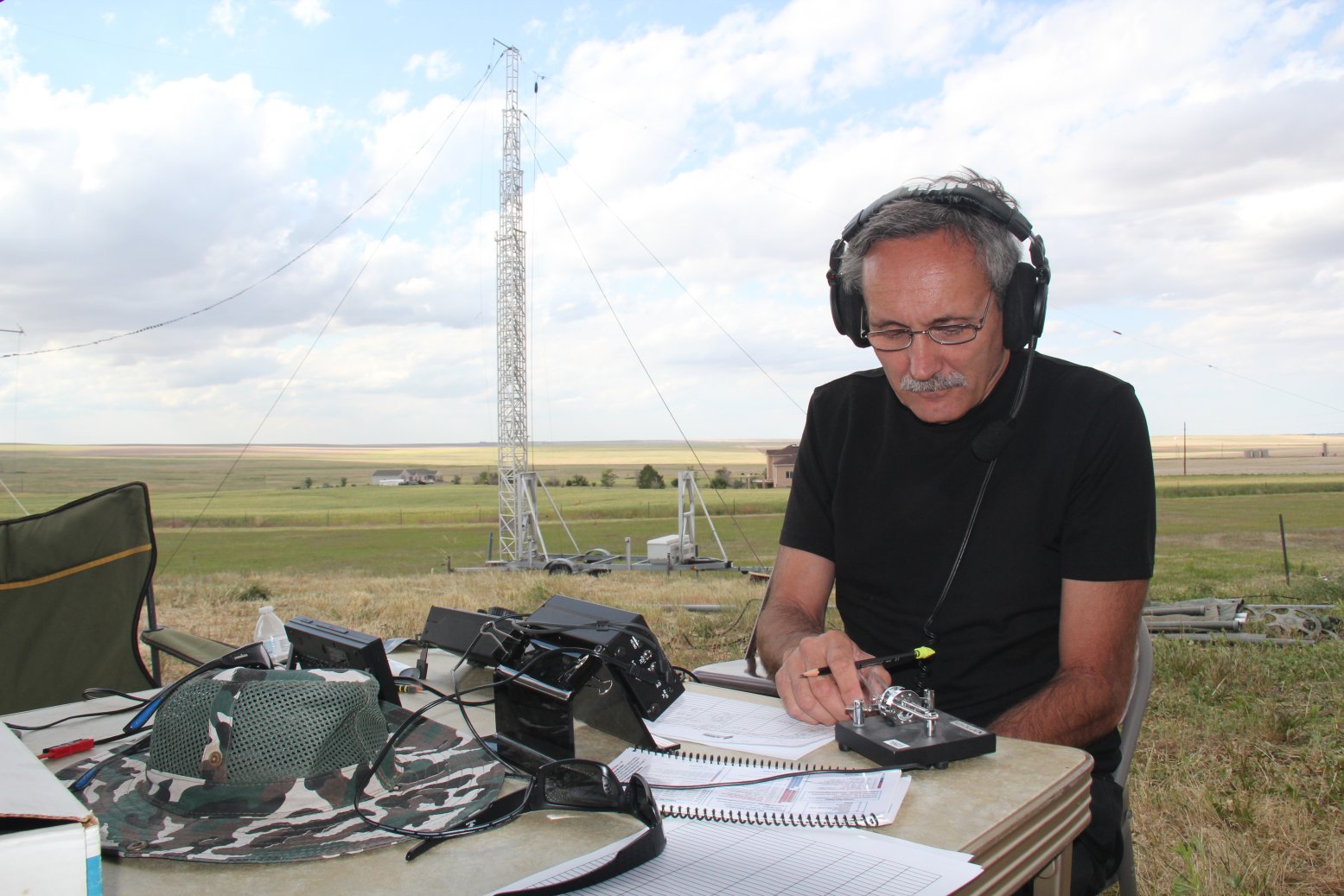
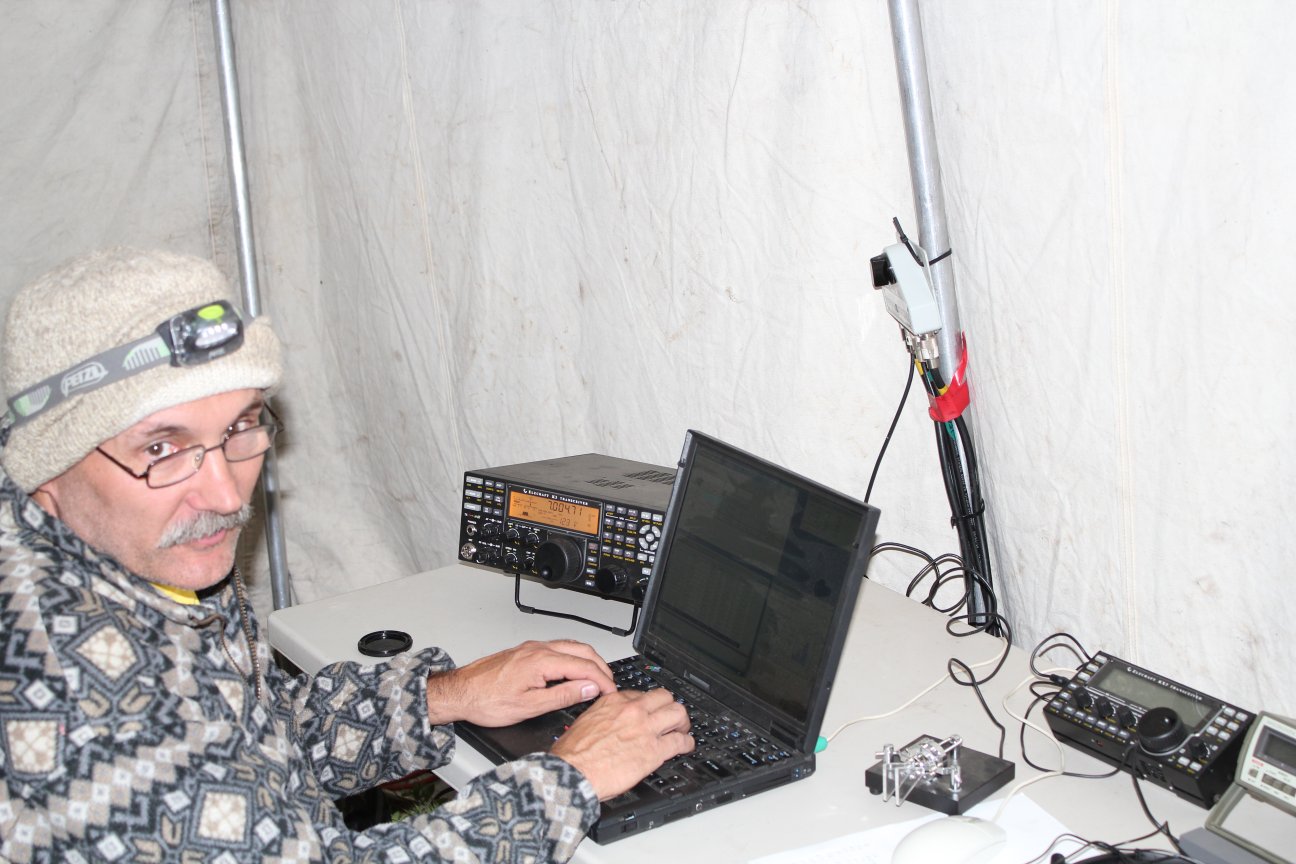
WBØJNR (me), operating Morse code at CQC's Field Day site at the Star Haven Observatory in Strasburg, Colorado.For regular operating, I am most active on the CW (Morse code) QRP calling frequencies of 14.060 and 28.060 MHz (even when they're "dead" at times). I usually limit myself to 100 milliwatts* (using an 88 foot doublet that's about 4.5 metres off the ground) but regularly work most parts of North America with it.
While at home, and sometimes on the road I monitor 146.52 MHz and 446.000 (FM) where I normally run 5 watts.
At home I use a Comet GP-9 Dual-Band VHF/UHF Base Vertical that's 27 feet (8.2 metres) off the ground on a push-up mast. Click Here for more about my station and Here for antennas...
I do allow myself "high power" (5 watts*) when I'm activating a summit for SOTA (Summits on the Air) or an entitiy for POTA (Parks on the Air). You can read a little bit more about my SOTA and POTA activations further down this page, suffice to say I am hooked on both!
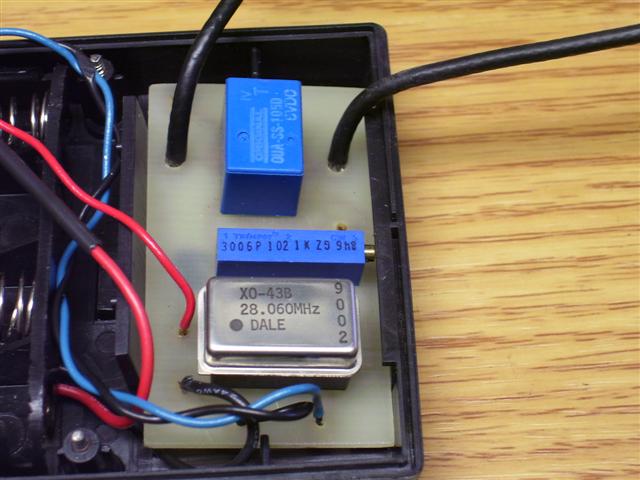
*I'm a stickler for RF output accuracy - I normally use a calibrated QRP wattmeter and, at times, double-check everything with an digital VOM/RF probe across a 50 ohm load. So, when you copy me saying that I'm running 100 milliwatts you can be assured that it's a pretty darn accurate figure!
|
|

|
Click Here for the International Morse code alphabet and phonetics |
|
|
Click Here for my tribute to Morse Telegraphy! |
|
|
Click Here for the QRP Calling Frequencies |
|
|
Click Here for an Extra Class lament! |
|
|
Click Here for "Q" and "Z" signals |
|
|
Click Here for the QRPp Award |
Amateur Radio
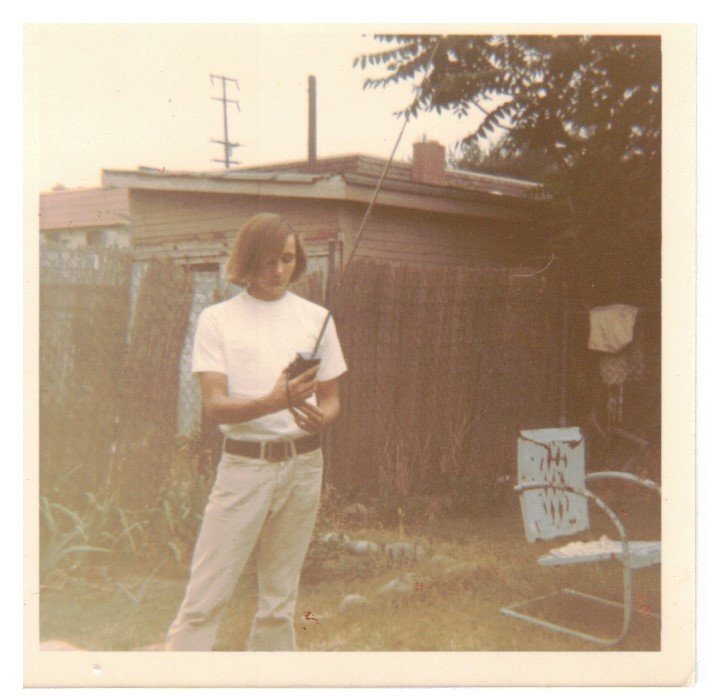
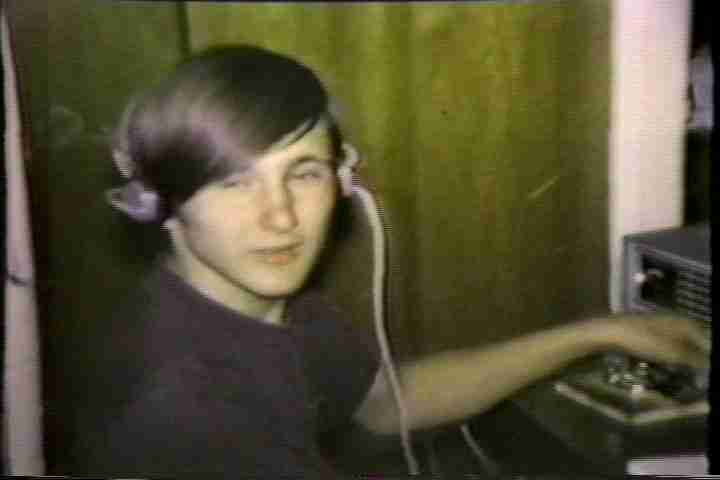
Me with a vintage 10 meter AM handheld at age 16First, a definition: Amateur radio, also known as "Ham" radio, is a radio electronics hobby (now including computers!) that's enjoyed by over a million people worldwide. Of these, a few hundred thousand are located in the United State where we often call ourselves "Ham operators" or simply "Hams." I'm not sure where the term "Ham" comes from but it probably has something to do with being on the air or "Hamming it up" in front of an audience - it's just my guess though because I've heard all kinds of explanations over the years...
Ham radio encompasses all kinds of communications techniques, antennas, and equipment. Although I, myself, love low power Morse code ("CW") amateur radio operators, in many situations, are authorized to transmit as much as 1,500 watts of output (PEP, or Peak Envelope Power). [Note that transmitter power must be the minimum necessary to carry out the desired communication...] But, not only can power output vary between operators but there are literally thousands of choices for antennas, transmitters, receivers, test equipment, Morse code keys/keyers, power supplies, and everything else associated with sending and receiving radio and video signals. (Yes, there's amateur radio television, too!) And, many ham operators are fond of designing and building their own equipment with their ideas and expertise often carried over into industry and the regular world!
Anyway, to become an amateur radio operator, or Ham, you must first pass an examination. The American Radio Relay League, here in the United States, can be contacted for all kinds of licensing and testing information at www.arrl.org. Ham operators use all kinds of equipment, antennas, and communications modes (FM, Single Sideband, Morse code, teletype, television, etc.) on a variety of frequencies throughout the radio spectrum. In addition to the millions of different frequencies at our disposal, we ham operators also use repeaters, our own satellites (see AMSAT), lasers, computer networks, and just about anything else that's available to experiment with!QRP, In Amateur "Ham" Radio, means to voluntarily limit your transmitter's output power to 5 watts or less (QRPp means one watt or less...). In a world of 50,000 watt AM broadcast stations and 1,000,000-watt digital TV transmitters why would anyone want to actually reduce their power output?
Well, for me, I reduce my power output nearly all of the time for the pure joy of it! Turning my power down adds to the challenge and requires a lot more skill, on both ends of the QSO (communications), to get the same results as those operators who run a lot more power. Also, I believe the idea of QRP is in keeping with an environmental ethic that helps reduce the already too heavy burden most of us are placing on mother Earth and her resources. If we all attempt a lot of simple things, to reduce the load a bit, a whole lot of benefit can be achieved that will improve the quality of life for not only us, but all of humankind in general! Oh, also, there is always a bit of a health risk when you're around any kind of radiation - that not only includes nuclear reactors and X-ray machines but radio waves and cell phones (I talk a lot about cellphone radiation on my Antennas page...). So, turning down your transmitter's power output is a good safety precaution even though amateur radio transmissions are nothing compared to a cellular tower or TV transmitter!
Finally, most people engaged in QRP seem, to me, to be more "in tune" with the experimenting and a sense of inquiry that was the foundation of amateur radio in its beginning (remember, back when radio was getting "off the ground," in the early 20th century, prefabricated store-bought equipment was unheard of!). That doesn't make low power operators any better or worse than anyone else - it just means they usually seem to have a greater sense of adventure and an interest in experimentation!
Anyway, as time permits I'll devote more time and space (on this page) to all things QRP!
72s!
72s!
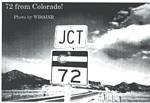
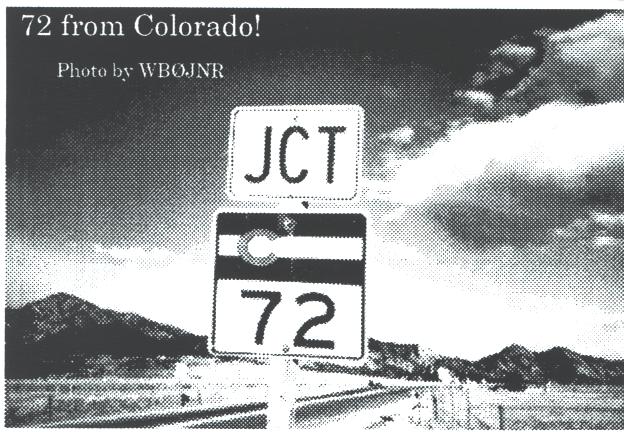
"72" is a form of radio shorthand that roughly translates as meaning "Best wishes QRP!" This is a scan from page 36 of the May, 1996 Low Down newsletter published by the Colorado QRP Club. I believe I took the photo, sometime earlier that year, while northbound on Highway 93 between Golden and Boulder, Colorado...
SOTA and POTA

Although I joined SOTA (Summits on the Air) in 2013, it wasn't until my retirement (mostly retired...) in late 2025 at the age of 70, that I activated my first summit! (under the tutelage of N5YCO). By year's end I had completed 21 activations, 3 of which were on peaks that had never been activated before! [Colorado's Unnamed 10055 (W0C/SP-105), Floyd Benchmark (W0C/PR-150), and JCMD 93 Benchmark (W0C/FR-200)]
For my first couple dozen activations I used a CTF1 xcvr (5 watts output, 3.5 watts output on 21 MHz) and an 66 foot/20 metre EFHW (End Fed Half Wave) antenna thrust into the air off of a 5.5 metre fishing pole and any nearby trees.
It was the last part of 2025, too, that I became active in POTA (Parks on the Air). By year's end I was able to activate Canyonlands National Park (US-0010) from the Needles District. I also activated the Pike and Roosevelt National Forests a couple of times.
SOTA and POTA have allowed me to pursue and combine my love of Morse code, hiking, mountaineering, and the outdoors. So, now I'm "hooked" and look forward to "hunting" and "activating" various peaks and parks for years to come!
Click Here to hear me working N5YCO while he was doing a winter activation on Barrian Mountain in Colorad, 01-30-2026

|
Hear the audio from my 100 mW CW QSO with AE5X in Houston, Texas |
Below are two audio recordings that were sent to me by AE5X (John) in Houston, Texas. John and I enjoyed a relatively long CW QSO at about 21:30 UTC on February 23, 2018. We were both on 14.060 CW with each of us using an Elecraft transceiver - his was a KX2 at 5 watts output and mine was a K2 initially set at 400 mW (when we first made contact) and then I turned mine down to 100 mW at his request. Band conditions were really good between his Houston location and my QTH near Golden, Colorado. His RST, at my location, was 589 with his first report to me, while I was running 400 mW, was 449. Thanks to improving band conditions (along with aiming his yagi in the direction of my QTH) he changed my report to 559 after I decreased my power output to 100 mW! In addition to the Elecraft's power output reading I also double-checked it with an HM-1 QRP wattmeter so am confident of these measurements. (At times I also double-check everything with an digital VOM/RF probe across a 50 ohm load) John's atenna was a yagi up 15 metres (50 feet) while mine was a 27 metre (88 foot) ladder-line fed doublet up 2.4 metres (8 feet) on one end of my property and 4.5 metres (15 feet) at the other end [My QTH is the side of a steeply sloping 2,089 metre (6,855 feet) "hill" near Golden, CO]. Using our locations and some internet distance calculations it turns out we were 1,403 kilometres (872 miles) apart for an 8,720 miles-per-watt QSO!
In 2015 I had the pleasure of accompanying the Kaul/Mitchler expedition for the first ascent up Agrigan Island in the Commonwealth of the Northern Marian Islands. In addition to the six climbers, there were five guys on the machete crew and another half dozen or so folks associated with the boat crew, Guam PBS, and Saipan radio station KKMP. Me, K3TM, and KD8USU (ROger and Clint Kaul, respectively) made up half the climbing team and brought along various two meter hand-helds and the KX3 transceiver you see in this video. WIth a somewhat limited time for operating we were were able to make a number of 15 meter CW contacts in addition to completing a number three-way two meter QSOs near the summit and crater rim. Amateur radio certainly added to our island adventure!
Homebrew
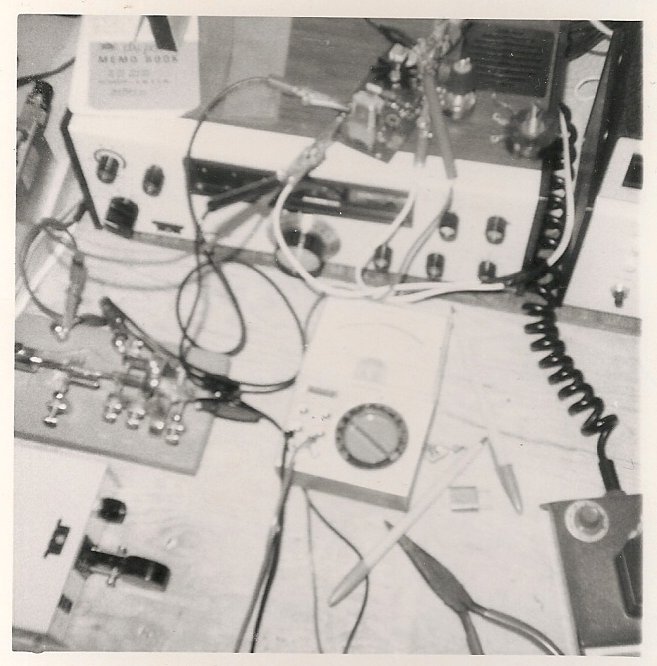
In January '75, shortly before going on active duty in the Coast Coast (I was still a teenager), I was trying to finish-up some QRP projets. This first photo is of a 40 meter transmitter strip that I was working on - notice the crystal and then the heat sink on the output transistor! Also, back then, I was fond of aligator clips and test leads for faster swaps between projects - even the Vibroplex was clipped into the circuit that way! In this photo you can also see the Ten Tec keyer and simple VOM I was using at the time.
High Altitude Marine Mobile QRP Record:
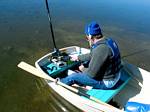
On August 14, 2004 fellow CQCer Jake Groenhof (NØ:LX) achieved what we believe to be an altitude record for QRP Marine Mobile! Click Here to get Jake's full story on running QRP Marine Mobile from a 13,800 foot lake just west of Denver on Mt Evans! Click Here for some shots of Jake, a few weeks later, as QRP bicycle mobile!
Low Power Long Distance Record:
According to Rich Arland, K7YHA (Now K7SZ), in World Radio Magazine (February 1990, Year 19, Issue 8, pp. 46-47) the long-distance low power record is held by KL7YU and W7BVV using one microwatt over a 1,650 mile Ten Meter path between Alaska and Oregon in 1970. This is the equivalent of 1.6 BILLION Miles per watt!!It's interesting to note that NASA's deep space missions typically achieve miles-per-watt ratings of over 500 million miles. One example was the 8-watt signal from Pioneer 10*. At a power level equal to that of a night light, the craft's signal traveled 11 billion km (6.8 billion miles) to Earth for a rating of 850 million miles per watt, or about half the KL7YU/W7BVV record...
*Launched on March 2, 1972 from Cape Kennedy aboard an Atlas Centaur rocket for a two-year mission to Jupiter. The probe is now about twice as far from the Sun as Pluto. At 13 km/s (28,000 miles per hour) it's heading in the general direction of the first magnitude star Aldebaran.
Braggin' Rights:
Who holds the Coast Guard's record for receiving Morse code? - ME!Coast Guard 40 wpm certificate.
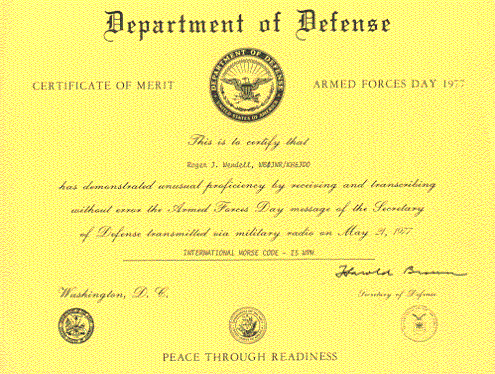
Armed Forces Day 25 wpm certificate.
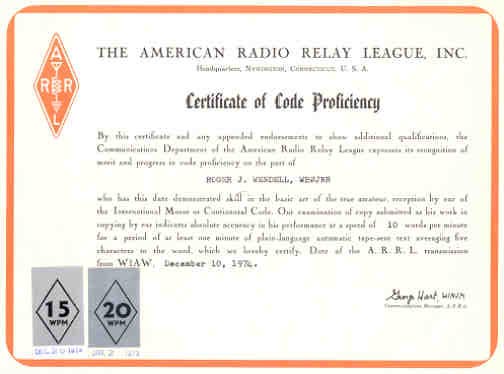
ARRL 20 wpm certificate.
Ex - WN6CDA, at age 14, 1970
Ex - KH6JDO, Wahiawa, Oahu 1976
Amateur Extra Class license since June 1982
General Radiotelephone license since August 1990
Restricted Radiotelephone Operator Permit since 1995
WN6CDA circa 1971
(I learned the code at age 14
by memorizing it out of a dictionary!)
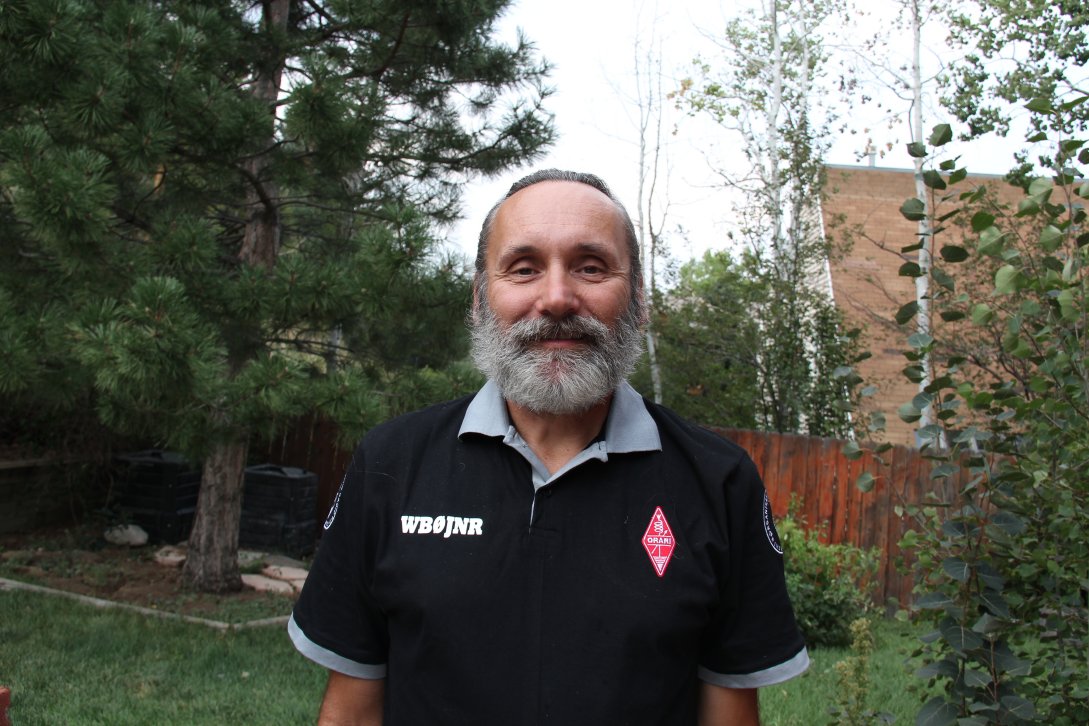
WBØJNR circa 2012
40 years later wearing an
ORARI (Indonesia) radio club shirt!Click on this hand key to hear real Morse code! (227k .wav file)
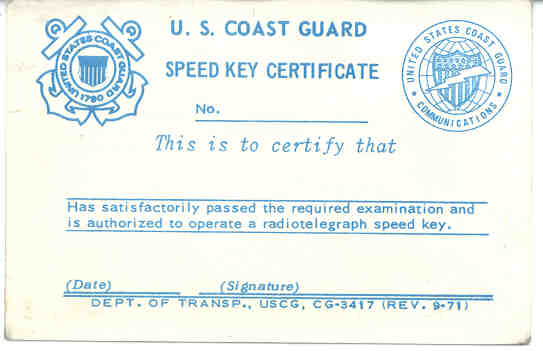
Coast Guard Speed Key Certificate Front
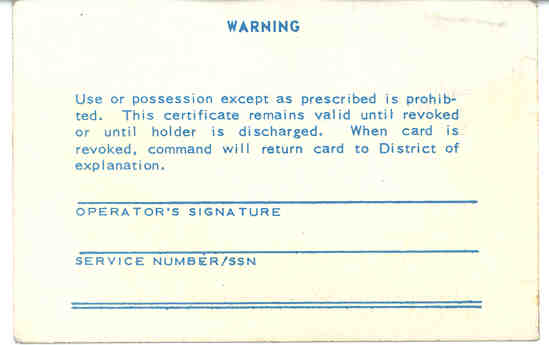
Coast Guard Speed Key Certificate Back
Beacons:
|
|
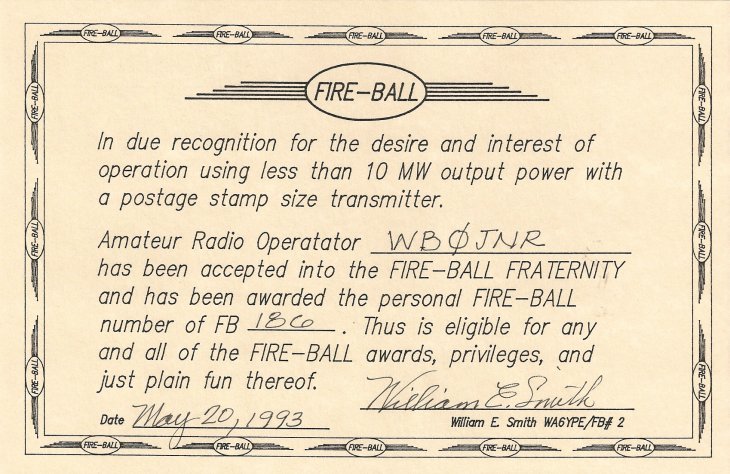
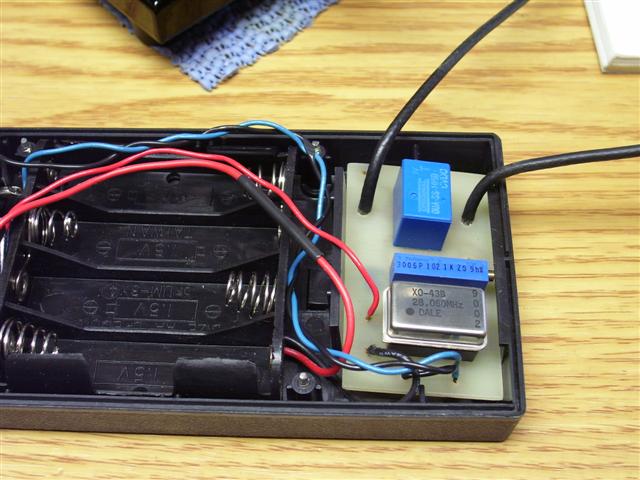
Fireball Fraternity (10 milliwatts!)

Photo permission WA6YPE
Photo permission WA6YPE
ARRL Field Day
WBØJNR (me), operating CW, at one-in-the-morning, at CQC's
8,000 foot (2,440 metres) Golden, Colorado Field Day site...
Each year the American Radio Relay League (ARRL) hosts amateur radio's most popular on-the-air event in the US and Canada. On the fourth weekend of June, more than 35,000 radio amateurs gather with their clubs, groups or simply with friends to operate from remote locations. Many participate for the fun of it while others do it as means to test their equipment and hone their skills for emergency preparedness. Whatever the reason, there's no doubt that Field Day is the most fun you can have on a June weekend - I look forward to it each year!
|
|
Audio from some of my Field Day announcements on radio station KGNU: |
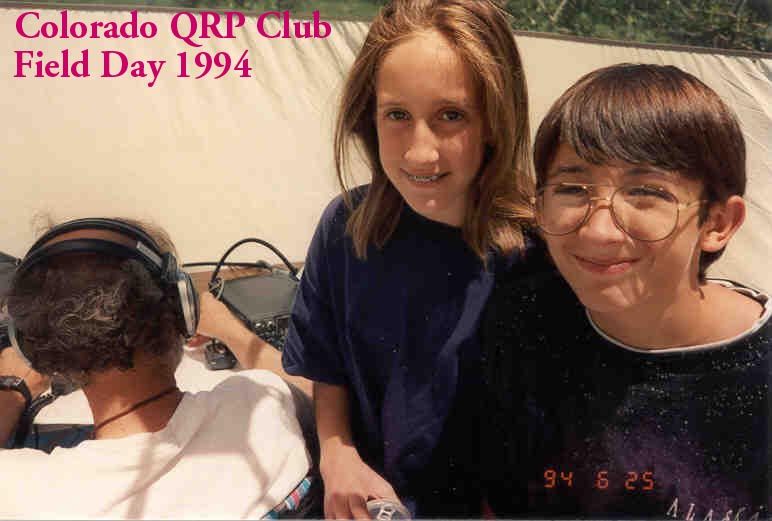
WØAH, Amber and KBØJFH
at CQC's first Field Day in 1994
|
Links:
|
|
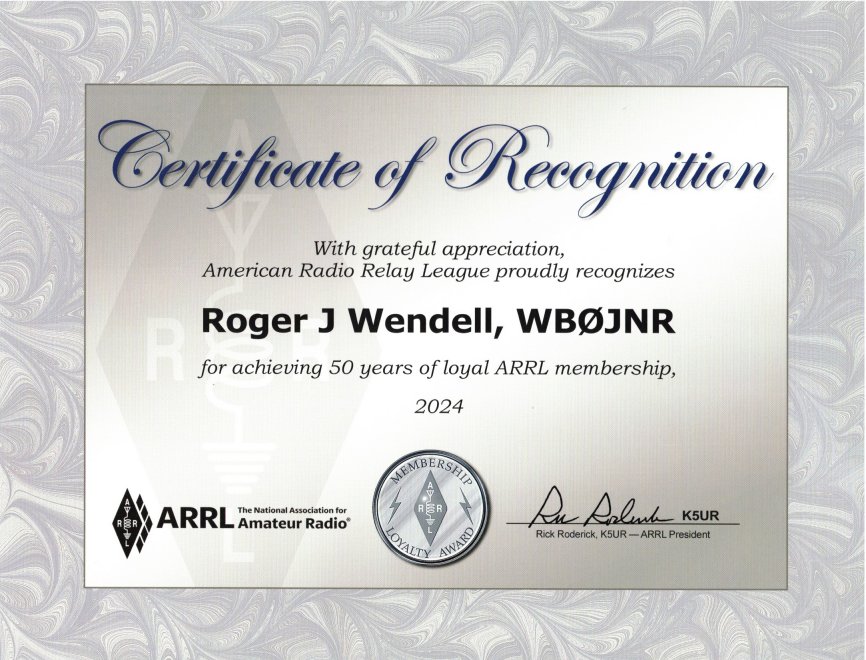
 Is your ARRL membership current? |
 QRPp-I Click on this handkey for the QRPp International club! |

|
 Click on this logo to visit a great QRP club! |
|
 Click on this logo to visit a great QRP resource! |
 Back to Roger J. Wendell's Home Page...

Abbey |
About |
Blog |
Contacting
Me |
Copyright |
Disclaimer |
Donate |
Guest
Book |
Home |
Links |
Site
Index |
Solutions |
Terms,
Conditions
and
Fair
Use |
What's
Changed
or
New?
Copyright
© 1955 -