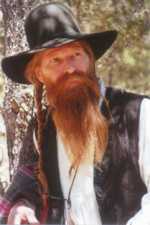
Roger J. Wendell
Defending 3.8 Billion Years of Organic EvolutionSM


Nature does matter!
"Deep Ecology" is a term that was introduced in 1973 by Norwegian philosopher and mountaineer Arne Naess. Although
there are no hard and fast Deep Ecology "rules," it is basically agreed that Deep Ecology is an ecological consciousness
based on some of the following:
- We have no right to destroy other living things without sufficient reason
- Minimization of personal property and possessions
- To lead a life that although not complex, is rich in positive experiences
- To walk softly, leaving as little impact as possible
- Emphasis always placed on the use of appropriate technology (non dominating science)
- Respect diversity
- Those who subscribe to the foregoing points have an obligation, directly or indirectly, to try and implement the necessary changes.
- Bill Devall and George Sessions in their 1985(!) book,
Deep Ecology (Living as if Nature Mattered), p. 127
Ahimsa is a principle that Jains teach and practice not only towards human beings but towards all nature.
It is an unequivocal teaching that is at once ancient and contemporary. The scriptures tell us (from BODHICITTA.NET):
Deep Ecology

Basically, Deep Ecology is a philosophy based on our sacred relationship with the Earth and all the creatures that inhabit it. In addition to being an international movement, Deep Ecology can also act as a path for self realization and a compass for daily action and living. Deep Ecology supports our continuing inquiry into the appropriate human roles on our planet and an analysis of unsustainable practices. A reduction of human population and consumption combined with conservation and the restoration of ecosystems play an important role in it as well. And, a life of committed action for the Earth will help realize progress towards these goals. In a way, Deep Ecology is a philosophy similar to what some Native Americans indirectly referred to as the Original Instructions. Although it would be presumptuous for me to attempt a description of the Original Instructions I believe I could safely summarize them by saying that they are not ideas like the Ten Commandments or our own Constitution - they are natural law, reality, or the way things are. They can't be understood in words other than to say that they are the relationship that we, and all living creatures, have with creation. Giving appreciation, thankfulness and a positive attitude towards the community of life are part of our Original Instructions and can be applied towards Deep Ecology.
"Koyaanisqatsi," in the Hopi language, describes a Native American concept for life out of balance (It's also a 1983 film that has similar meaning...). The opposite, "hozho nahasdlii" (harmony restored), is my own hope and prayer for what we've done to this beautiful little planet.
Related to this, in the book Ecological Medicine, Kenny Ausubel says, "I think that to restore our personal and collective sanity we need to get back on track, to rediscover a universe of living beings intimately related: the biosphere as our family. This family has values: respect for life, harmony with nature's cycles, gratitude, balance, and above all, reciprocity - don't take anything without giving something back." I [Roger Wendell] agree with Ausubel but believe there are even greater reasons for implementing the ideals of Deep Ecology than just restoring our collective sanity. It's clear that Nature and the natural world have a simple right to exist in as pristine and natural state as possible for no other reason than it's part of creation and doesn't need to justify its existence to humanity. Other living beings and systems have a right to be here - and we have no right to disrupt or destroy them without sufficient reason...
Deep Ecology in Music
|
The howl of the wolf is the soundtrack of wilderness And wilderness, the ferment of the soul Primal humans knew what modern humanity has forgotten, that life is balance The world endlessly consuming itself and joyously making love to itself through its constituent parts Every species equal, with an inherent, intrinsic value sacred worth, sacred worth Civilization is a mere 16,000 year imbalance after the shared adventure of three and a half billion years of ecstatic evolution Now called Deep Ecology, this sacred worldview was the life and practice of all primitive peoples and it will be the worldview once again of any peoples to survive the Earth's cataclysmic cleansing
- Lone Wolf Circles |
|
Deep Ecology is defined as:
End of the Wild
In a Domesticated World, Human Choices Will Determine Nature's Future
"Just about every place on Earth has been altered in some way by human actions, according to a new study in the journal Science by Nature Conservancy researchers. The study finds that half of the world's lands are now tilled or grazed, more than 50 percent of forests have been felled, and even the most wild places show traces of human handiwork."The Nature Conservancy
Deep Ecology, Earth First! and Anarchism
by David Orton
Earth First! Journal Lugnasadh (August/September) 2001, p. 18
"Deep ecology provides us with a non-human-centered philosophical relationship to the natural world. This is an interdependence of humans with other life forms, on a basis of equality, with all of Nature - humans are not set apart from Nature. According to deep ecology, the further people are removed from Nature, the more that humans value themselves, the more Nature is devalued and treated as nothing but a commodity. Deep ecology says that through a fundamental revolution in consciousness, we can change existing human relationships of attempted dominance over the natural environment. This is deep ecology's profound and unique contribution to our time, but the most appropriate social, political, cultural and economic relationships for such a world are yet to be determined."
More Quotes:
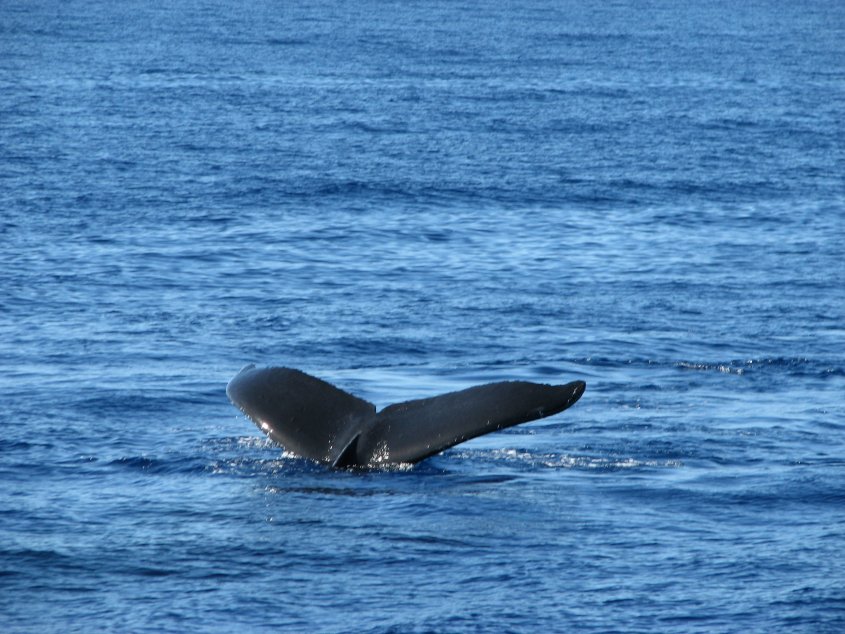
Humpback Whale, Auau Channel
- Arne Naess, as quoted from an interview at the Los Angeles Zen center, April 1982
- Aldo Leopold, 1953
- part of the World Charter for Nature, as adopted by the United Nations General Assembly, October 1982.
- His Holiness, The Dalai Lama, in his book An Open Heart (Chapter 7, "Compassion")
- Dr. Albert Schweitzer, from the book The Animal World of Albert Schweitzer edited by Charles Joy.
- Dan Brown, from his book The Da Vinci Code, pp. 125-126
- John Johnson, EF! Journal, Samhain/Yule 2005 (25th Anniversary Edition) p. 43 - Do We Know Where Our Deep Ecology Is?
Recommended Reading:
Deep Ecology
(Living as if Nature Mattered)
- Bill Devall and George SessionsDeep Ecology for the Twenty-First Century
- edited by George SessionsDiscussion Course on Deep Ecology
- Northwest Earth InstitueThinking Like a Mountain
(Towards a council of all beings)
- John Seed, Joanna Macy, Pat Fleming, and Arne Naess
Miscellaneous Definitions:
- Gaia Hypothesis - An ecological hypothesis that proposes that the biosphere and the physical components of the Earth (atmosphere, cryosphere, hydrosphere and lithosphere) are coupled together to form a complex interacting system. This system is proposed to act in a homeostatic fashion that preserves climatic and biogeochemical conditions on Earth that are suitable for living organisms. Named after the Greek Titan of the earth, the hypothesis is frequently described as viewing the Earth as a single organism.
- Precautionary Principle - "In order to protect the environment, the precautionary approach shall be widely applied by States according to their capabilities. Where there are threats of serious or irreversible damage, lack of full scientific certainty shall not be used as a reason for postponing cost-effective measures to prevent environmental degradation. [Article 15 of the Rio declaration of 1992]
Here is a large portion of the Cathedral Forest Wilderness Declaration:
(The Cathedral Forest Action Group was formed in 1984 to take a stand in protecting
80,000 acres of forest wilderness in central Oregon's Cascade mountains...)
"We belive that all things are connected, that whatever we do to the Earth, we do to ourselves. If we destroy our remaining wild places, we will ultimately destroy our identity with the Earth: wilderness has values for humankind which no scientist can synthesize, no economist can price, and no technological distraction can replace."We believe that we should protect in perpetuity these wild places, not only for our own sake, but for the sake of the plants and animals for the good of the sustaining Earth. The forests, like us, are living things: wilderness should exist intact solely for its own sake; no human justification, rationale, or excuse is needed.
"We perceive the Earth is dying. We pledge ourselves to turning this process around, to stopping the destruction, so that the Earth can become alive, clean, and healthy once again."
(from page 196 of Deep Ecology)
Other Related Thoughts:
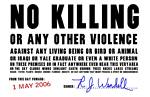
- A Short Dance published in the Fall, 1992 edition of the Garden Doctor
and a number of other publications around that time period as well...
- Stop Hunting for sport and pleasure.
- Respecting Insects as well!
"I was in Nature and I felt good. I didn't know if it was funny or sad that human beings have evolved incorrectly for so long that we have reached the point where most people are afraid to be out in Nature. In fact, we are more comfortable; watching Nature on TV, walking around malls instead of forests, listening to stereos instead of birds, smelling perfume instead of flowers, wasting time on computers instead of watching a sunset. And I can't for the life of me figure out why!"
Deep Ecology
Earth First! Journal
Yule Edition, December 1987
The central insight of John Muir and of the science of ecology was the realization that all things are connected, related; that humyn beings are merely one of the millions of species that have been shaped by the process of evolution for three-and-a-half billion years.With that understanding, we can answer the question, "Why Wilderness?"
Is it because wilderness makes pretty picture postcards? Because it protects watersheds for downstream use by agriculture, industry and homes? Because it's a good place to clean the cobwebs out of our heads after a long week in the auto factory or over the video display terminal? Because it preserves resource extraction opportunities for future generations of humyns? Because some unknown plant living in the wilds may hold a cure for cancer?
No. because wilderness is. Because it is the real world, the flow of life, the process of evolution, the repository of that three-and-a-half billion years of shared travel.
All natural things have intrinsic value, inherent worth. Their value is not determined by what they will ring up on the cash register of the Gross National Product, not by whether or not they are good. They are. They exist for their own sake, without consideration for any real or imagined value to humyn civilization.
Even more important than the individual wild creature is the wild community - the wilderness, co-evolution, the stream of life unimpeded by industrial interference or humyn manipulation.
These twin themes of interconnectedness and intrinsic value form the core of the ideas of such pioneer ecological thinkers as John Muir, Aldo Leopold and Rachel Carson, and are the basis for action by Earth First!ers. This biocentric worldview, as opposed to the anthropocentric paradigm of civilization (and the reformist position of mainstream environmental groups), has been recently developed into the philosophy of Deep Ecology by philosophers such as Arne Naess of Norway, John Seed of Australia, Alan Drengson of Canada, and George Sessions and Bill Devall of the United States, among others.
Naess and Sessions elaborated on the basic principals of Deep Ecology:
- The well-being and flourishing of humyn and non-humyn life on Earth have value in themselves (synonyms: intrinsic value, inherent value). These values are independent of the usefulness of the non-humyn world for humyn purposes.
- Richness and diversity of life forms contribute to the realization of these values and are also values in themselves.
- Humyns have no right to reduce this richness and diversity except to satisfy vital needs.
- The flourishing of humyn life and cultures is compatible with a substantial decrease of the humyn population. The flourishing of non-humyn life requires such a decrease.
- Present humyn interference with the non-humyn world is excessive, and the situation is rapidly worsening.
- Policies must therefore be changed. These policies effect basic economic, technological, and ideological structures. The resulting state of affairs will be deeply different from the present.
- The ideological change is mainly that of appreciating life quality (dwelling in situations of inherent value) rather than adhering to an increasingly higher standard of living. There will be a profound awareness of the difference between big and great.
- Those who subscribe to the foregoing points have an obligation directly or indirectly to try to implement the necessary changes. (From the book, Deep Ecology - Living As If Nature Mattered, by Bill Devall and George Sessions and available through Earth First! Books.)
Earth First!, therefore, does not operate from a basis of political pragmatism, or what is perceived to be "possible," Wilderness, natural diversity, is not something that can be compromised in the political area. We are unapologetic advocates for the natural world, for Earth.
Devoted though we must be to the conservation cause, I do not believe that any of us should give it all of our time or effort or heart. Give what you can, but do not burn yourselves out -- or break your hearts. Let us save at least half of our lives for the enjoyment of this wonderful world which still exists. Leave your dens, abandon your cars and walk out into the great mountains, the deserts, the forests, the seashores. Those treasures still belong to all of us. Enjoy them to the full, stretch your legs, expand your lungs, enliven your hearts -- and we will outlive the greedy swine who want to destroy it all in the name of what they call GROWTH.
God bless America -- let's save some of it.
Long live the weeds and the wilderness yet!
Links:
|
 Back to Roger J. Wendell's Home Page...

Abbey |
About |
Blog |
Contacting
Me |
Copyright |
Disclaimer |
Donate |
Guest
Book |
Home |
Links |
Site
Index |
Solutions |
Terms,
Conditions
and
Fair
Use |
What's
Changed
or
New?
Copyright
© 1955 -