Roger J. Wendell
Defending 3.8 Billion Years of Organic EvolutionSM


|
Creation TheoriesWhere did it all begin? |
I don't have all of the answers. Nevertheless, questions about our origins are both interesting and important - certainly worth some attention. Admittedly, the universe can be a big and scary place. Still, that's no reason to fool ourselves with any old story that happens to make us feel good. So, the idea here is to present theories, on the origins of everything, that are based on thought and reason. And, please remember that it's okay if some theories are incomplete or don't match others - that's the nature of inquiry while we seek truth.*
|
So, I welcome your suggestions and constructive contributions. Although this page is not meant to disparage anybody's religion or belief system we must remember to avoid displaying unsubstantiated stories - no matter how ancient or ingrained they are in one's culture. Again, the best presentations are those backed by thoughtful research and consideration...
Oh yes, I also want to mention that this page stands alone on its own. That means that it is not connected to any
particular group, organization, web page or server. Wherever you happen to find it on the web (it's been floating
around from one server to another since early 1999) is because the price was right! [Note: as of the early 2000s this page actually resided on my own server after having been on Geocities and other free sites...]
|
*Columbia University professor of physics Brian Greene, in his book The Elegant Universe, put it this way; "Progress in science proceeds in fits and starts. Some periods are filled with great breakthroughts; at other times researchers experience dry spells."

|
Click Here for reader comments... |
|
|
Click Here for my page on Evolution... |
|
|
Click Here for my page on Cosmology... |
Bondi:
"First we are all struck with awe and wonder when we contemplate
the universe around us, whether we think of the depths of space in astronomy,
or of the incredible complexity of even the simplest forms of life, or of the
structure of mountains, or of ecology, or of the intricate web of human relationships.
Anyone not so impressed must be very insensitive."
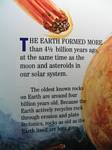
Denver Museum of Nature and Science:
(I found this on display during a January 2002 visit)
"The proper scene for the slow brewing of life from non-life was the early Earth.
The Earth's conditions favored certain chemical combinations over others, and with the
passage of time a direction was set."
- Lynn Margulis and Dorion Sagan, 1993
"If string theory is right, the microscopic fabric of our universe is a richly intertwined multidimensional labyrinth within which the strings of the universe endlessly twist and vibrate, rhytmically beating out the laws of the cosmos. Far from being accidental details, the properties of nature's basic building blocks are deeply entwined witht he fabric of space and time."
- Brian Greene, in his 1999 book The Elegant Universe
"The earth was initially very hot and without an atmosphere. In the course of time it cooled and acquired an atmosphere from the emission of gases from the rocks. This early atmosphere was not one in which we could have survived. It contained no oxygen, but a lot of other gases that are poisonous to us, such as hydrogen sulfide (the gas that gives rotten eggs their smell)."There are, however, other primitive forms of life that can flourish under such conditions. It is thought that they developed in the oceans, possibly as a result of chance combinations of atoms into large structures, called macromolecules, which were capable of assembling other atoms in the ocean into similar structures. They would thus have reproduced themselves and multiplied.
"In some cases there would be errors in the reproduction. Mostly these errors would have been such that the new macromolecule could not reproduce itself and eventually would have been destroyed. However, a few of the errors would have produced new macromolecules that were even better at reproducing themselves. They would have therefore had an advantage and would have tended to replace the original macromolecules.
"In this way a process of evolution was started that led to the development of more and more complicated, self-reproducing organisms. The first primitive forms of life consumed various materials, including hydrogen sulfide, and released oxygen. This gradually changed the atmosphere to the composition that it has today and allowed the development of higher forms of life such as fish, reptiles, mammals, and ultimately the human race."
- Summarized from Stephen W. Hawking's 1988 book; A Brief History of Time
"As a teenager reading African parasitology books in the medical library, I was boggled by the array of creatures equipped to take root upon a human body. I'm boggled still, but with a finer appreciation for the patnership. Back then I was still a bit appalled that God would set down his barefoot boy and girl dollies into an Edan where, presumably, He had just turned loose elephantiasis and microbes that eat the human cornea. Now I understand, God is not just rooting for the dollies. We and our vermin all blossomed together out of the same humid soil in the Great Rift Valley, and so far no one is really winning. Five million years is a long partnership."
- From Barbara Kingsolver's Novel; The Poisonwood Bible
"Everything about the origin of life on Earth is a mystery, and it seems the more that is known, the more complex the puzzle gets.
The dates have become increasingly awkward. Instead of there being a billion or so years for the first cells to emerge from a warm broth of chemicals, life seems to pop up almost instantly after the last of the titanic asteroid impacts that routinely sterilized the infant planet. The discovery last month of microbes that lived near volcanic vents formed 3.2 billion years ago confirms that heat-loving organizsms were among earth's earliest inhabitants."
- Nicholas Wade, Puzzle Deepens on Life's Origins, Gene evidence recasting theories (July 2000)
"We must question the story logic of having an all-knowing all-powerful God, who creates faulty Humans, and then blames them for his own mistakes."
- Gene Roddenberry
"It is far better to grasp the universe as it really is than to persist in delusion, however satisfying and reassuring."
- Carl Sagan
|
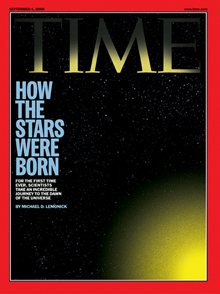
"The current record for distance, held by Japan's Subaru telescope, is for a galaxy whose light started its journey to Earth a billion years or so after the Big Bang. But Ellis suspects he has found not one but six galaxies from an astonishing half a billion years earlier still.
"A discovery like that would give astrophysicists their first real glimpse into a crucial and mysterious era in the evolution of the cosmos. Known as the Dark Ages of the universe, it's the 200 million-year period (more or less) after the last flash of light from the Big Bang faded and the first blush of sun-like stars began to appear. "What happened during the Dark Ages set the stage for the cosmos we see today, with its billions of magnificent galaxies and everything that they contain -- the shimmering gas clouds, the fiery stars, the tiny planets, the mammoth black holes. "When the Dark Ages began, the cosmos was a formless sea of particles; by the time it ended, just a couple hundred million years later, the universe was alight with young stars gathered into nascent galaxies. "It was during the Dark Ages that the chemical elements we know so well -- carbon, oxygen, nitrogen and most of the rest -- were first forged out of primordial hydrogen and helium. And it was during this time that the great structures of the modern universe -- superclusters of thousands of galaxies stretching across millions of light-years -- began to assemble."
|
"They weighed no more than a handful of peanuts, had large, saucer-like eyes and flitted about the treetops of humid Asian rain forests on feet no bigger than rice grains. Shy nocturnal creatures, they snapped up insects and nectar as quickly as their tiny bodies could digest them, all the while trying to avoid becoming a meal themselves for nightly predators such as owls."
- Alice Park on Eosimias, a 45 million -year-old fossil primate that may be the common ancestor to monkeys, apes and humans (Time Magazine, March 27, 2000 - page 84)
"For naturalism, fed on recent cosmological speculations, mankind is in a position similar to that of a set of people living on a frozen lake, surrounded by cliffs over which there is no escape, yet knowing that little by little the ice is melting, and the inevitable day drawing near when the last film of it will disappear, and to be drowned ignominiously will be the human creature's portion. The merrier the skating, the warmer and more sparkling the sun by day, and the ruddier the bonfires at night, the more poignant the sadness with which one must take in the meaning of the total situation."
- William James The Varieties of Religious Experience, p. 159
"There was never a Garden of Eden in the Mesoamerican worldview. The first people, molded out of ground maize dough, never sinned, they never fell from grace. They were, instead, the most recent efforts by the gods to create creatures to speak and pray to them and honor them through sacrificial offerings. In return, the people of maize would be fed and, as the Aztecs thought, given the gift of laughter and sleep "so that [they] would not die of sadness' (Sahagun 1950-82, 6:93)."The gods previously had tried to create appropriate earthly companions, They had always been disappointed, however, by the inability of these earlier races to nourish them through prayers and offerings and, at times, by their overweening arrogance. So the gods had destroyed their own creations. According to the Aztecs, the very first creatures were giants that the gods had devoured by fierce jaguars; the most recent were transformed into fish when floods destroyed the mountains and the sky crashed to the earth.
"According to the Maya Popol Vuh, the gods continually tried to create a more perfect world, looking for a race that could speak in order to pray, that could remember the gods in order to be thankful. After their previous attempts (four for the Aztecs; three for the Maya), the gods finally created this one, the world of the true Sun and Moon, of maize and humans.
"Lifting the sky from the sea, where it had crashed in the floods, and naming the mountains and caves and places of the land, they created the middle world of earthlings. The world of the maize people was ordered into four directions and centered by the world tree that reached into the earthly underworld with its roots and raised up to the heavens with its branches. For all Mesoamericans this world was created through the ultimate self-sacrifice of the gods. To create the Sun and Moon, two Aztec gods had thrown themselves onto a raging fire; and Maya ancestral deities had entered the Underworld where they were defeated and decapitated in a game of hipball by the gods of death and disease. Eternal night was banished, and the world was ordered and perfected for humans only through the blood sacrifices of the central Mexican god Quetzalcoatl ('feathered serpent') and the Maya hero twins, all of whom traveled to the Underworld to find the skulls and bones of their ancestors in order that they could magically reborn in the sky. It was from these sacrifices that maize sprouted and the primordial ancestors ground the kernels to shape the first humans out of cornmeal."
"THREE BILLION years ago the land was virtually devoid of life. More than that, it was uninhabitable. No ozone layer existed in the stratosphere, and the progenitor molecules of oxygen in the air below were too thin to create it. Short-length ultraviolet radiation traveled unimpeded to the earth and beat down on the dry basaltic rocks. It assaulted organisms venturing there out of the sea, shutting down their enzymatic synthesis, opening their membranes to ambient poisons, and rupturing their cells. But in the water, safe from the lethal rays, microscopic organisms swarmed. They were close to modern cyanobacteeria (sometimes called blue-green algae) and a mélange of bacteria and bacteria-like species. Most were single-celled and prokaryotic, and a few were composed of cells strung together in filaments. These simple organisms were devoid of nuclear membranes, mitochondria, chloroplasts, and the other organelles that give structural complexity to the cells of higher plants and animals.""A large portion of the early life forms were concentrated in thin scummy sheets called microbial mats. Under the mats they built up distinctive rock formations called stromatolites, resembling stacks of mattresses (stroma, mattress) strewn about the shallow sea bottoms like packages on a warehouse floor. Modern versions of these organism-topped rocks still grow in subtidal marine waters in a few scattered localities such as Baja California and northwestern Australia."
"Imagine yourself back more than 4.5 billion years in time to the newly minted black surface of that Hadean Earth. You could not have survived long in the harsh, alien landscape. Meteors incessantly bombard the surface, cracking the thin brittle black crust, showering shattered rock and gobs of magma across the plains. Countless volcanic cones rise, growing steadily to heights of many thousands of feet, their immense magma fountains powered by the explosive release of steam and other volatiles that will, some fine day, cool enough to become the oceans and atmosphere. No trace of life-supporting oxygen is to be found. On this unforgiving young Earth, your nostrils are assaulted by the foul-smelling sulfurous compounds, your skin scalded by venting steam, your eyes burned by the noxious hot gases. Your exruciating death agonies will be brief on such a hostile world."
- Robert M. Hazen
The Story of Earth
(The FIrst 4.5 Billion Years, From
Stardust to Living Planet), p. 74
Links:
 Back to Roger J. Wendell's Home Page...

Abbey |
About |
Blog |
Contacting
Me |
Copyright |
Disclaimer |
Donate |
Guest
Book |
Home |
Links |
Site
Index |
Solutions |
Terms,
Conditions
and
Fair
Use |
What's
Changed
or
New?
Copyright
© 1955 -