Roger J. Wendell
Defending 3.8 Billion Years of Organic EvolutionSM

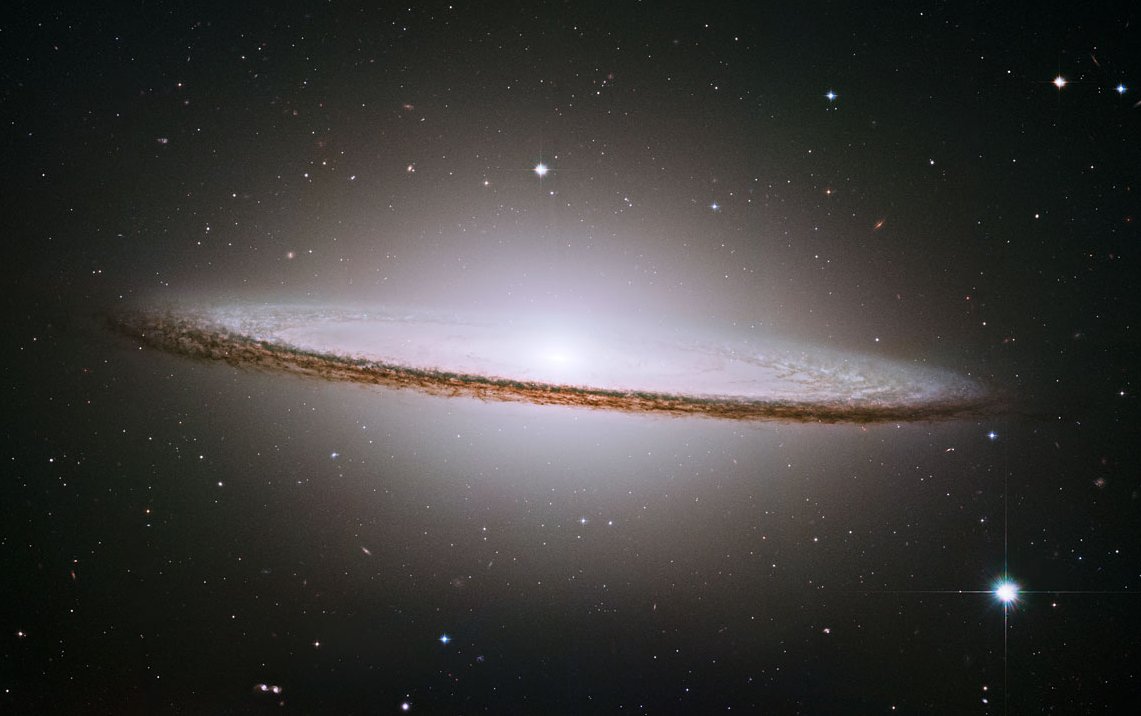
Sombrero Galaxy (Messier 104) by NASA/ESAMy page on astronomy, SETI, and the
study of the Universe in its totality...(See also my pages on Science, Biology, Evolution, and Time)
"The size and age of the Cosmos are beyond ordinary human understanding. Lost somewhere between immensity and eternity is our tiny planetary home. In a cosmic perspective, most human concerns seem insignificant, even petty. And yet our species is young and curious and brave and shows much promise. In the last few millennia we have made the most astonishing and unexpected discoveries about the Cosmos and our place within it, explorations that are exhilarating to consider. They remind us that humans have evolved to wonder, that understanding is a joy, that knowledge is prerequisite to survival. I believe our future depends on how well we know this Cosmos in which we float like a mote of dust in the morning sky."
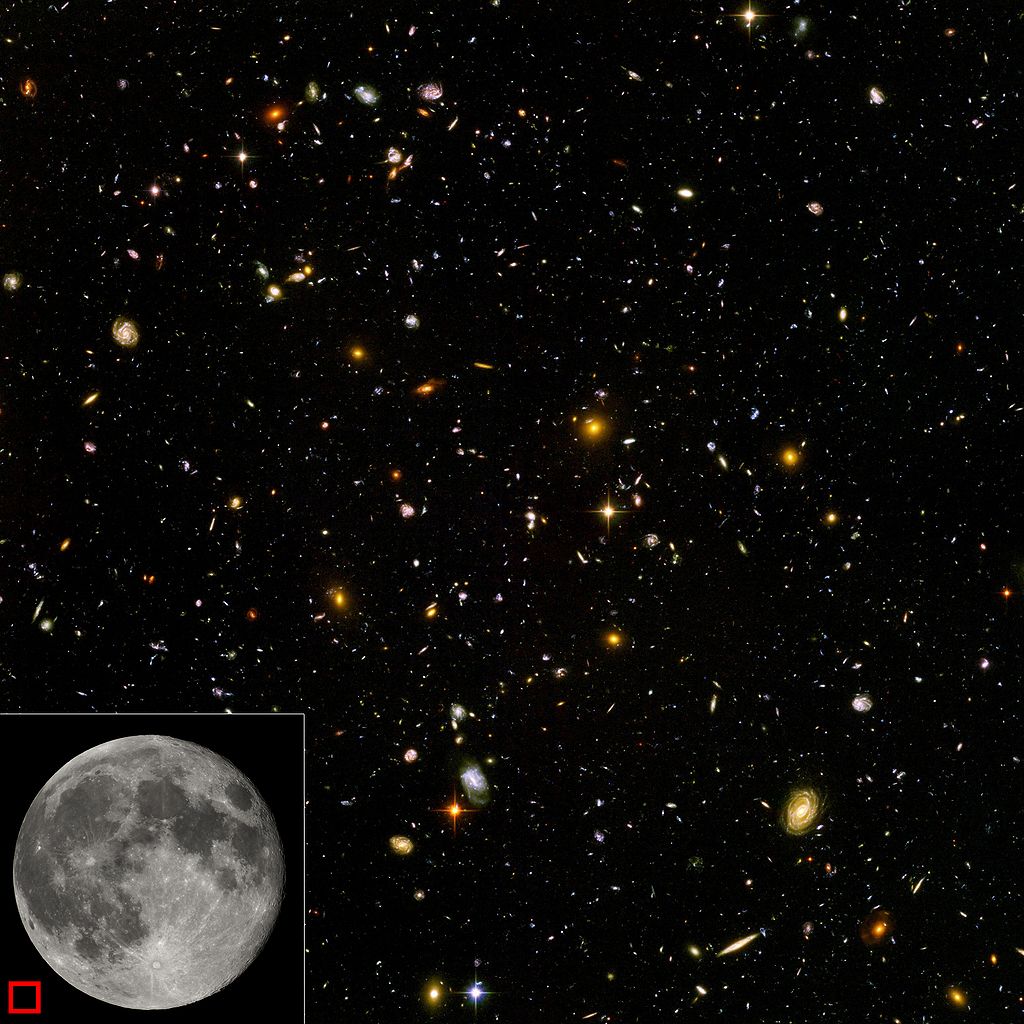
Hubble Ultra Deep Field Image
Photo credit:
NASA, Space Telescope Science Institute, and the European Space AgencyHubble Ultra-Deep Field image of a region of the observable universe (equivalent sky area size shown in bottom left corner), near the constellation Fornax. Each spot is a galaxy, consisting of billions of stars. The light from the smallest, most redshifted galaxies originated nearly 13.8 billion years ago.
- Most galaxies are receding away from us faster than the speed of light, making them permanently unreachable.
- Even if we could travel at light speed, we could never get to them.
- The relentless cosmic expansion, driven by dark energy, ensures that any galaxy beyond 18 billion light-years is forever beyond our reach. As time passes, only a tiny fraction of the universe's galaxies - about 6 percent - will remain accessible to us.
- Every year, an estimated 160 billion stars vanish from potential exploration as they drift past this cosmic event horizon.
- In the far future, only the Local Group - a small cluster of galaxies including the Milky Way - will be within our reach. The idea of intergalactic travel may seem thrilling, but the universe itself is shutting the door on most of its wonders. Our cosmic neighborhood is getting lonelier, reminding us just how fleeting our window into the universe truly is.
Gravity Waves Detected
South Pole, Antarctica
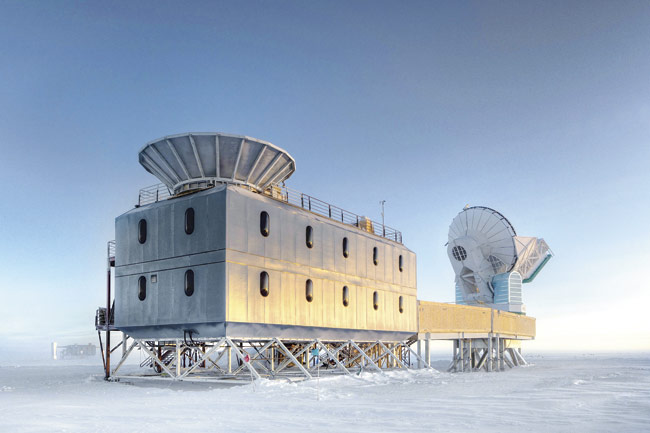
The discovery was made using the Background Imaging of Cosmic Extragalactic Polarization (BICEP2) and the results were presented by the team leader Dr. John Kovac. This announcement came near the 50 anniversary of the discovery of the Cosmic Microwave Background (CMB) itself...
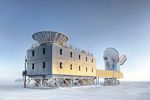
In early 2014 it was believed gravity waves (or ripples in space-time), remnants from the earliest moments of the "Big Bang," had been indirectly detected by the Dark Sector Laboratory at the South Pole. Researchers at the Harvard-Smithsonian Centre for Astrophysics were confident enough to go public with their findings although more verification may be needed - I'll update this entry as more of this tantilizing information becomes avaialble!
Gran Telescopio Milimétrico
(Large Millimeter Telescope)
Volcán Sierra Negra, México
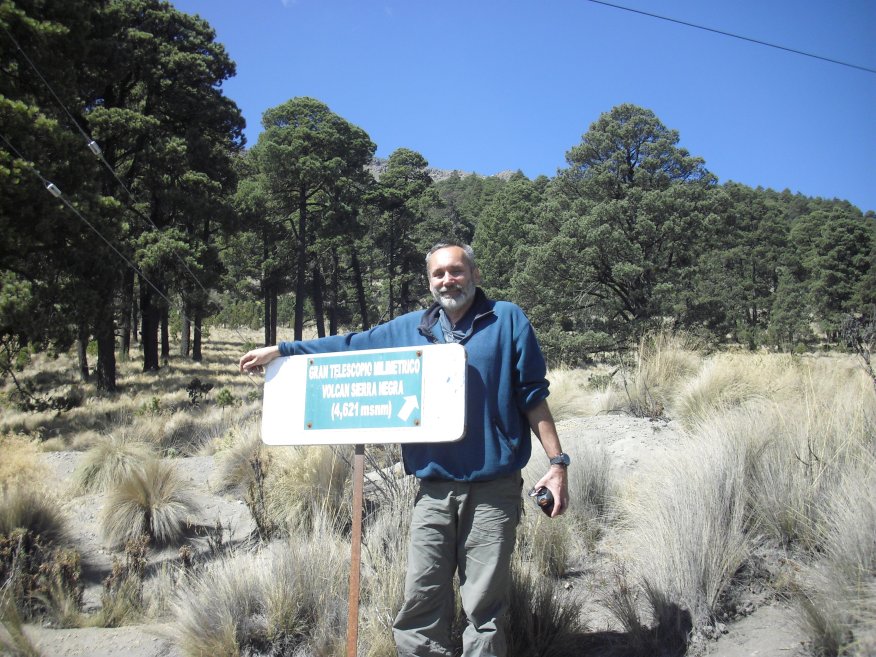
Me at the park entranceIn March of 2014 I had the good fortune of hiking the 600 metres (nearly 2,000 feet) up the telescope access road to the top of the Sierra Negra volcanoe (4,640 metres / 15,260 feet). It was with the telescope personnel's permission that I was able to get to the very highest point of rock adjacent the telescope itself. The Large Millimeter Telescope (or Gran Telescopio Milimétrico) is the world's largest single-dish steerable millimetre-wavelength telescope designed specifically for astronomical observations in the wavelength range of 0.85 - 4mm. This binational project between México and the United States of America represents the largest and most complex scientific instrument constructed in México. Situated on the summit of Volcán Sierra Negra, the LMT is exploring the physical processes that lead to the formation and evolution of planetary systems, stars, black-holes and galaxies thoughout the 13.7 billion year history of our Universe.
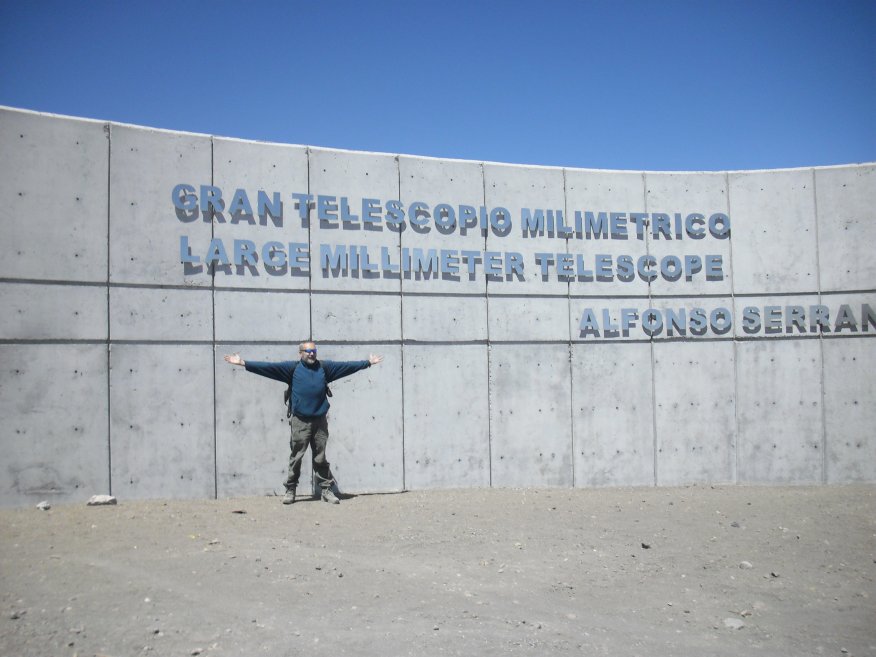 1. Entrance near the summit |
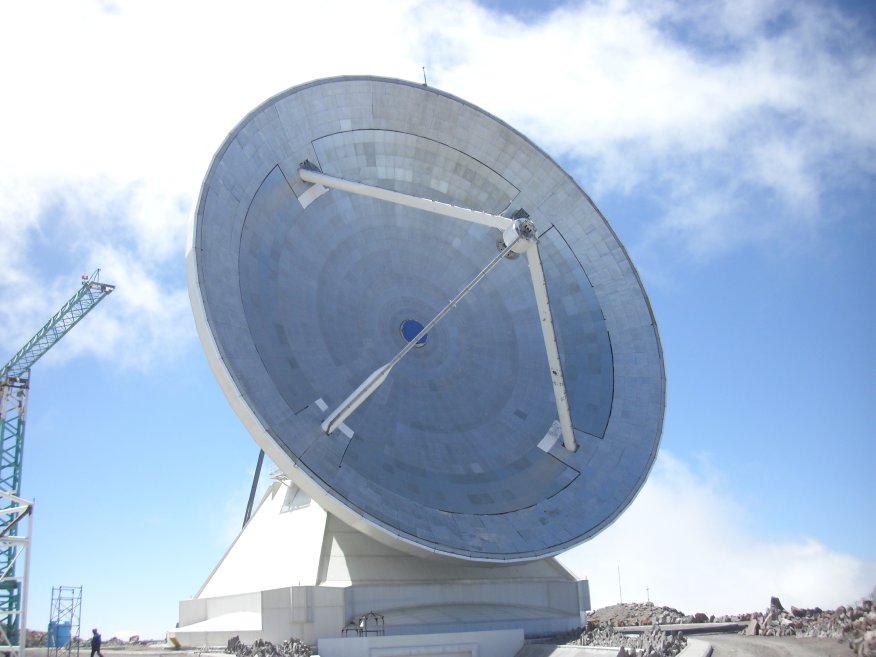 2. 50 metre diameter antenna |
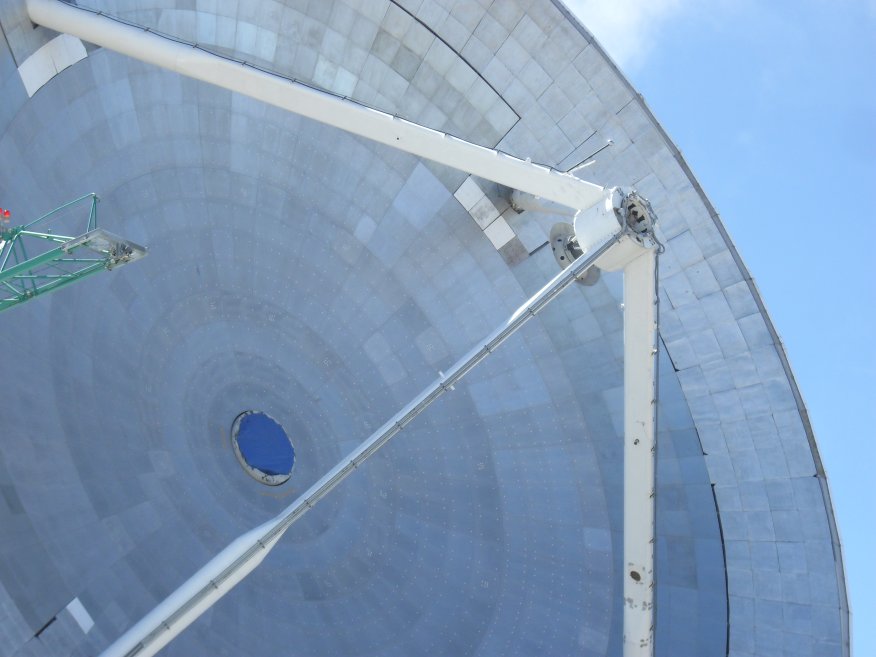 3. 50 metre diamter antenna |
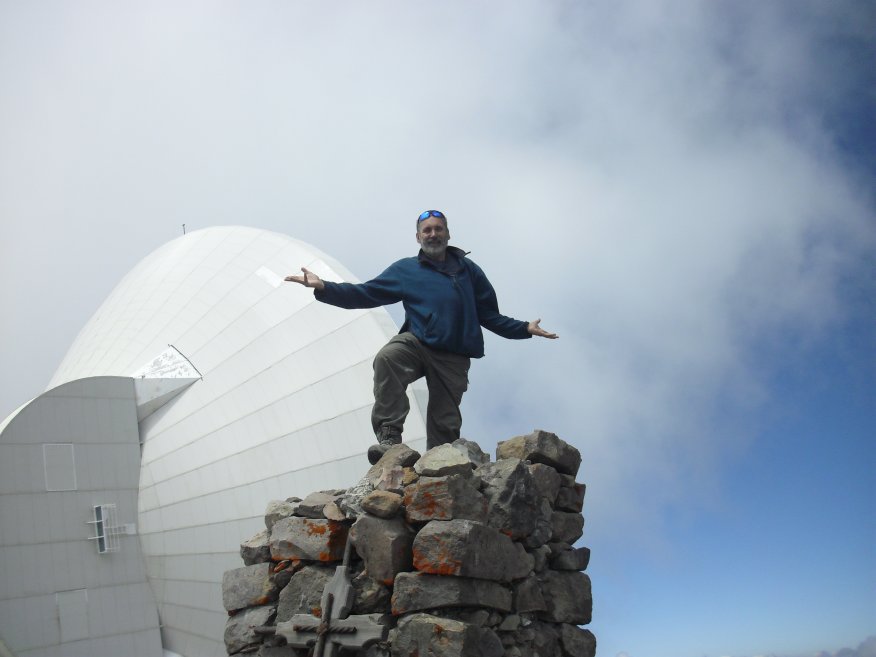 4. Me on the summit |
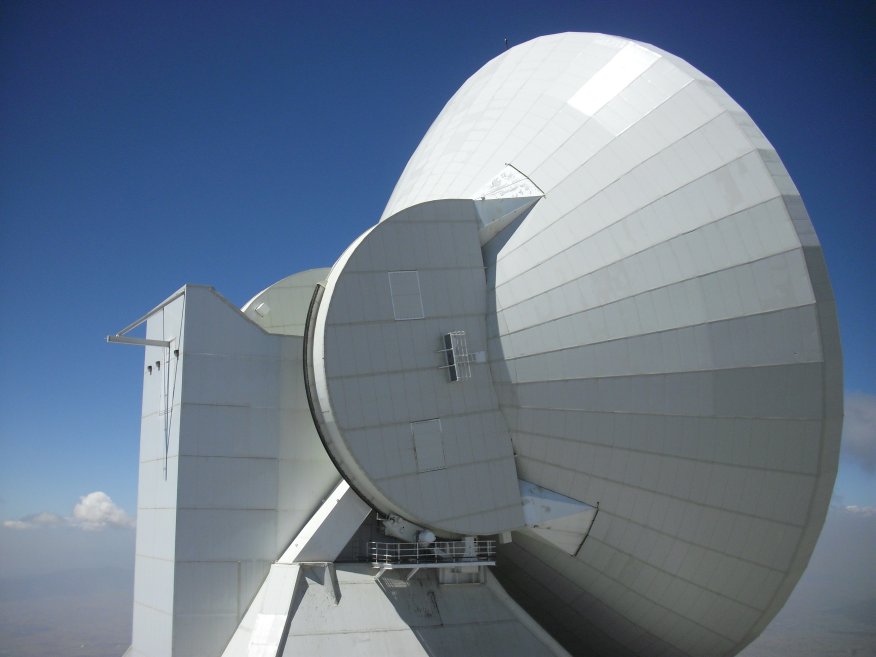 5. Side view |

|
Click Here for my YouTube video at the dish antenna on top of Sierra Negra... |
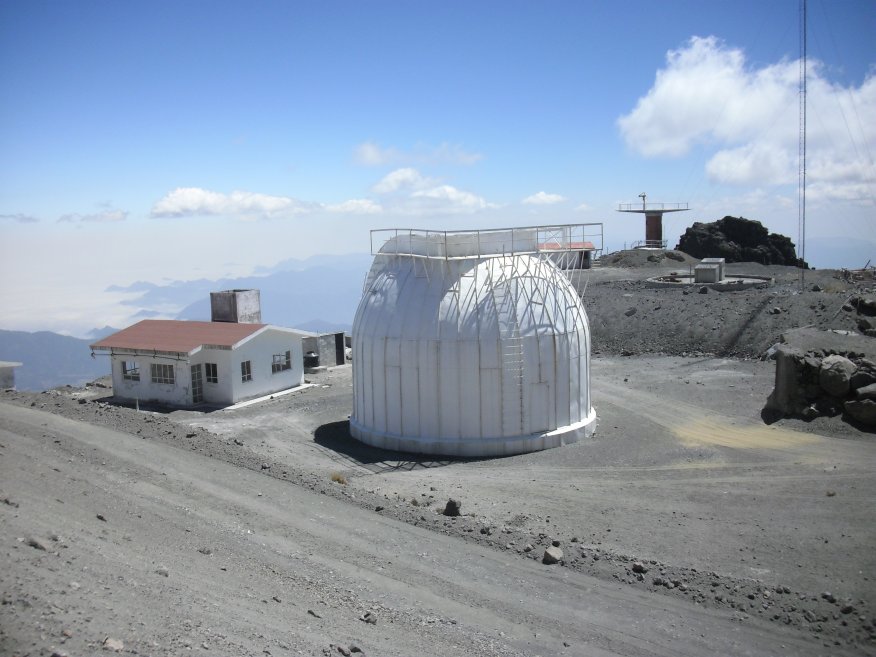 6. Observatory near summit |
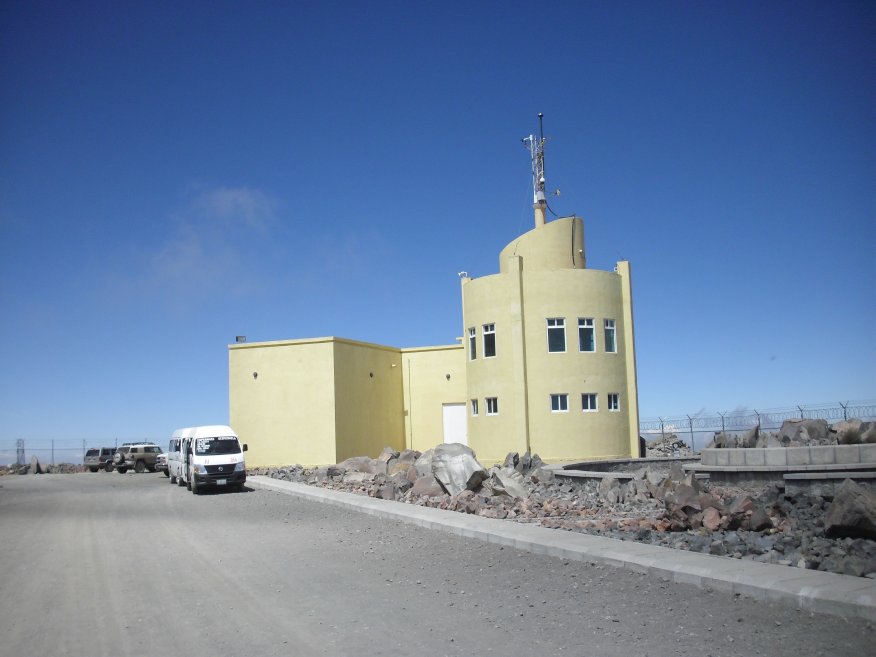 7. Visitor center |
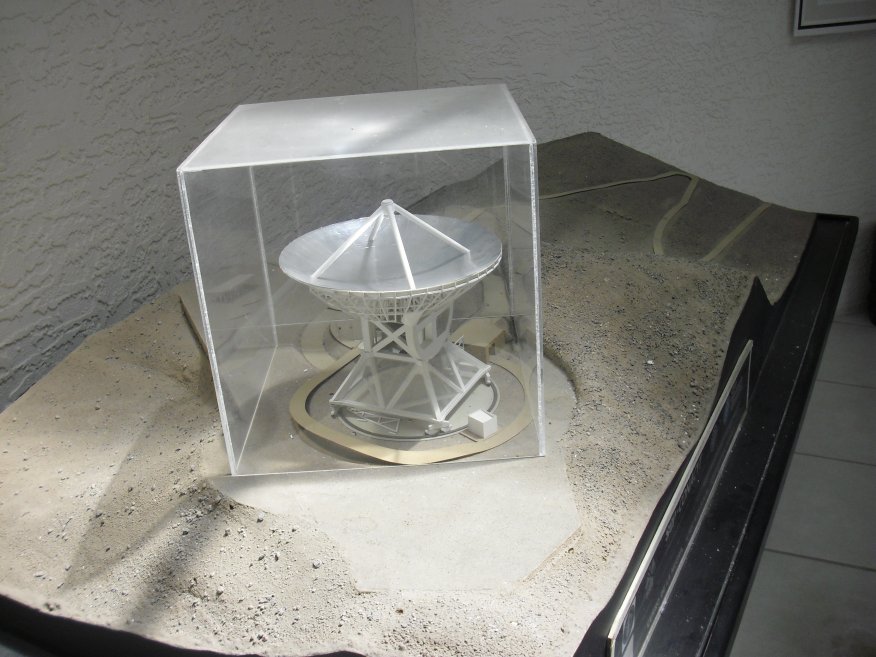 8. Visitor center model |
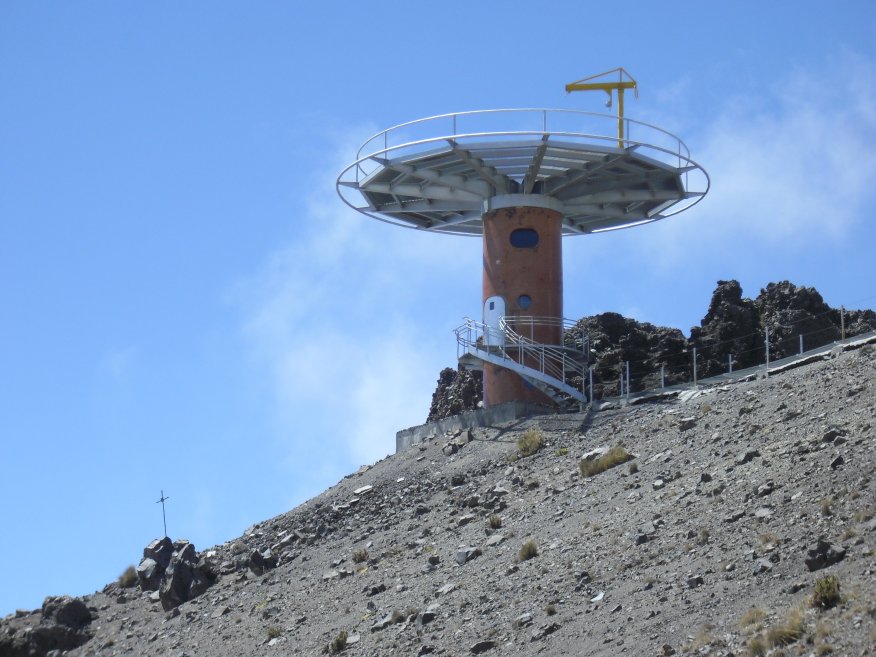 9. Observation platform |
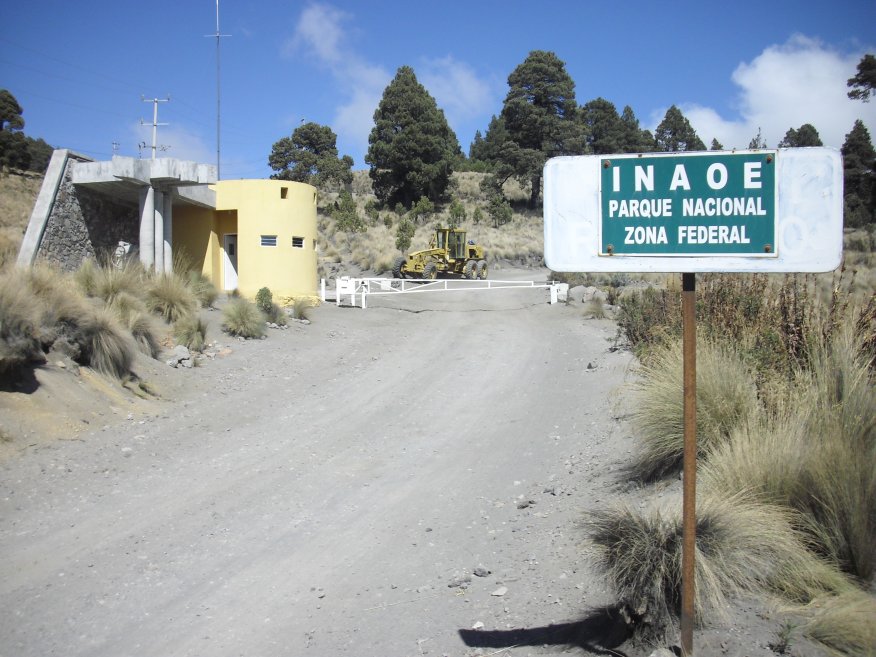 10. Zona Federal |
Cosmic Ray Research
Telescope Array Project
Delta, Utah
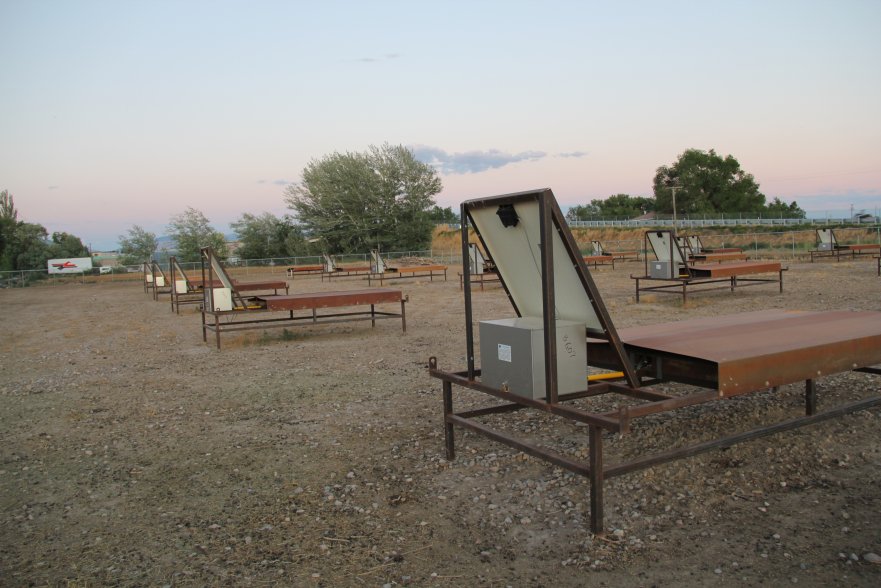
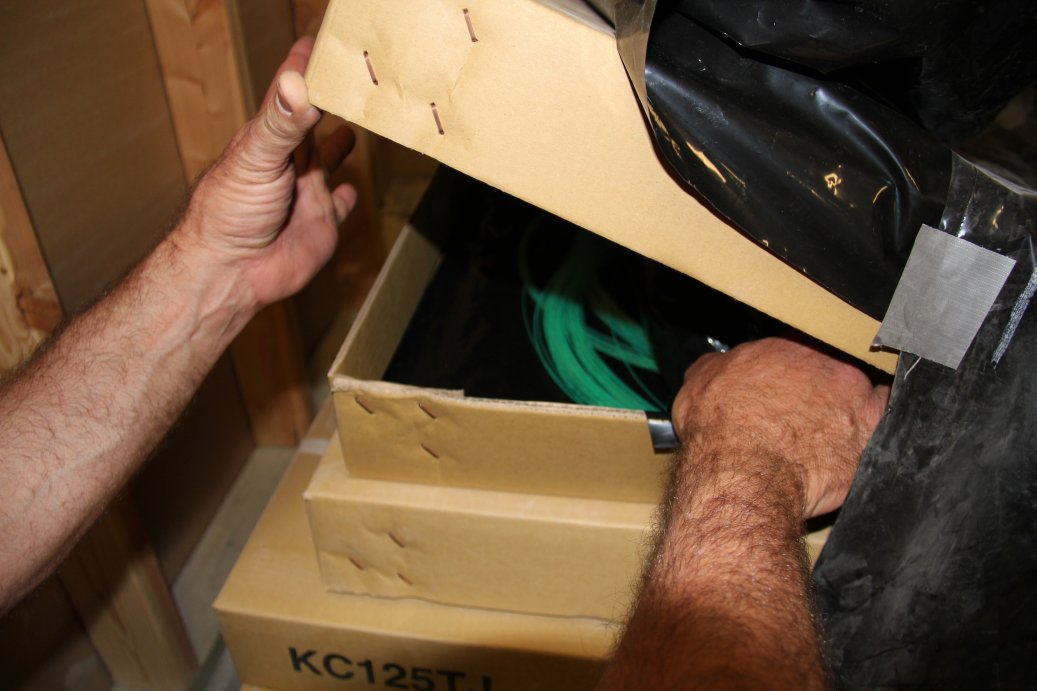
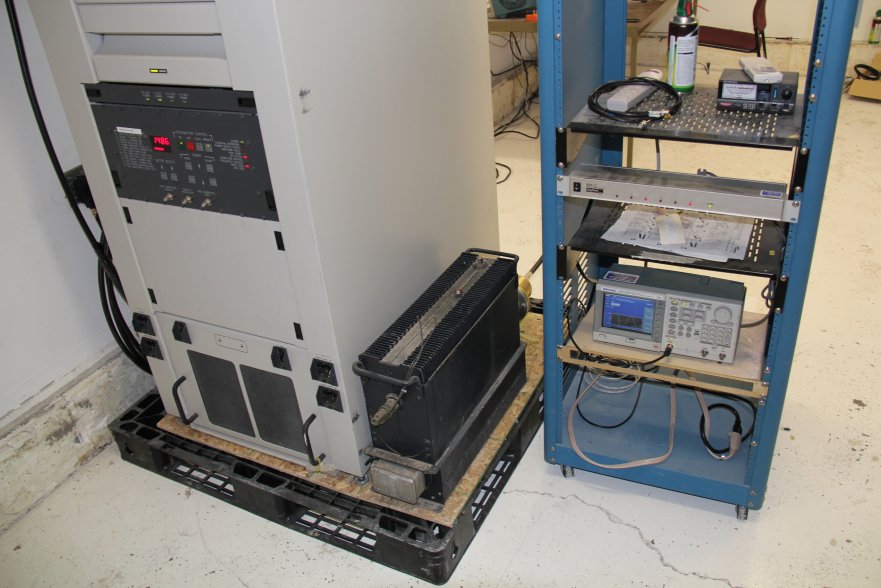
During a warm summer evening in August I had the pleasure of touring this wonderful project in the Utah desert. Prior to my arrival in Delta I couldn't help noticing the surface detectors strategically placed around the valley floor.A University of Utah Department of Physics brochure described the devices this way; "The surface detectors contain sheets of a plastic which generate tiny light signals when the charged particles of the shower pass through them. Optical fibers gather that light and deliver it to very sensitive amplifiers which convert the light to an electrical signal. The detectors communicate with the base station via radio. Each detector is placed 1.2 km apart (∼ ¾ mi.) and the entire array covers about 800 sq. km."
A big "Thank You" goes out to John for providing me a private tour of the facility that evening - it was great! - Roger J. Wendell, August 2011
 1. Lon & Mary Watson |
 2. Cosmic Ray Center, Utah |
 3. Office construction |
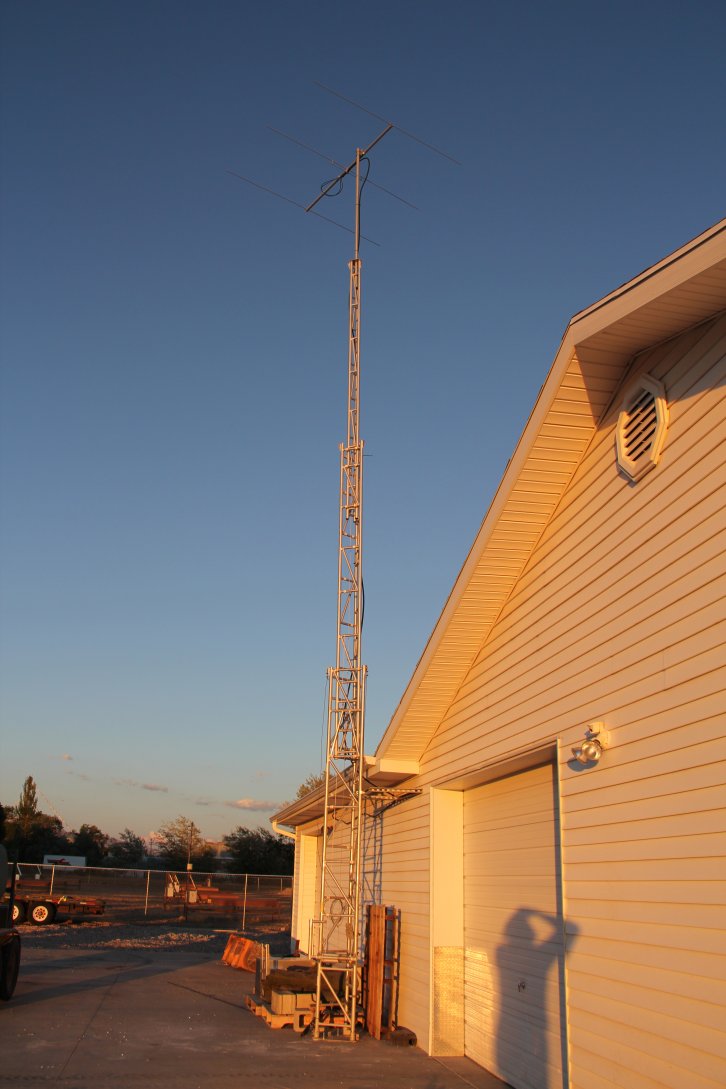 4. Radio tower |
 5. 54 MHz Yagi |
 6. Solar batteries |
|
|
Click Here for my YouTube video about the surface detectors... |
 7. Me! |
 8. Surface detectors |
 9. Surface detectors |
 10. Fiber optics |
 11. Radio gear |
 12. 54 MHz |
The aforementioned brochure described Cosmic Rays this way;
"'Cosmic Rays' are elementary particles and atomic nuclei which arrive at the Earth from outer space. These particles come from many different sources and have a wide range of energies.""Our own Sun is a source of the lowest-energy cosmic rays. Super-nova explosions are the likely source of the highest energy cosmic rays produced in the Milky Way galaxy, yet many particles have been observed with energies far exceeding the acceleration power of supernovas.
"Many of these extremely high-energy cosmic rays appear to be from outside our galaxy and may have their origin in black-hole powered radio galaxies, active galactic nuclei or quasars. Or, they may be produced by as-yet unknown mechanisms. Understanding the origin of the highest-energy cosmic rays is one of the great unanswered questions in fundamental physics and is the primary goal of the Telescope Array Project."
www.TelescopeArray.org
|
|
Click Here for my YouTube video about the plastic detector surface... |
"We say pronounce, sentence, and declare that you Galileo . . . have rendered yourself in the judgment of this Holy Office vehemently suspect of heresy, namely . . . that the Sun is the center of the world and does not move from east to west and that the Earth moves and is not the center of the world . . . Consequently we order that the book Dialogue of Galileo Galilei be prohibited by public edict. We condemn you to formal imprisonment in the Holy Office."
Voyager Golden Record
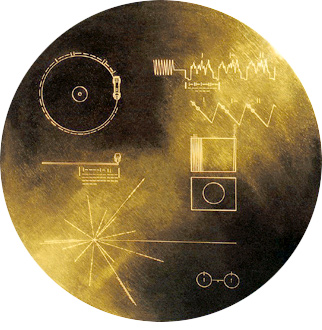
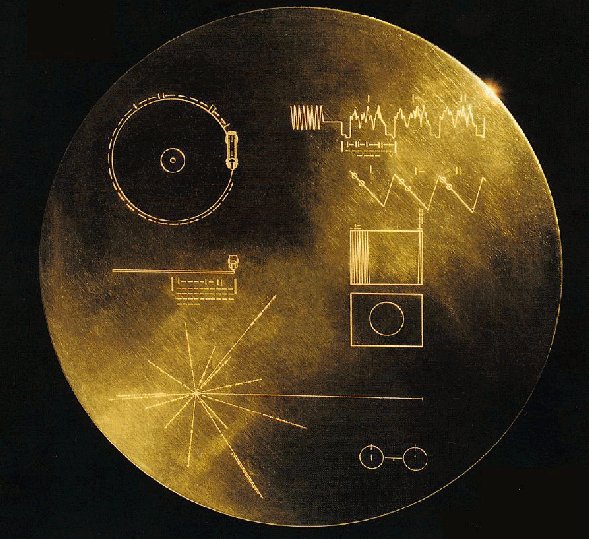
Two Voyager spacecrafts, launched in 1977, contain a phonograph record inside the gold-plated cover featured in the picture at left. The records, themselves, contain sounds and images selected to portray the diversity of life and culture on Earth - the idea being that another space-faring civilization might encounter either craft and be able to interpret the instructions for playing the phonograph records. In 2012 Voyager left our solar system, taking another 40,000 years before coming anywhere close to another star. So, obviously, the Voyager probes are extremely small compared to the vastness of interstellar space - making the probability of another civilization encountering them very small. Carl Sagan, who initially conceived the idea of the golden record, said, "The spacecraft will be encountered and the record played only if there are advanced space-faring civilizations in interstellar space. But the launching of this 'bottle' into the cosmic 'ocean' says something very hopeful about life on this planet."
Jimmy Carter, in his official message included with the launches, said the Golden Record is "a present from a small, distant world, a token of our sounds, our science, our images, our music, our thoughts and our feelings. We are attempting to survive our time so we may live into yours."
Thus the golden record is best seen as a time capsule or a symbolic statement more than a serious attempt to communicate with extraterrestrial life...
In their November 15, 2010 edition, Time Magazine (page 8) took questions from readers for Stephen Hawking:

Does the universe end? If so, what is beyond it? - Paul Pearson, HULL, ENGLAND
Observations indicate that the universe is expanding at an ever increasing rate. It will expand forever, getting emptier and darker. Although the universe doesn't have an end, it had a beginning in the Big Bang. One might ask what is before that, but the answer is that there is nowhere before the Big Bang, just as there is nowhere south of the South Pole.
How Much is Nothing?
Consider that a thimbleful of air would contain trillions upon trillions of atoms. In a commercial vacuum tube, the same thimble would hold only a few billion. In the best vacuum scientists make today, the number would be reduced to about 500. A thimble on the surface of the moon would have perhaps 50 inside, and if that thimble were put in the empty regions of the galaxy, it would hold, on average, a single atom.
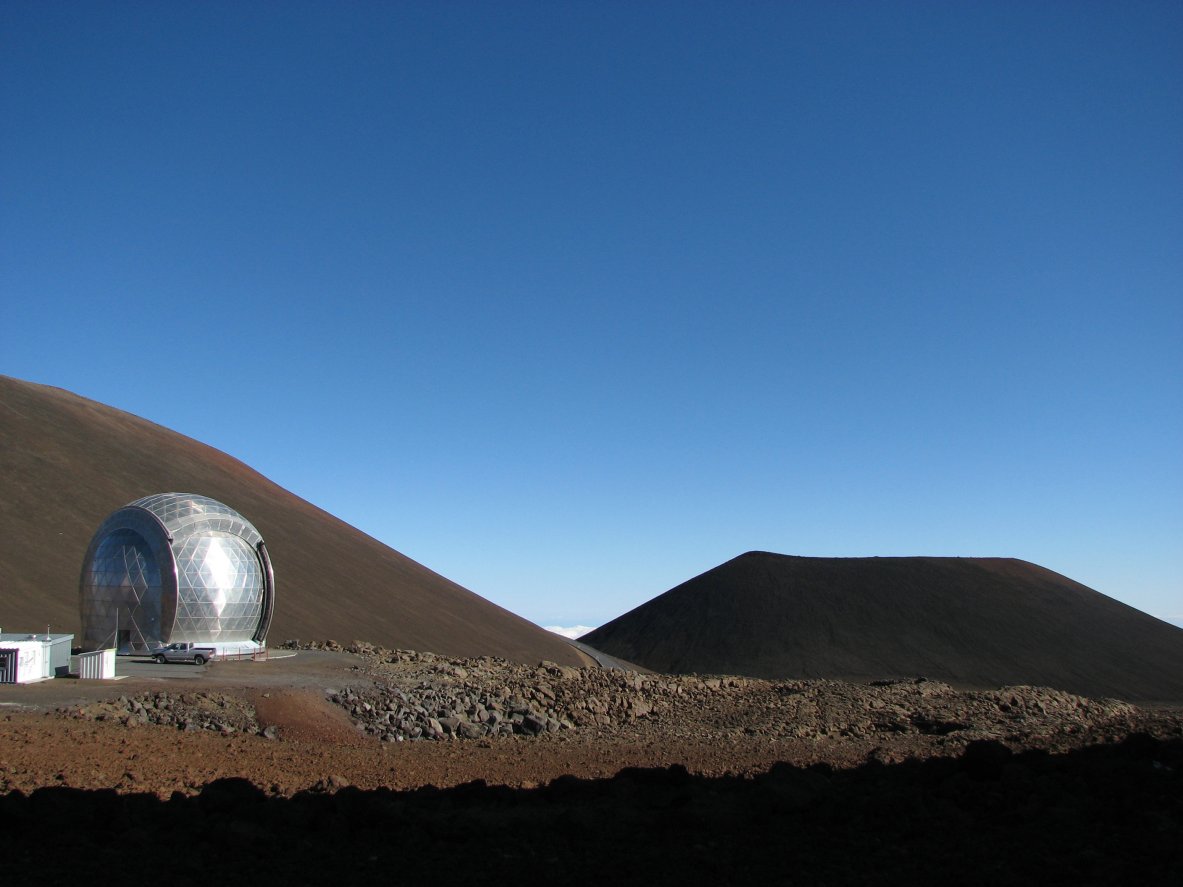
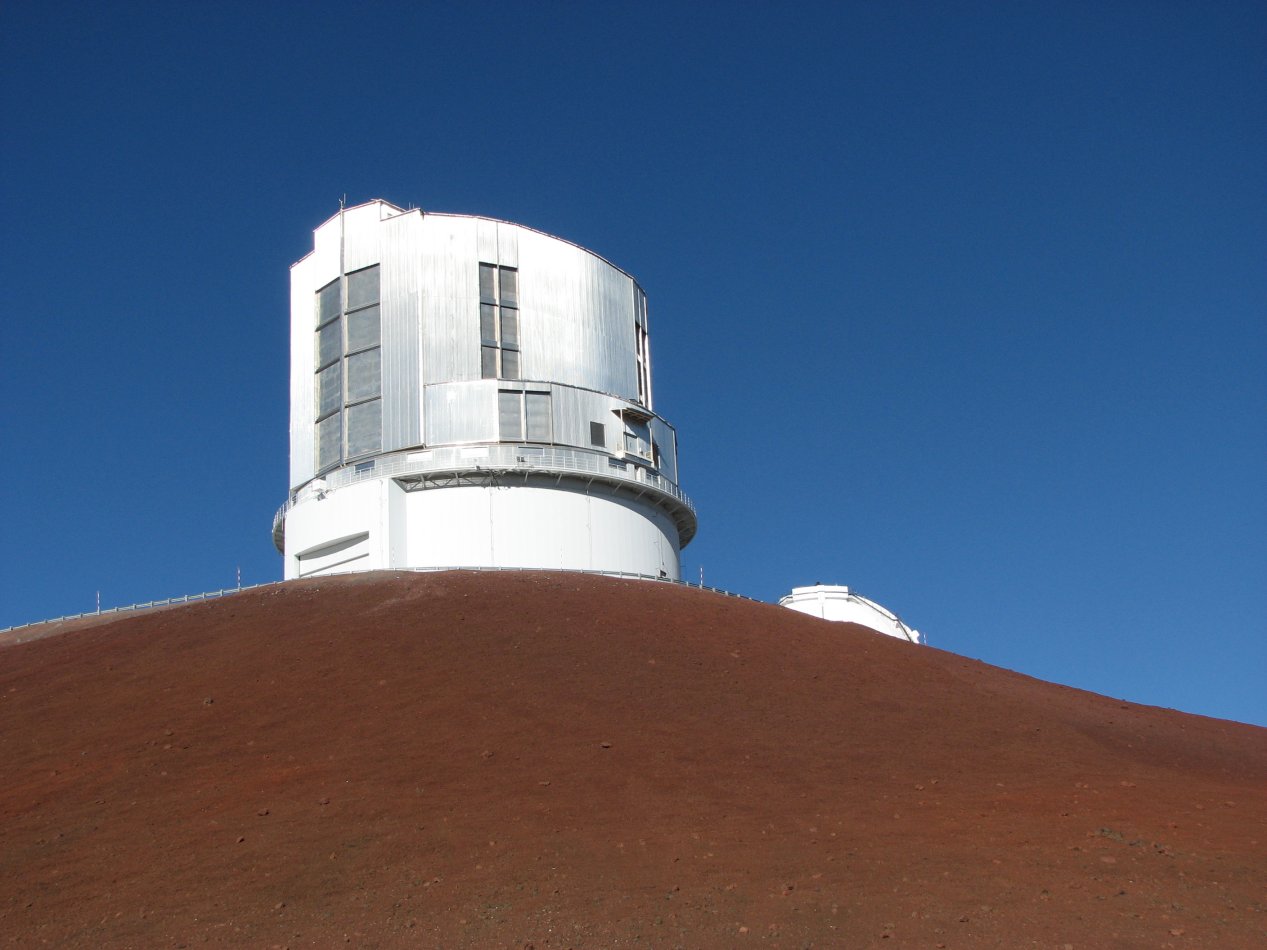
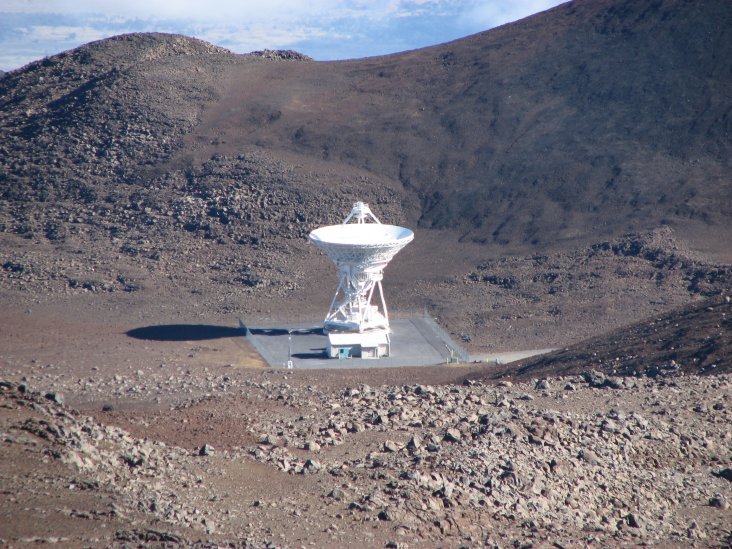
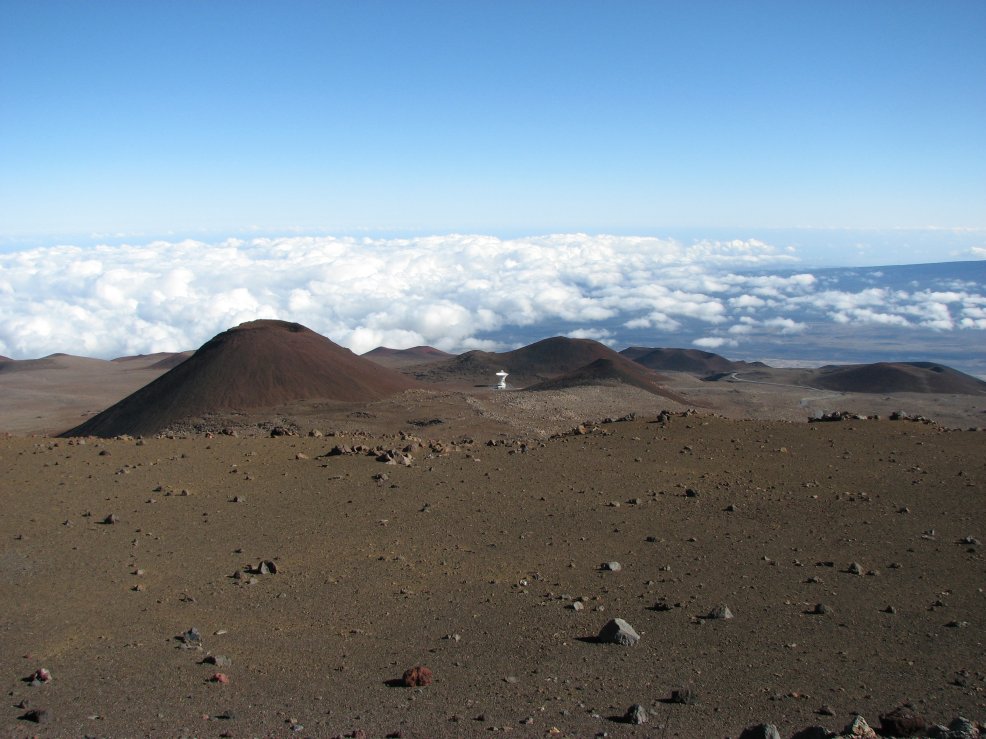
Mauna Kea, Hawaii
 |
 |
 |
 |
 |
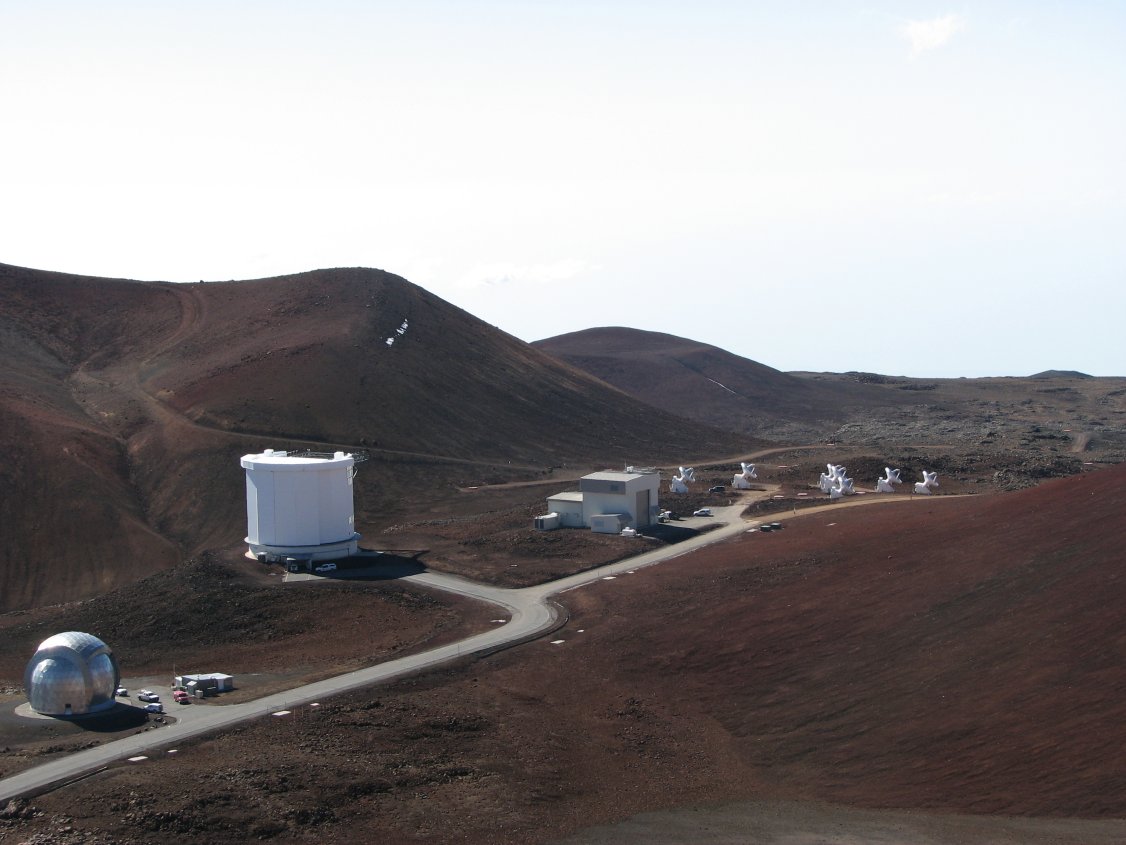 Very Long Base Line Array |
 On top |
 On the way up |
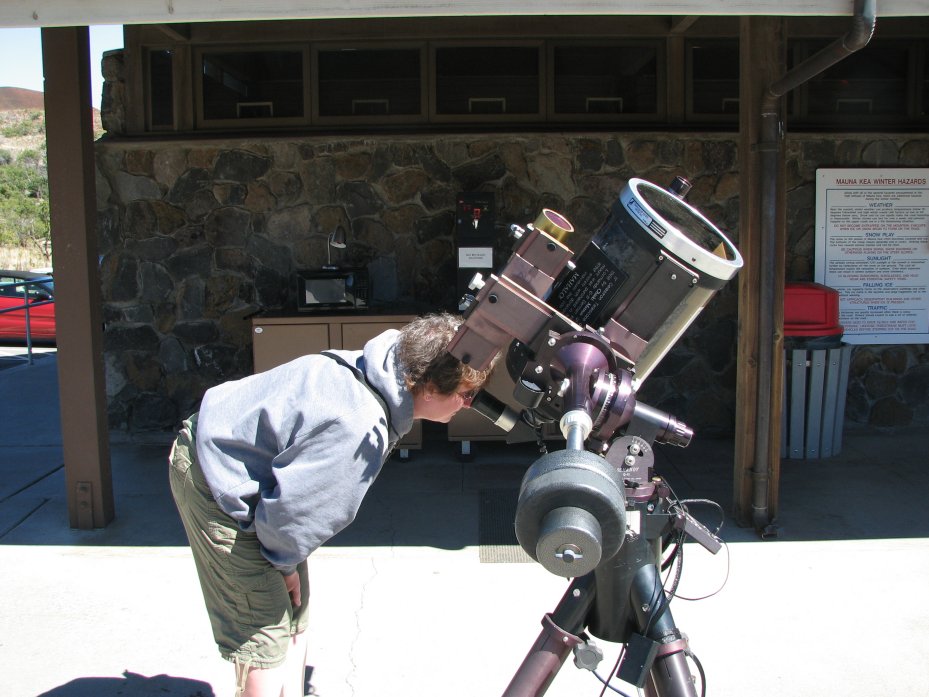 14 Inches at 9,000 feet! |
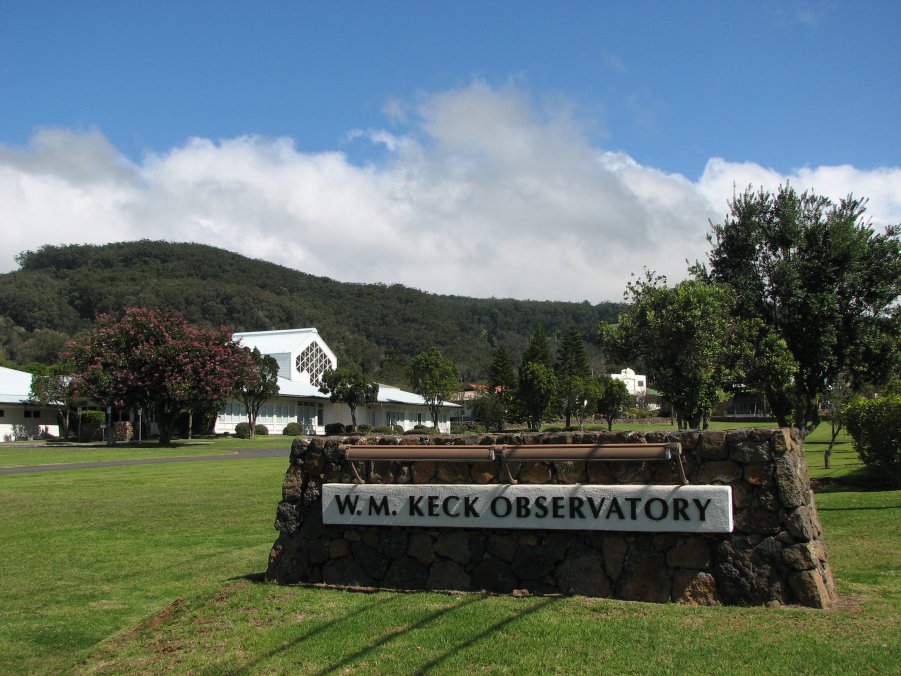 Headquarters at sea level! |
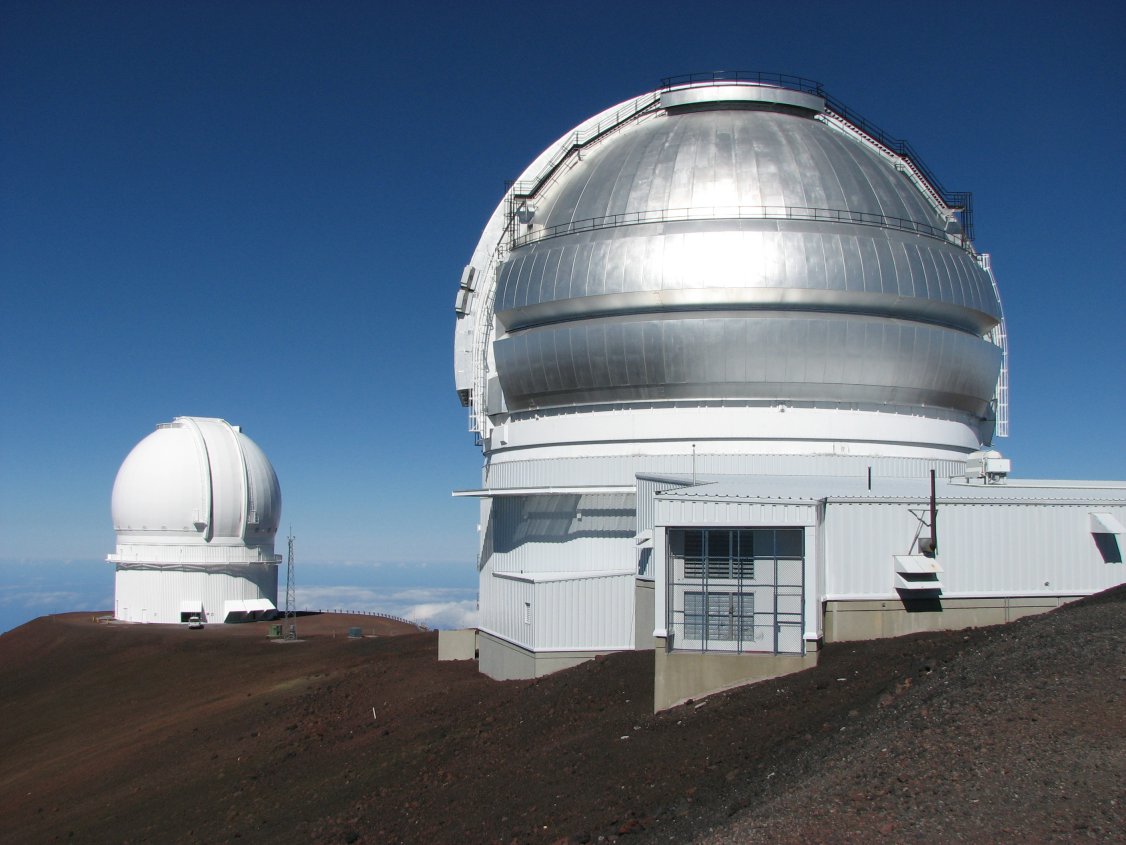
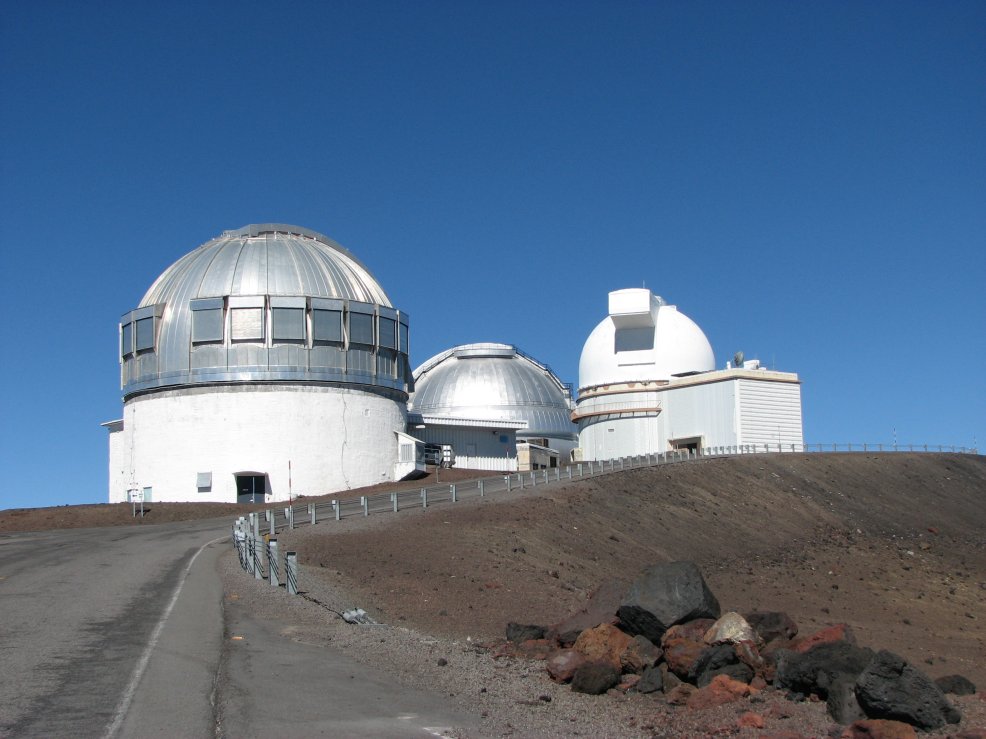
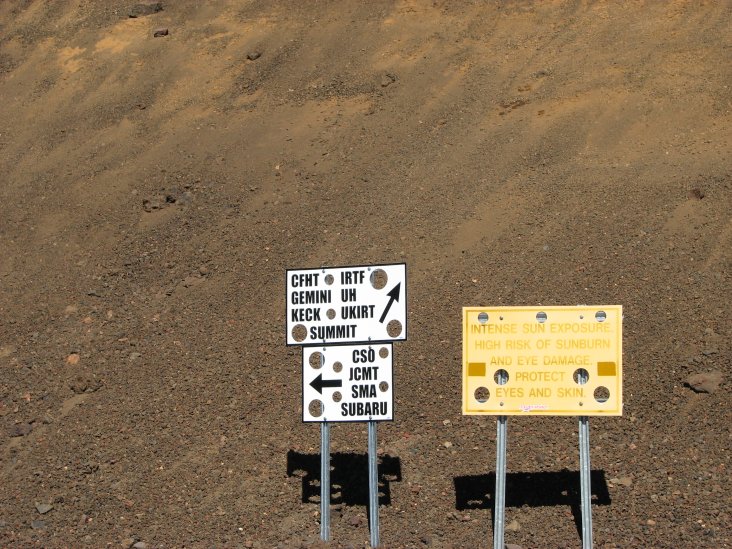
| In February 2007 I took another fantastic trip back to Hawai'i where we were able to visit the observatoris on Mauna Kea's 13,796 foot peak twice - once during the day and again at night where we watched the stars with the roof of our convertible folded down... |

|
Click Here for a video I took of Keck 1 being rotated... |
WASHINGTON (Reuters)
Memorial Day Weekend, 2007
"The giant Keck telescope he is using, on the summit of Hawaii's Mauna Kea volcano, is sending images straight to a digital camera, to be analyzed by a computer.""'There are no eyepieces anywhere. In fact, we don't have an eyepiece for the Keck telescope,' [Geoff] Marcy, an astronomy professor at the University of California, Berkeley, said in a telephone interview as he finished up a night of planet-hunting."
"'We've done about 85 stars tonight,' Marcy said. 'We started at about 6 p.m. and it is 4:30 a.m. now. We never stop and we never take any breaks. The world's largest telescope is so precious that you don't want to waste a second.'
"Marcy is in fact not even sitting at the telescope. The eight-story telescope is a 45-minute drive away, in the thin air above 13,000 feet (4,000 meters)." "He is connected by audio and video link to a telescope operator who points and clicks at his command." "The $100 million telescope collects the light from stars and sends them straight to a spectrometer that, like a prism, separates light into its colored wavelengths." "'It goes to a digital camera, the spectrum is recorded, and I take it back to the University of California Berkeley to get all the data,'" said Marcy. "Using this method, Marcy's team has discovered 28 new planets orbiting other stars in the past year. They are responsible for two-thirds of the 236 known exoplanets."
"Most of the planets seen so far are gas giants like Jupiter, unlikely to host life. But astronomers hope to refine their methods so they can spot small, rocky planets covered with liquid water, like our own."
"'The real question that is on everybody's minds, whether you are 6 years old or 96, is whether there is intelligent life in the universe,' Marcy said. 'We will point our telescopes at those Earths hoping to pick up transmissions from any intelligent species that might happen to be living there.'"

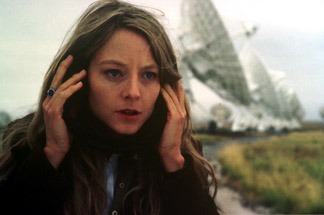
Jodie Foster in the movie, Contact
SETI, an acronym for Search for Extra-Terrestrial Intelligence, is a project based on organized efforts to detect intelligent life throughout our galaxy and even beyond. There have been a number of organized projects engaged in this effort including some funded by the United States Government. The general approach is to survey the sky to detect electromagnetic emissions (usually in the form of high frequency radio waves) from civilizations on distant planets.So far, at the time I created this page in January 2007, there were no verified reception reports of such signals and emmissions. However, because both our galaxy, and the universe itself, is so broad and vast the scientific search for these signals has been relatively narrow - there's certainly room for a lot more searching and listening - a whole lot more!
There are huge challenges in searching across the sky to detect intelligent transmissions from other worlds. The signal(s)' direction, spectrum, strength, bandwidth, and other factors are all challenges that can only be guessed at and anticipated by scientists. Also, there are problems with weak signal strengths as the radio waves travel over such great distances (this is illustrated by the Inverse Square Law - where the intensity of light observed from a source of constant intrinsic luminosity falls off as the square of the distance from the object).
There are also issues related to the absorbtion of signals by interstellar dust and debris - even though most of the universe is nearly a perfect vacuum, one or two stray atoms per cubic metre, over millions of miles, can attenuate signals. And, of course, there's the problem of human generated interference - evertyhing from malfunctioning automobile ignitions to over-active microwave ovens and satellite TV broadcasts have the potential of interfering with sensitive SETI receivers .
Nevertheless, despite the huge challenges (and expense!) SETI remains one of the most important scientific and philosophical endeavors of human existance. I believe this effort deserves the full support of our people and government!
- Roger J. Wendell, January 2007
Golden, Colorado
|
| Click Here for my page on antennas... |
Life
Schrödinger"There are so many billions of stars (maybe an infinity of them) that even if life is an incredibly rare accident it is clear that it will occur eventually in odd parts of the universe."
- Paul Davies, Other Worlds p. 144"Stephen Hawking argues that it's unremarkable that at least one planet has conditions for life."
- Richard Allen Greene, in his September 2, 2010 CNN piece, Stephen Hawking: God didn't create universe
Green Bank Formula
Also known as the Drake or Sagan Equation, it was first devised by Dr Frank Drake in the early 1960s. According to the formula, throughout our galaxy there could be millions of different civilizations interested in, or capable of, technilogical communications with other civilizations.When working with the formula, Scientists usually allow two values for each term. One is a normal value based on our present state of knowlege and the other is an absolute minimum value. The final value, N, is then the number of technilogical civilizations capable of communicatios with others:
Whereas:
R* = the average annual number of new stars that are like our sun;
Fp = the number of stars with possible living beings;
Ne = the average number of planets which orbit the ecosphere of their sun and so have adequate conditions for the development of life by human standards;
Fl = the number of planets favored in this way on which life has actually developed;
Fi = the number of planets which are populated by intelligences with thier own ability to act during the lifetime of thier sun;
Fe = the number of planets inhabited by intelligences that have already developed technical civilization;
L = the lifespan of a civilization (Only very long lasting civilizations could encounter each other, given the vast distances in the universe);
If we take the lowest possible figures for all terms in this formula we get: N = 40.
However, if we take the admissable maximum value, we get N = 50,000,000.
Sky & Telescope, in there November '92 "SETI at a Crossroads" article (by Robert Naeye) included a sidebar called "Is anybody out There?" A small portion of it, on page 512, had this to say; "...astronomer James Sweitzer (university of Chicago) criticizes the broad use of this equation in popular books and articles. He points out that, except for the term R*, scientists have no idea as to the true values of the remaining terms. Moreover, they do not have even the knowledge needed to calculate these probabilities. Sweitzer says that assigning values gives the false impression that N can in fact be quatified."Optimists maintain that with 400 billion stars in our galaxy alone and an abundance of organic molecules in interstellar space, life must be commonplace. And since intelligence conveyed considerable survival advantages to Homo sapiens, given enough time intelligent species should arise on many worlds. As John Billingham, who heads the SETI office at NASA's Ames Research Center, points out, 'There's a countless number of possiblew life sites out in the galaxy. And if it happened here, why shouldn't it happen somewhere else?'"
|
|
Click Here for the SETI@Home program. SETI@home is a scientific experiment that uses Internet-connected computers in the Search for Extraterrestrial Intelligence (SETI). You can participate by running a free program that downloads and analyzes radio telescope data. |
"...SETI@Home has done more to raise public consciousness about SETI than any other project, and SETI League members are eager and active participants. The project has demonstrated how a large-scale task can be broken downinto manageable chunks, and parsed out to a cadre of participants. What remains now is to marry the distributed processing aspects of SWTI@home to the distributed observing network of The SETI League's Project Argus all-sky survey. The result will be the most powerful SETI project ever, a net stretched wide to capture that elusive fish in the comsic pond."
6EQUJ5
(The "Wow!" Signal)
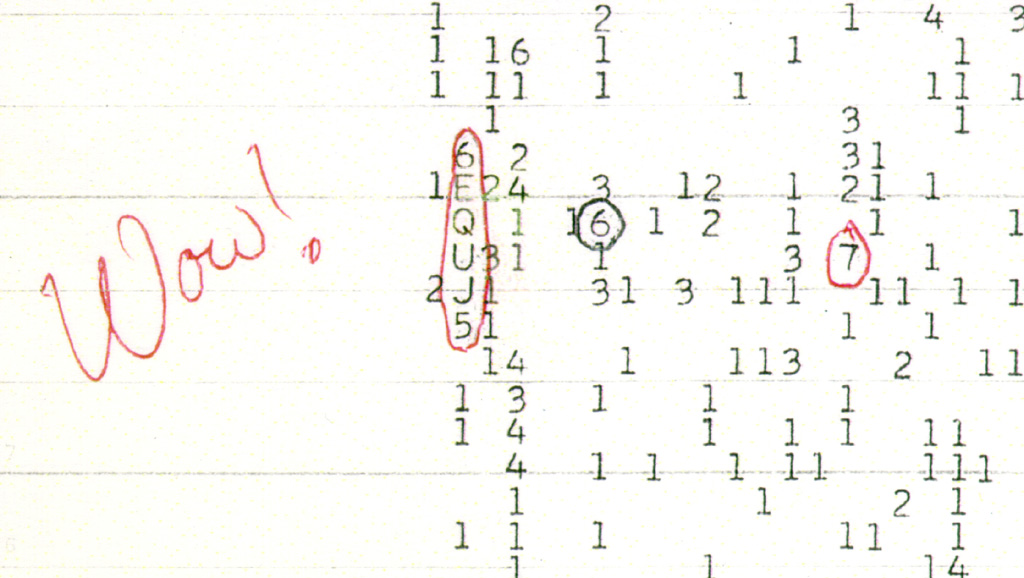
Photo Credit: The Ohio State University Radio Observatory and the North American Astro Physical Observatory (NAAPO)Although the story of the "Wow!" signal has alway intrigued me I was never completely convinced that it's origin was extraterrestrial. Nevertheless, a lot of people (who are much smarter than me!) believe that it may be evidence of signal from somewhere beyond Earth. The photo, at left, is a scan of a color copy of the original computer printout, taken several years after the 1977 arrival of the Wow! signal. (Despite various internet recordings there is no actual audio saved from the detection of that signal...) Anyway, there's extensive history avaible for the "Wow!" signal but, in summary, it was a strong narrowband radio signal detected by Jerry R. Ehman on August 15, 1977. At that time Ehman was working on a SETI project at the Big Ear radio telescope located at the Ohio Wesleyan University's Perkins Observatory in Delaware, Ohio. The signal contained the expected hallmarks of non-terrestrial and non-Solar System origin. It lasted for the full 72-second window that Big Ear was able to observe it, but has not been detected again. The signal has been the subject of significant scientific and media attention.
Amazed at how closely the signal matched the expected signature of an interstellar signal Ehman circled the signal on the computer printout and wrote the comment "Wow!" on its side. This comment became the name of the signal. The circled alphanumeric code, 6EQUJ5, describes the intensity variation of the signal. The frequency of the Wow! signal matches very closely with the hydrogen line, which is at 1420.40575177 MHz. The hydrogen line frequency is significant for SETI searchers because, it is reasoned, hydrogen is the most common element in the universe, and hydrogen resonates at about 1420.40575177 MHz, so extraterrestrials might use that frequency to transmit a strong signal...
Arecibo Radio Telescope
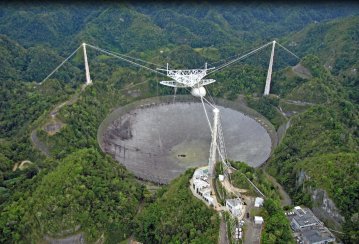
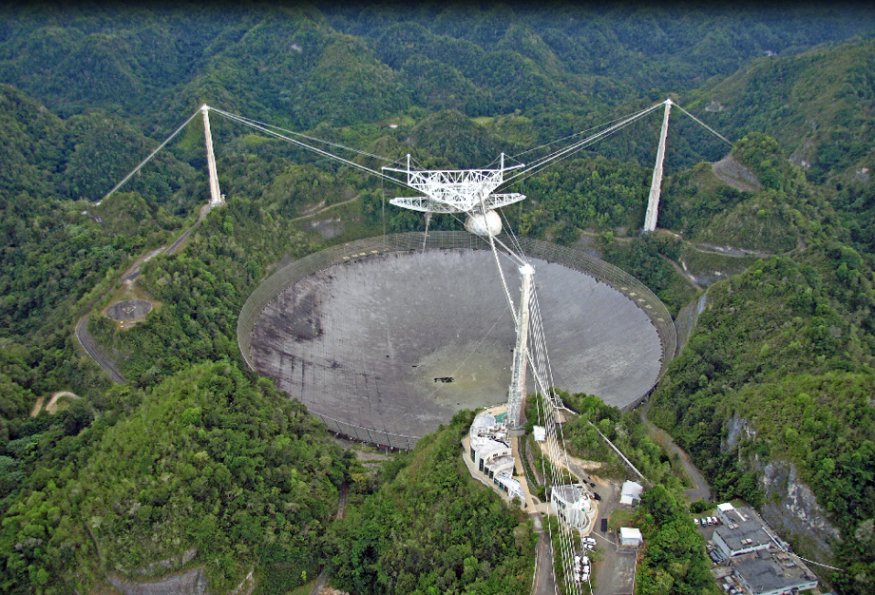
The Arecibo Observatory is a radio telescope in the municipality of Arecibo, Puerto Rico that's managed by the National Science Foundation. The Observatory's telescope is a 305 metre (1,000 ft) bowl-shaped aluminum dish built into an immense limestone sinkhole. It's the world's largest single-aperture telescope and is calculated to hold 357 million boxes of cornflakes. On November 16, 1974 Dr. Frank Drake, and other scientists, focused the massive dish on the M13 globular cluster, located some 25,000 light-years away in the Hercules constellation, to broadcast a hopeful message to other possible civilizations. The Arecibo message was broadcast a single time via frequency modulated radio waves at a ceremony to mark the remodeling of the telescope. The message consisted of 1,679 binary digits, approximately 210 bytes, transmitted at a frequency of 2,380 MHz and modulated by shifting the frequency by 10 Hz, with a power of 1,000 kW. The "ones" and "zeros" were transmitted by frequency shifting at the rate of 10 bits per second. The total broadcast was less than three minutes but, if received and reconstructed properly, will display the numbers one to ten, the atomic numbers of the elements hydrogen, carbon, nitrogen, oxygen, and phosphorus, [which make up deoxyribonucleic acid (DNA)], the formulas for the sugars and bases in the nucleotides of DNA, the number of nucleotides in DNA, and other information related to the telescope, it's location in our solar system, and humans.
Because of the antennas incredible gain (In electromagnetics, an antenna's power gain or simply "gain" is a key performance figure which combines the antenna's directivity and electrical efficiency ) it was calculated that the Arecibo Message was broadcast with an effective radiance of twenty million megawatts for the message's duration - "outshining" our Sun by a factor 100,000...
More on SETI:
"Perhaps the safest thing to do at the outset, if technology permits, is to send music. This language may be the best we have for explaining what we are like to others in space, with least ambiguity. I would vote for Bach, all of Bach, streamed out into space, over and over again. We would be bragging of course, but it is surely excusable to put the best possible face on at the beginning of such an acquaintance. We can tell the harder truths later."
33.5 Metre Dish in Australia
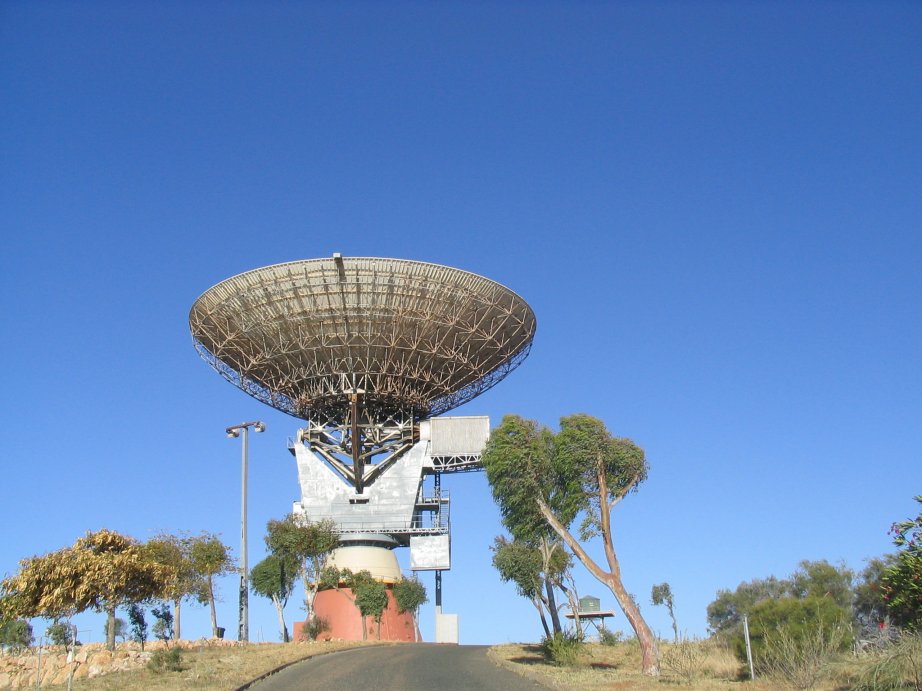
Carnarvon Shire, AustraliaNote: We stopped by the 33.5 metre Carnarvon Shire "dish" while in Western Australia. At about the time of our visit some amateurs were asking to convert part of its use to SETI work. We're hoping they're succesful! The antenna is described as a fully steerable precision unit that's of Casegrain design with the focal point situated in the control room beneath the dish. It seemed huge as we parked beneath it that summer's day!!
Dr. Jim Moravec talks about the receiving a coherent signal from space
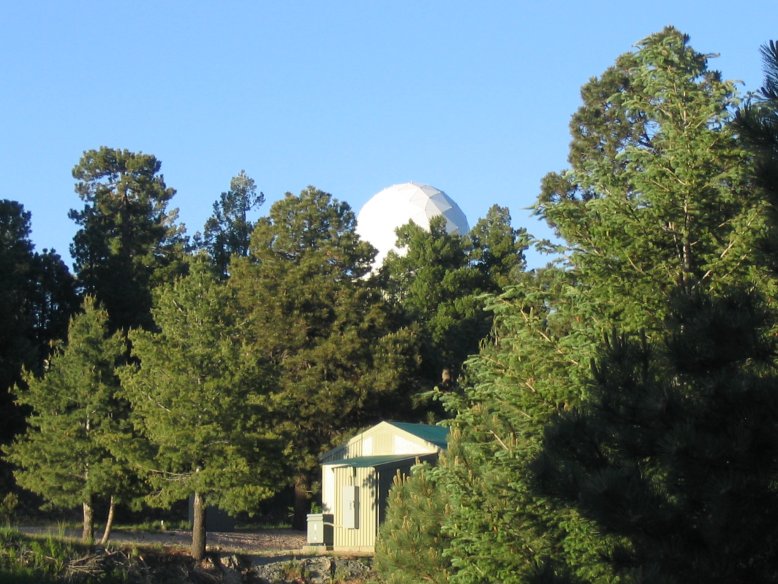
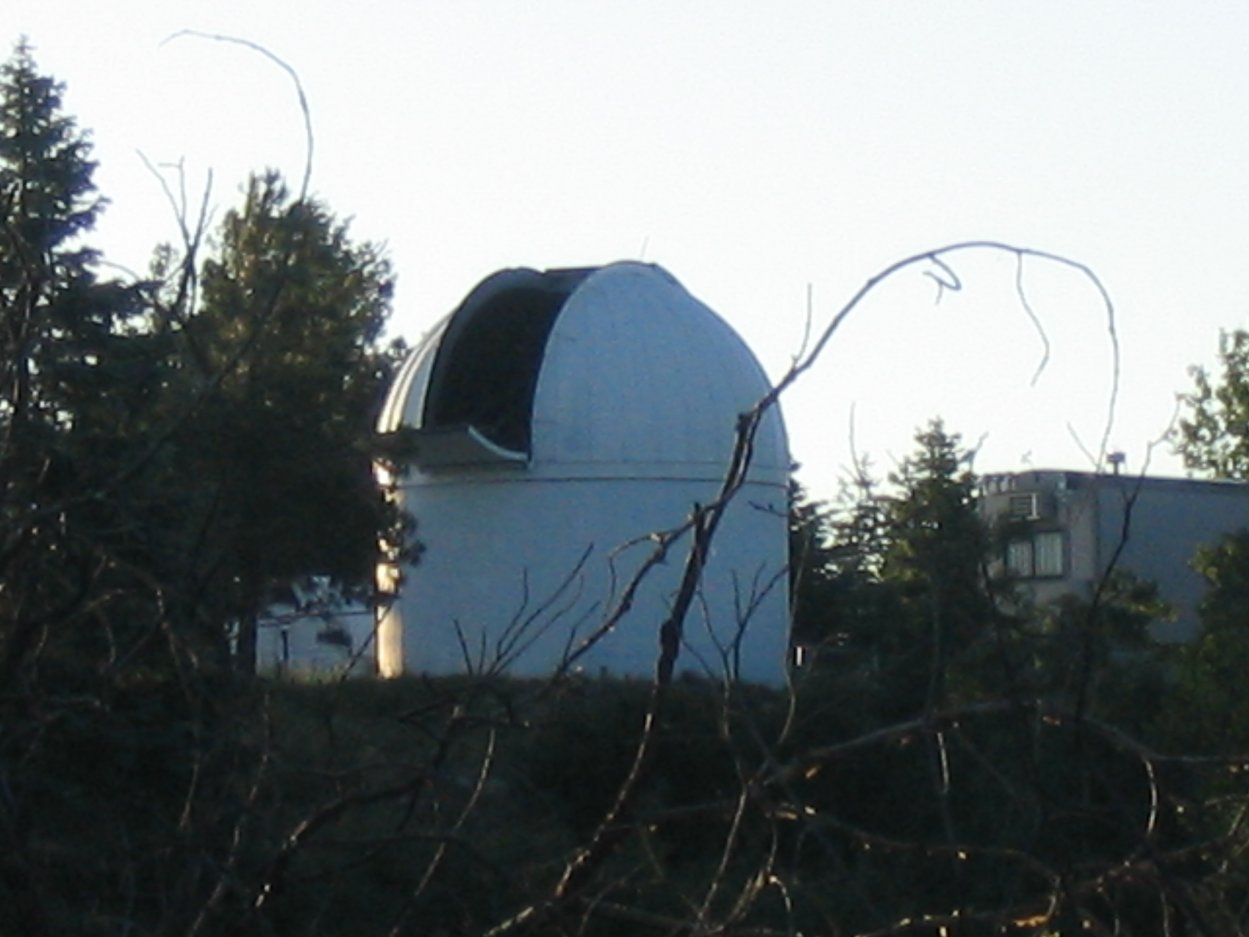
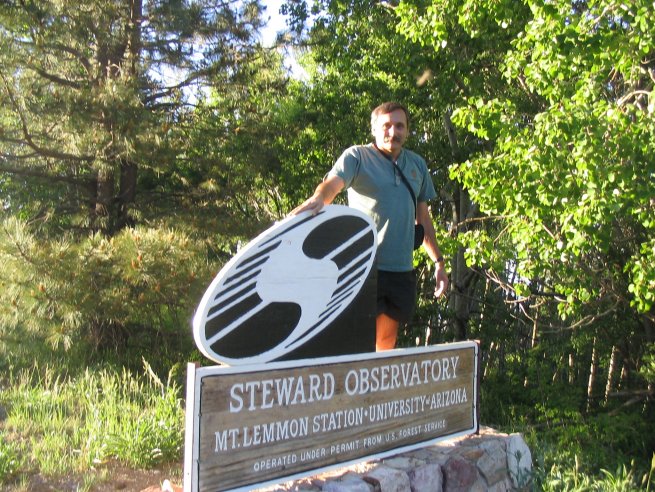
Steward Observatory
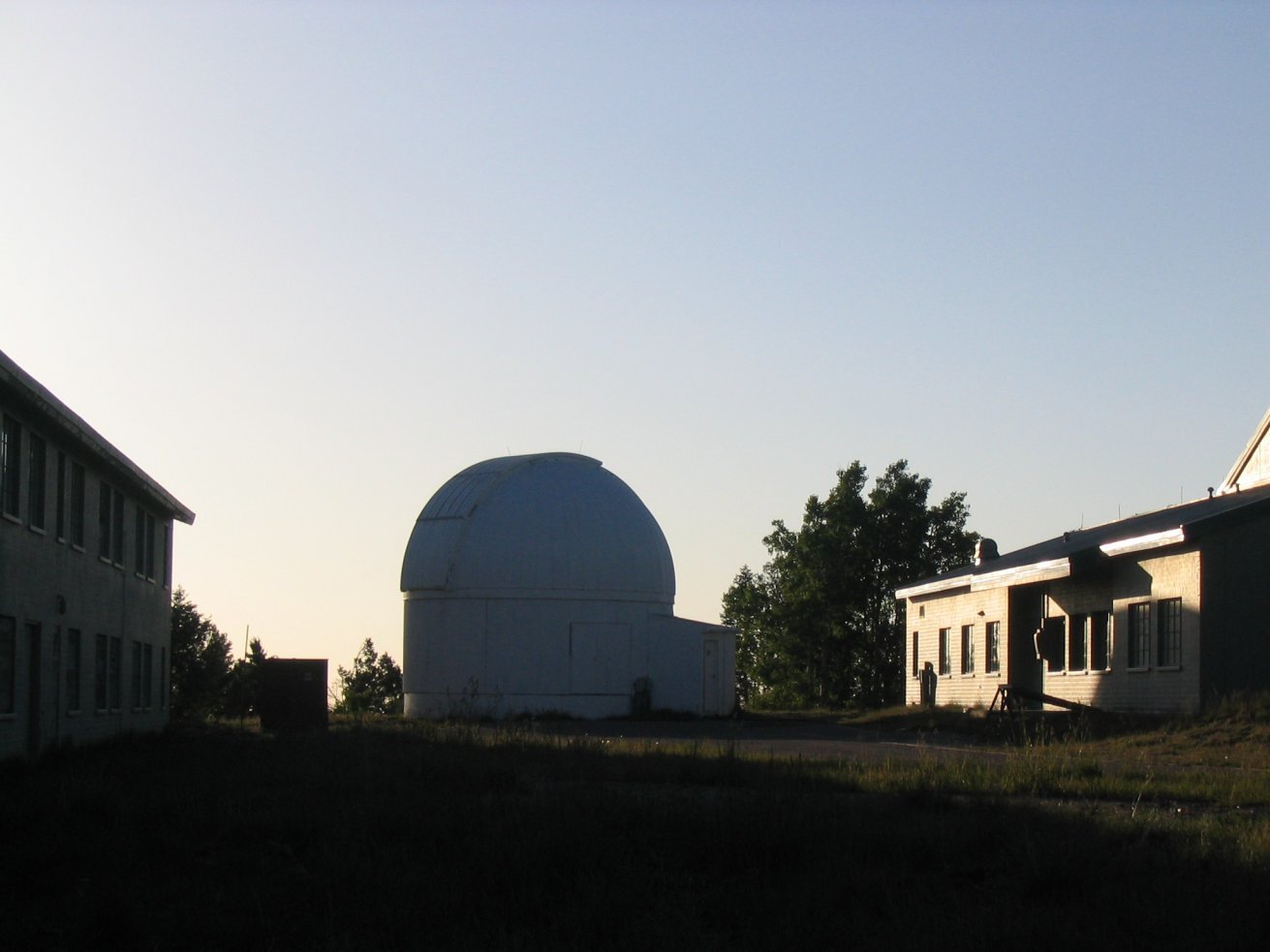
While on business in Tucson, in June of '07, I took
a drive up Mt. Lemmon and got a pretty close look at
the observatory. The University of Arizona actually
let me through their gate, by accident (I believe they
thought I was with some other students or something),
but I decide to "play fair" left the facility to take
my photos from outside the fence and perimeter...
 |
 |
 |
 |
Miscellaneous Definitions:
Relativity and Common Sense by Herman Bondi) Mathematicians say it's the time a body takes to turn through an angle of just over 57 degrees [180°/Π to be precise (Your browser may not be displaying 180 Degrees divided by Mathematical Pi)].
Miscellaneous Photographs:
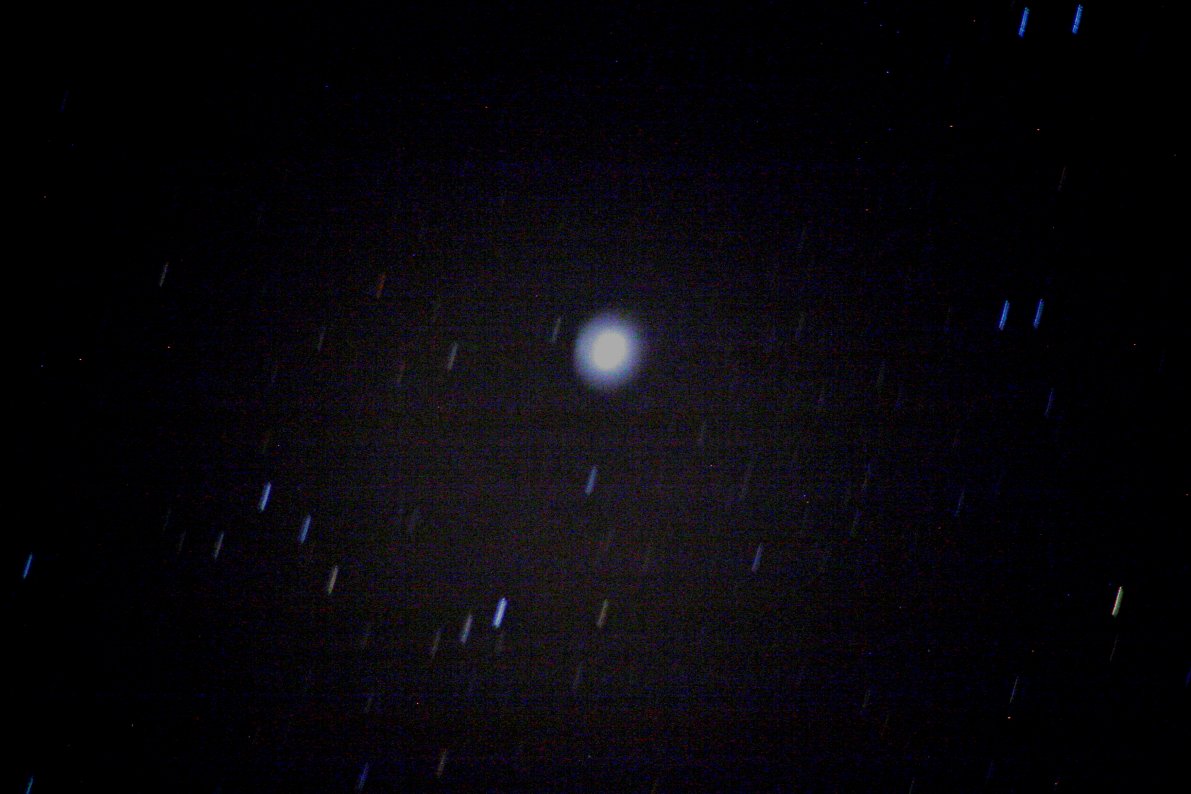 Comet 17P/Holmes |
This photo was taken by my brother, Randy Wendell, at about 9PM EST on November 04, 2007. He was using a Canon 20D with a 300mm zoom lens with about a 50 second exposure with the aperture at F/9.1 |
Ancient Astronomy:
"By measuring the days and years and by studying the seasons and movement of celestial bodies, the ancient Americans hoped to understand and to influence, if not totally control, the most important events of their world. The study of the planets and stars, believed to be manifestations of the gods, led to the development of calendars for guiding people through the agricultural and ritual cycles of their lives."Naked eye astronomy was aided by building alignments and window slats. Sometimes entire complexes were constructed for observatories, such as the Caracol at the Yucatec city of Chichén Itsá. Mesoamerican skywatchers plotted the movements of the stars in the night skies so skillfully they could predict the positions of Venus for over 500 years with only a two-hour margin of error. Entire cities could be aligned with an astronomical event, such as the heliacal set of Pleiades - known as the 'rattlesnake' by the Mesoamericans - that divided the year into rainy and dry seasons. Or a sacred building, such as a great ruler's tomb, might be designed to glow in the setting sun at solstice, a symbolic moment when the sun was believed to enter the Underworld, the realm of the dead."
Pale Blue Dot:
A Vision of the Human Future in Space
by Carl Sagan (Random House, 1994)
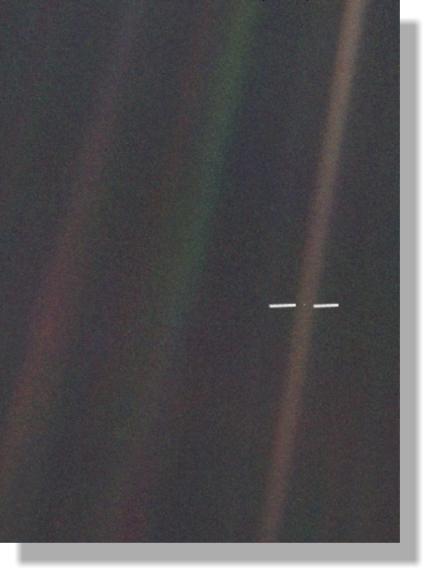
Earth as seen from 3.7 billion miles away by Voyager 1 in 1990."We succeeded in taking that picture [from deep space], and if you look at it, you see a dot. That's here. That's home. That's us. On it everyone you love, everyone you know, everyone you ever heard of, every human being who ever was, lived out their lives. The aggregate of our joy and suffering, thousands of confident religions, ideologies, and economic doctrines, every hunter and forager, every hero and coward, every creator and destroyer of civilization, every king and peasant, every young couple in love, every mother and father, hopeful child, inventor and explorer, every teacher of morals, every corrupt politician, every "superstar," every "supreme leader," every saint and sinner in the history of our species lived there - on a mote of dust suspended in a sunbeam. "The Earth is a very small stage in a vast cosmic arena. Think of the rivers of blood spilled by all those generals and emperors, so that, in glory and triumph, they could become the momentary masters of a fraction of a dot. Think of the endless cruelties visited by the inhabitants of one corner of this pixel on the scarcely distinguishable inhabitants of some other corner, how frequent their misunderstandings, how eager they are to kill one another, how fervent their hatreds. Our posturings, our imagined self-importance, the delusion that we have some privileged position in the Universe, are challenged by this point of pale light.
"Our planet is a lonely speck in the great enveloping cosmic dark. In our obscurity, in all this vastness, there is no hint that help will come from elsewhere to save us from ourselves. The Earth is the only world known so far to harbor life. There is nowhere else, at least in the near future, to which our species could migrate. Visit, yes. Settle, not yet. Like it or not, for the moment the Earth is where we make our stand. It has been said that astronomy is a humbling and character building experience. There is perhaps no better demonstration of the folly of human conceits than this distant image of our tiny world. To me, it underscores our responsibility to deal more kindly with one another, and to preserve and cherish the pale blue dot, the only home we've ever known."
Earth as seen through Saturn's rings
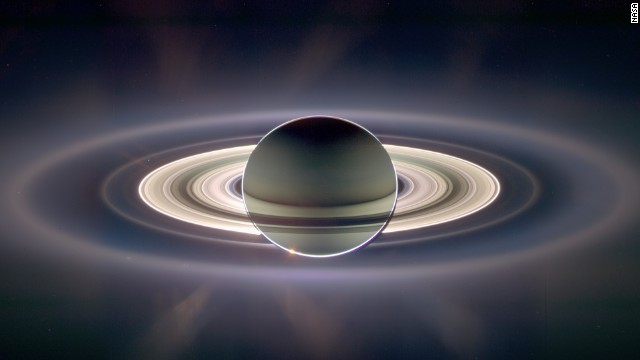
NASA's Cassini-Huygens spacecraft has been in service since 1997 and in orbit around Saturn since 2004.
In this 2006 image, Earth is a tiny dot on the left, just to the inside of the second outer ring.
|

|
Some Definitions:

2014/Oct./28
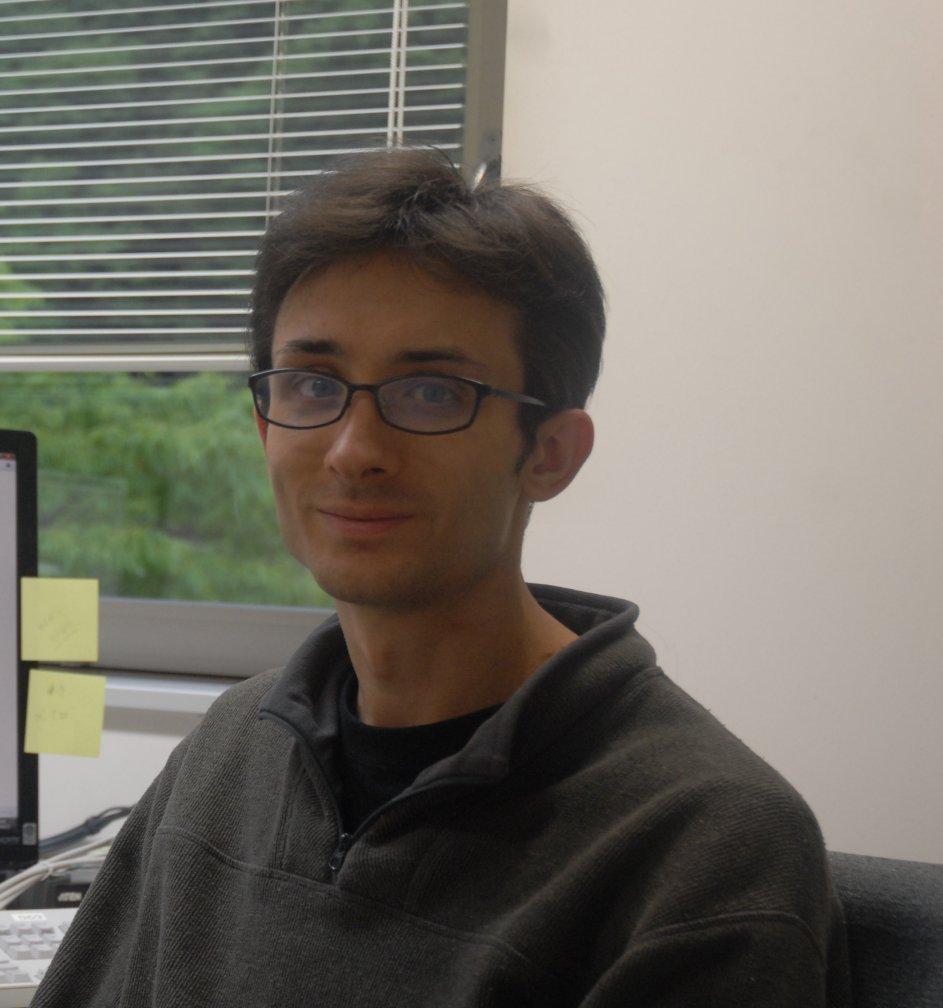
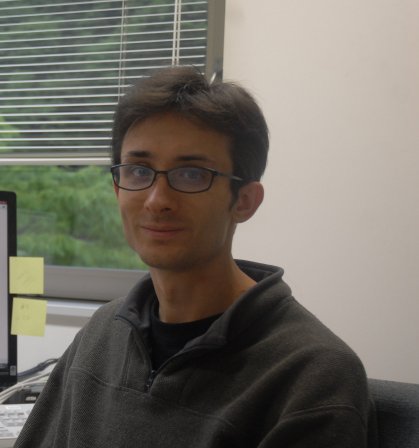
Assistant professor Roger Wendell has been awarded the Young Scientist Award of the Physical Society of Japan for contributions to "The first observation of evidence for the appearance of oscillation-induced atmospheric tau neutrinos." The result of this research have been published in 'Physical Review Letter 110, 181802 (2013)' under the title "Evidence for the appearance of atmospheric tau neutrinos in Super-Kamiokande." Though neutrino oscillations* were first discovered via the disappearance of atmospheric muon neutrino, this work is the first observation of the tau neutrino that they are thought to oscillate (change) into and thereby lays to rest the final piece of the long standing atmospheric neutrino problem. Further, as an observation of a neutrino after it has undergone oscillations, it has paved the way for the era of neutrino appearance measurements.
Professor Wendell will give a lecture describing these results at the 70th meeting of the Physical Society of Japan, to be held at Waseda University in March 2015.
*Neutrino oscillations: A phenomenon in which a neutrino of one type change into another during flight.
Big Bang Crash Course
Dimensions of Earth (in "Freedom Units")

Superficial Area 196,950,000 Sq. miles
Land Surface 57,510,000 Sq. miles
North America 8,500,000 Sq. miles
South America 6,814,000 Sq. miles
Europe 3,872,000 Sq. miles
Asia 16,990,000 Sq. miles
Africa 11,500,000 Sq. miles
Australia 2,974,581 Sq. miles
Water Surface 139,440,000 Sq. miles
Atlantic Ocean 31,830,000 Sq. miles
Pacific Ocean 63,801,000 Sq. miles
Indian Ocean 28,356,000 Sq. miles
Arctic Ocean 5,440,000 Sq. miles
Equatorial Circumference 24,902 miles
Meridional Circumference 24,860 miles
Equatorial Diameter 7,926.677 miles
Polar Diameter 7,899.988 miles
Equatorial Radius 3,963.34 miles
Polar Radius 3,949.99 miles
Volume of the Earth 260,000,000,000 cubic miles
Mass, or Weight 6,592,000,000,000,000,000,000 tons
Mean Distance from Sun 92,897,416 miles
|
Links: |
|
|
 Back to Roger J. Wendell's Home Page...

Abbey |
About |
Blog |
Contacting
Me |
Copyright |
Disclaimer |
Donate |
Guest
Book |
Home |
Links |
Site
Index |
Solutions |
Terms,
Conditions
and
Fair
Use |
What's
Changed
or
New?
Copyright
© 1955 -