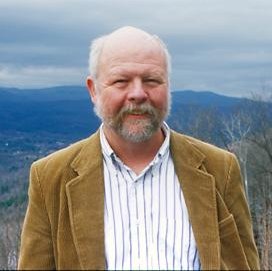
Roger J. Wendell
Defending 3.8 Billion Years of Organic EvolutionSM

Humanity does not have the right
to destroy an entire species, any species,
for any reason - Roger J. Wendell

|
Click Here for a Youtube video of what I believe is the Fritillary Butterfly endangered species research area on Uncompahgre Peak... |

|
Click Here for my page about Paleontology... |
|
|
Click Here for my page on Evolution... |
|
|
Click Here for my page on Biology... |
|
|
Click Here for my page on Life... |
Living creatures, biotic "communities," and ecosystems have an intrinsic value unto themselves. Their existence doesn't need to be justified in economic terms or as some benefit to business and commerce. Every living thing is special and has just as much right to pursue its existence as we do. Think about that for a moment - why would my right to exist trump yours or any other creature's??The sadness, of course, is the tragic loss of so many creatures, species, and living systems at the hand of humankind. Many times it's for greed, but at others it's due to simple ignorance or indifference. Whatever the reason, however, the losses continue mounting while the majority of us only concern ourselves with football scores, tax returns and television...
I hope this little page helps raise some awareness. Although it's a work in progress I don't want it to become just a catalog of loss - I hope that it can contribute, in some way, to saving a few species, a bit of habitat, or maybe even change some ways of thinking...
Roger J. Wendell
October 2nd, 2004
Golden, Colorado
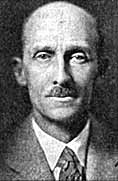 |
"When the last invdividual of a race of living things breathes no more, another heaven and another earth must pass before such a one can be again."
- Charles William Beebe (July 29, 1877 - June 4, 1962) American naturalist, ornithologist, marine biologist, entomologist, explorer, and author |
| "Surely we can agree that each species, however inconspicuous and humble it may seem to us at this moment, is a masterpiece of biology, and well worth saving. Each species possesses a unique combination of genetic traits that fits it more or less precisely to a particular part of the environment. Prudence alone dictates that we act quickly to prevent the extinction of species and, with it, the pauperization of Earth's ecosystems-hence of the Creation." |
| "According to the University of Chicago paleontologist David Raup, the background rate of extinction on Earth throughout biological history has been one species lost every four years on average. According to one recent calculation, human-caused extinction now may be running as much as 120,000 times that level." |
Rewilding North America
(A Vision for Conservation in the 21st Century)
Chapter 2 - The Pleistocene-Holocene Event:

By Dave Foreman
"If we step out of today and look closely at the historical, biological, and fossil records, we find that the current extinction crisis did not begin only four hundred years ago, and it has not been caused solely by colonial and industrial Europeans empires. Today's extinction crisis - the end of the Pleistocene, in Soulé's* words - has been ongoing for forty thousand years, initiated by early Stone Age cultures spreading into previously unoccupied parts of the world. Indeed , only in the last few decades has industrial civilization begun to rival these cultures in the significance of the number of species it has exterminated." p. 23*Michael E. Soulé is a U.S. biologist, best known for his work in promoting the idea of conservation biology.
Chapter 4 - The Second and Third Waves
"The central reality of our era is extinction. Nothing is more important. Mass extinction is our legacy as a species so far. No other moral challenge is so great as controlling our destructive power over nature." p.60
Extinction threatens world's plants, U.N. says
by the Associated Press (March 24, 1992)
[things have only gotten worse since then...]
"World population growth, environmental destruction and modern farming practices threaten thousands of native plant species with extincion...""The Earth's plant genetic resources are a limited and perishable natural resource, and their loss constitutes a grave threat to our world food security..."
"Today's disruption of the plants' ecologlical equilibrium is taking place so quickly, and the population growth is so massive, that nature does not have time bilologically to cope..."
Humans...

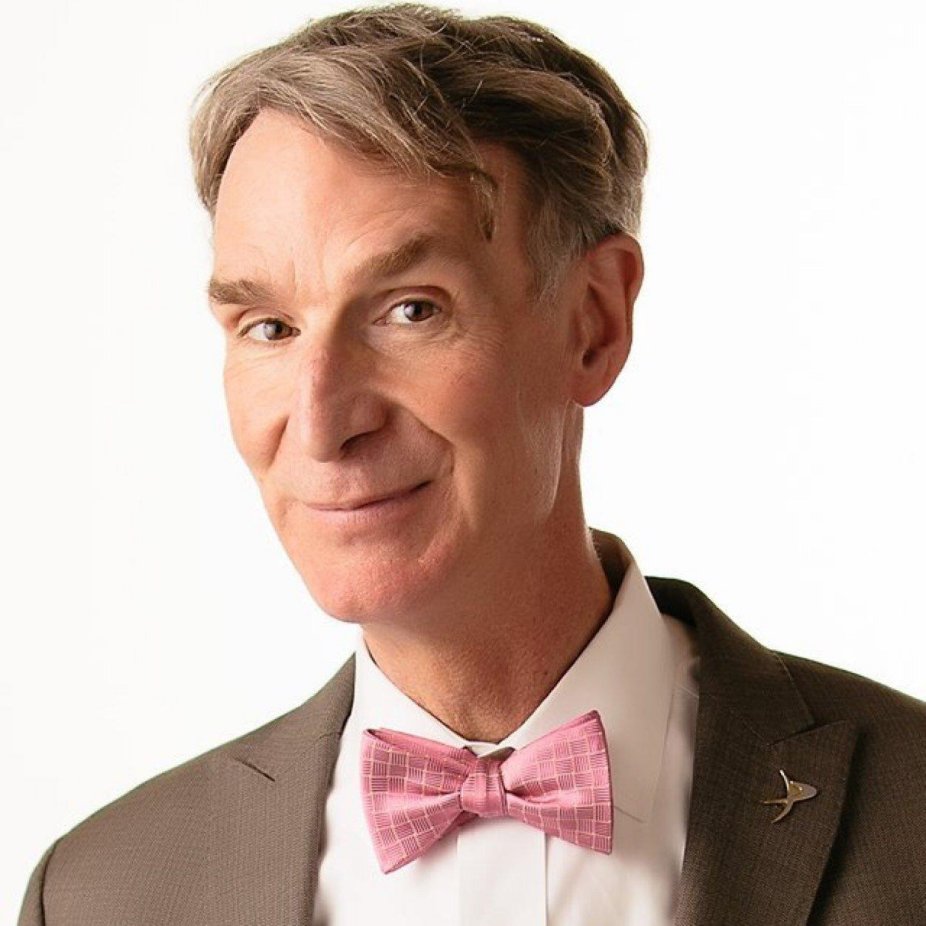
"You see the impact of humans on Earth's environment every day. We are trashing the place: There is plastic along our highways, the smell of a landfill, the carbonic acid (formed when carbon dioxide is dissolved in water) bleaching of coral reefs, the desertification of enormous areas of China and Africa (readily seen in satellite images), and a huge patch of plastic garbage in the Pacific Ocean. All of these are direct evidence of our effect on our world. We are killing off species at the rate of about one per day. It is estimated that humans are driving species to extinction at least a thousand times faster than the otherwise natural rate."
- Bill Nye in his book, Undeniable (Evolution, and the Science of Creation), p. 93
World on brink of mass extinction of species...
by the Associated Press (Sunday Denver Post - June 7, 1987)
[Another warning from the past that's been completely ignored...]
"Human destruction of forests and other ecosystems threatens to wipe out species on a scale unmatched since the dinosaurs diesappeared..." "Extinction surviviors, the record shows, tend to be ecological opportunits. They reproduce quickly, eat indiscriminately and tolerate a wide range of conditions - characteristics we associate with pests...""Plankton that bloom uncontrolled after a marine extinction, birds like house parrows and starlings, and the rats, cockroaches and weedy plants that flourish in disturbed environments all suppress the recovery of diversity by their prolific reproduction and intense competition for resources."
Extinct Species Take Others Along, Study Finds
Reuters News Service - September 13, 2004
"WASHINGTON - More than 6,000 species of butterflies and other insects, as well as mites, fungi and assorted unloved but important species, will also be wiped out when listed endangered species go extinct, scientists said.""We estimate that 6,300 affiliate species are 'coendangered' with host species currently listed as endangered," an international team of researchers wrote in their report, published in the journal Science. "Up to 50 percent of species are predicted to be lost in the next 50 years," they added. "Current extinction estimates need to be recalibrated by taking species coextinctions into account."
"Up to 50 percent of species are predicted to be lost in the next 50 years," they added. "Current extinction estimates need to be recalibrated by taking species coextinctions into account."
"The team, led by Lian Pin Koh and Navjot Sodhi of the National University of Singapore, compiled a list of 12,200 plants and animals currently listed as threatened or endangered. They then looked at insects, mites, fungi and other organisms that are uniquely adapted to some of the species."
"What we found is that with the extinction of a bird, or a mammal or a plant, you aren't just necessarily wiping out just one, single species," said Heather Proctor from the University of Alberta in Canada, who also worked on the study."
"We're also allowing all these unsung dependent species to be wiped out as well."
"For example, a vine that became locally extinct in Singapore took along with it a species of butterfly, Parantica aspasia, that was dependent on the vine for survival."
"When we lose this vine, this beautiful butterfly dies off with it, and we'll never see it again except in photographs at museums," said Proctor."
"While coextinction may not be the most important cause of species extinctions, it is certainly an insidious one," the researchers added.
The Diversity of Life

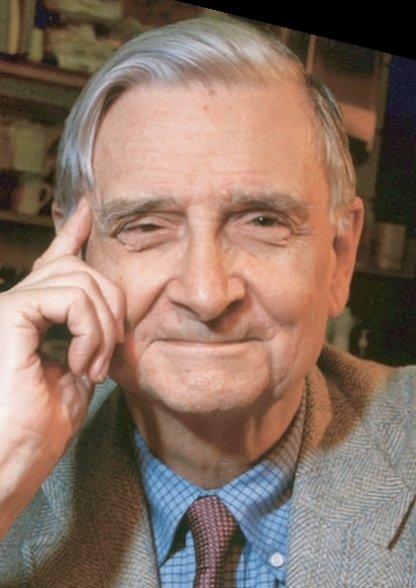
Edward O. Wilson
"This vision of the origin of diversity raises a troubling question with ethical overtones: if evolution can occur rapidly, with the number of species quickly restored, why should we worry about species extinction? The answer is that new species are usually cheap species. They may be very different in outward traits, but they are still genetically similar to the ancestral forms and to the sister species that surround them. If they fill a new niche, they probably do so with relative inefficiency. They have not yet been fine-tuned by the vast number of mutations and episodes of natural selection needed to insert them solidly into the community of organisms into which they were born." pp. 73-74"A recent survey by the Center for Plant Conservation revealed that between 213 and 228 plant species, out of a total of about 20,000, are known to have become extinct in the United States. Another 680 species and subspecies are in danger of extinction by the year 2000. About three fourths of these forms occur in only five places: California, Florida, Hawaii, Puerto Rico, and Texas. The predicament of the most endangered species is epitomized by Banara vanderbiltii. By 1986 this small tree of the moist limestone forests of Puerto Rico was down to two plants growing on a farm near Bayamon. At the eleventh hour, cuttings were obtained and are now successfully growing in the Fairchild Tropical Garden in Miami." pp. 257-258
"If past species have lived on the order of a million years in the absence of human interference, a common figure for some groups documented in the fossil record, it follows that the normal 'background' extinction rate is about one species per one million species a year. Human activity has increased extinction between 1,000 and 10,000 times over this level in the rain forest by reduction in area alone. Clearly we are in the midst of one of the great extinction spasms of geological history." p. 280
"A complete recovery from each of the five major extinctions required tens of millions of years. In particular the Ordovician dip needed 25 million years, the Devonian 30 million years, the Permian and Triassic (combined because they were so close together in time) 100 million years, and the Cretaceous 20 million years. These figures should give pause to anyone who believes that what Homos sapiens destroys, Nature will redeem. Maybe so, but no within any length of time that has meaning for contemporary humanity." p. 31
Aloha Po'ouli
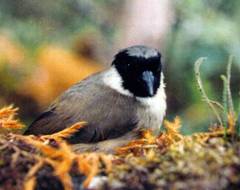
"Thirteen minutes before midnight on November 26, 2004, at the avian intensive care unit in Maui, a sparrow-sized bird with a black bandit's mask exhaled its last. With that, caretakers of the bird with the Hawaiian name po'ouli quite likely witnessed the final moment of a species."
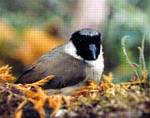
by William Stolzenburg
Nature Conservancy, Summer 2005, p. 80
Hardened professionals, ostensibly steeled to the brutal facts of life in the extinction capital of the United States, wept upon hearing of the last po'ouli's death. Even as they did, the field crews were heading back to the bird's last know hideaway, within the jungled heights of Maui's Haleakala Volcano, to resume their vigil on the wisp of a chance that another po'ouli or two survived."
"While the po'ouli's passing puts the most recent face on the planetary plague of extinction, the ivory-bill's resurrection - however lasting or fleeting - appends the heart-rending question, But when to give up the ghost?"
"'There's a danger in pretending birds haven't gone extinct,' says Stuart Pimm of Duke University, an expert on the global loss of biodiversity. 'There are forces of darkness out there inclined to say, 'Ah ha! No bird extinctions in the last fifty years. This so-called extinction crisis is a setup.'"
"'But the moment we wake up and say we can't do anything for the po'ouli, it's a slippery slope to saying, well, we can't do anything about the 'alala [the Hawaiian crow, existing only in captivity]. Why bother with eh puaiohi, with only 300 individuals in the wild? Once you say it's okay to cut the se species loose, then in fact you're basically saying it's okay to let species go extinct. We have to say, 'Hell no, we have to bring these species back from the brink.'"
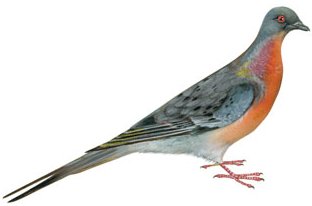
The Passenger Pigeon, Ectopistes migratorius, was once the
most common bird in the United States, numbering in the billions...
|
John James Audubon, in an 1813 trip down the Ohio River, observed a spectacle that is incomprehensible in today's world of environmenal reduction and destruction. Audubon recorded, in his journal, the passing of flocks of Passenger Pigeons so large that they actually darkened the sky for as far as his eye could see:
"I dismounted, seated myself on an eminence, and began to mark with my pencil, making a dot for every flock that passed. In a short time finding the task which I had, undertaken impracticable, as the birds poured in in countless multitudes, I rose, and counting the dots then put down, found that 163 had been made in twenty-one minutes. I traveled on, and still met more the farther I proceeded. The air was literally filled with Pigeons; the light of noon-day was obscured as by an eclipse, the dung fell in spots, not unlike melting flakes of snow; and the continued buzz of wings had a tendency to lull my senses to repose... Before sunset I reached Louisville, distance from Hardensburgh fifty-five miles. The Pigeons were still passing in undiminished numbers, and continued to do so for three days in succession." |
|
"Martha," a passenger pigeon named after George Washington's wife, the last of her kind, died on September 1st, 1914 at the Cincinnati Zoological Gardens. She was packed in an enormous 300-pound block of ice and shipped to the Smithsonian. According to author Joel Greenberg (A Feathered River Across The Sky) the passenger pigeon was the most abundant bird to ever exist on this planet... |
Miscalculations may mean grim outlook
Extinction risks underestimated 100-fold, possibly
by Brittany Anas - Boulder Camera
Thursday, July 3, 2008 - p. 1B
"A math glitch could mean the future of creatures on endangered species lists is even grimmer, as the calculations commonly used underestimate extinction risks by as much as 100-fold, according to a new study from a University of Colorado researcher."Brett Melbourne, an assistant professor in CU's ecology and evolutionary biology department, said math models used to determine extinction threats, or 'red-listed' status, of species worldwide overlook random differences among individuals in a given population."
"Survival rates and reproductive success can hinge on those variations - such as male-to-female ratios, as well as size or behavioral variations. And that has a large effect on extincion risk calculations, according to Melbourne's study."
"The findings could have a profoun impact on the conservation biology field, as experts are urged to adjust their calculations and could find that species may be on a much more rapid extinction path, Melbourne said."
"'When we apply our new mathematical model to species extinction rates, it shows that things are worse than we thought,' Melbourne said. 'By accounting for random differences between inddividuals, extinction rates for endangered species can be orders of magnitude higher than conservatin biologists have believed.'"
What is a Species?
"Probably the most widely accepted definition of a species is the biological species concept (Mayr 1969; Slobodchikoff 1976). This definition says that a species is a group of actually or potentially interbreeding populations that are reproductively isolated from other such groups. The key part of this definition is reproductive isolation. If two populations can interbreed, they are not considered to be separate species. While this is fine from a theoretical standpoint, in practice this definition presents some difficulties. One major difficulty is in establishing reproductive isolation between two or more populations. We can often make inferences about reproductive isolation, such as when two populations might have different chromosome numbers or DNA patterns, or in the case of insects, have genitalia that are so different that reproduction between populations is simply physically impossible. Another major difficulty is that it ignores the possibility that species are evolving units, and two groups of populations might be evolving into different habitats and have different morphologies, but still may not have lost their ability to interbreed. This is the situation with several of the canid or dog species. Domestic dogs can breed with coyotes to produce dog-coyote hybrids, and can also breed with wolves to produce dog-wolf hybrids. Although wolves, coyotes, and domestic dogs live in different habitats, and have different behaviors, they have not diverged very much in terms of the similarity of their DNA and have not lost the ability to interbreed. In this case, we call wolves, dogs, and coyotes separate species primarily for our convenience, because they all look and act differently, although there is a movement among some biologists to consider domestic dogs as members of the wolf species. A third difficulty is that sometimes two groups of organisms look very similar or identical, but cannot or do not interbreed because of chromosomal differences or differences of behavior, such as activity times are found in some animals such as insects. Still, even with these difficulties, the biological species concept offers us a criterion, most of the time, for deciding when two or more populations all belong to the same species."
Some North American History
"At the peak of the Ice Age, when massive amounts of water were locked up in the continental ice sheets, the sea level was low enough to create a landbridge from Asia, between Siberia and Alaska. The woolly mammoth, mastodon, bison, saber-toothed tiger, and other mammals then made their way across to populate America. Humans later followed them to enter a hunting paradise. Within a short time, the camel, rhinoceros, horse, giant beaver, giant ground sloth, musk ox, mastodon, woolly mammoth, and glyptodont all became extinct. It can be safely assumed that, like the moose today, all of these large mammals were tame and unafraid of humans. However, the moose, bison, caribou, deer, and wapiti survived, probably because they were part or wholly forest dwellers. Yet, even many of these species that remain would not be alive today, for the same reason why all the others died out, were it not for our modern communication system that permitted a coordinated conservation response in the nick of time. The prehistoric Clovis-Folsom hunter who, seeing such plentiful game, killed off most of the large American wildlife, would not have been any more concerned about possible extinctions than were the 19th-century American frontiersmen when confronting the vast bison herds. These animals, too, would have been obliterated, were it not for the accumulation of knowledge that allowed the formulation of a response beyond the local level. In the past, as game got scarce, the hunters merely moved on over the next hill, or beyond the next river. And always, wherever they sent, the animals were tame because they had never in their evolutionary history encountered human predators."
"By about 100,000 years ago, many of the large beasts had gone extinct, probably mostly from human hunting (although scientists - including those who gathered at the Oxford megafauna conference - are actively debating the impact of the various factors at work). In California, grassland experts believe that as recently as 6,000 years ago, 19 species of large browsing and grazing animals still populated the open lands."
Stephen Jay Gould
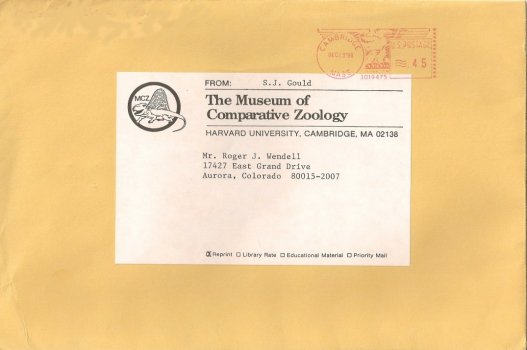
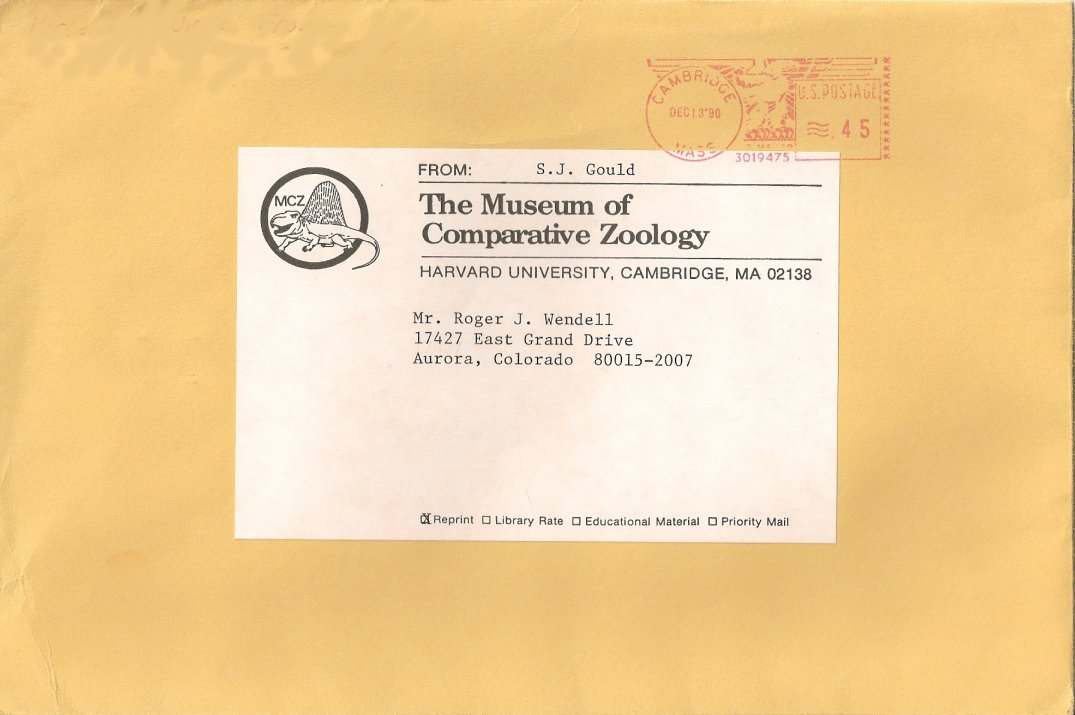
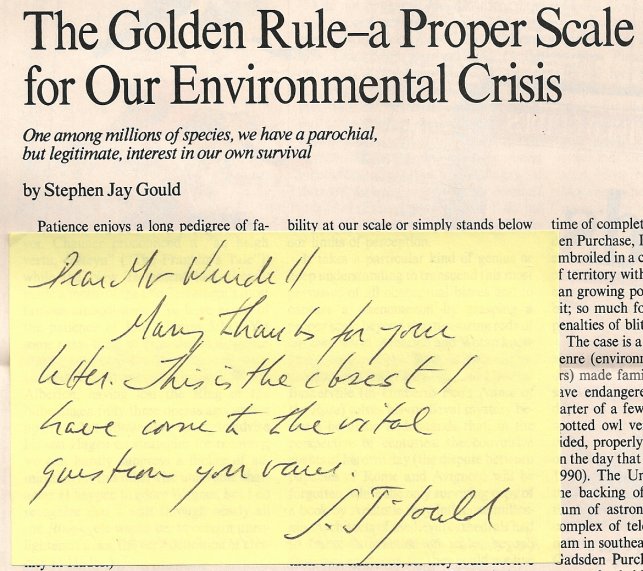
I had the good fortune to receive correspondence from Dr. Gould in late 1990. At that time I wrote him a letter (email
was in its infancy back then) asking what he thought about the current rate of human-induced extinctions. This great
scientist took time out of his busy schedule to not only respond with concern but to include a related article from the
Sep '90 edition of Natural History (pp. 24 - 30)] - Roger J. Wendell
Links:
|
|
 Back to Roger J. Wendell's Home Page...

Abbey |
About |
Blog |
Contacting
Me |
Copyright |
Disclaimer |
Donate |
Guest
Book |
Home |
Links |
Site
Index |
Solutions |
Terms,
Conditions
and
Fair
Use |
What's
Changed
or
New?
Copyright
© 1955 -