Roger J. Wendell
Defending 3.8 Billion Years of Organic EvolutionSM

Energy

|
"The second revolution, equal in importance, is a material, economic, and industrial revolution that alters the connection between the way we meet our material needs, on the one hand, and Earth's resources and ecosystems, on the other. This revolution is a technical one, about extreme efficiency in the use of all energy and materials. We must learn to use as little energy as possible - and the safest kind - to heat buildings, move vehicles, and drive machines. Every material product used by human beings should be designed to last essentially forever, to be recycled, or to be composted. Every 'waste' then would become a resource. Prices and economic measures must take natural systems into account."
- John Firor and Judith E. Jacobsen in their book, The Crowded Greenhouse (Population, Climate Change, and Creating a Sustainable World) |

|
Click Here for my wind energy page... |
|
|
Click Here for my page about solar energy and appropriate technology... |
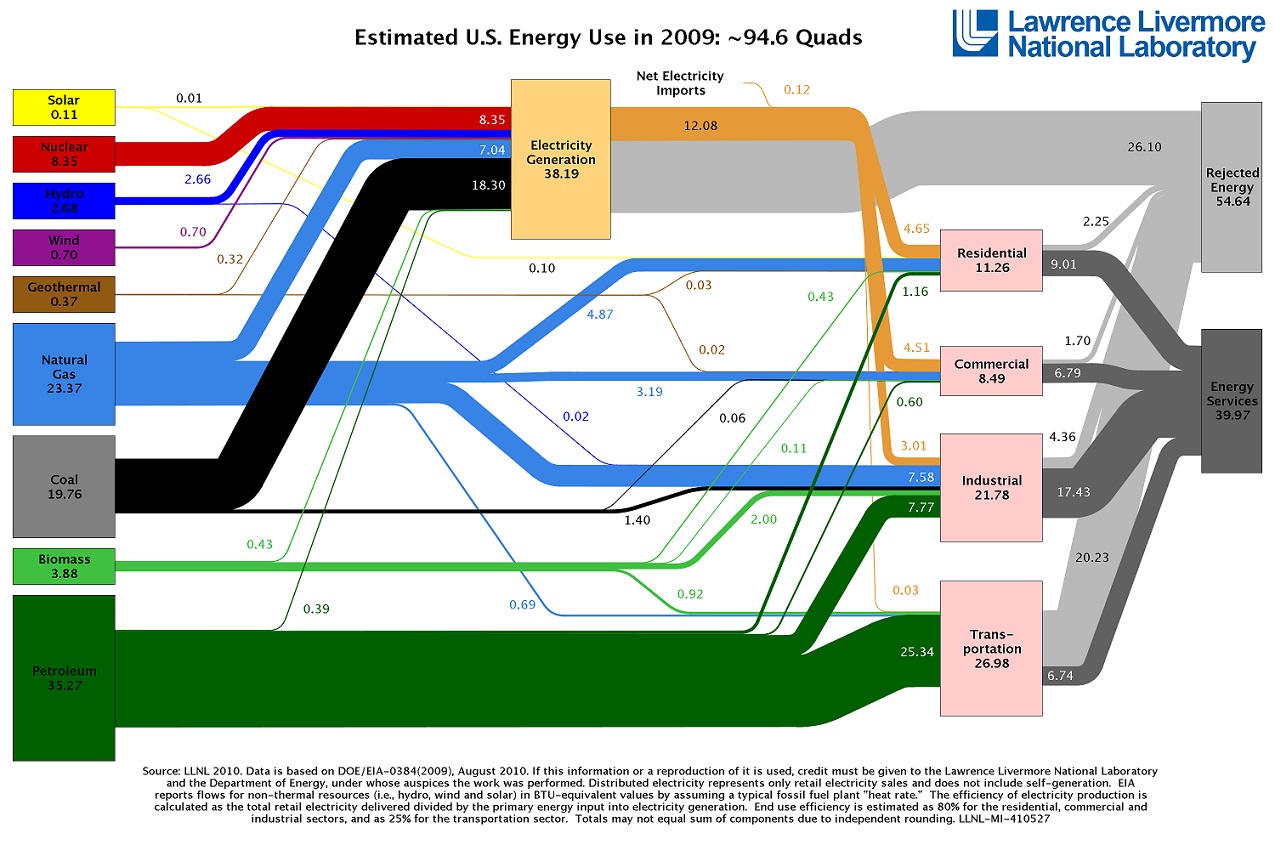
Government chart shows that we continue to waste more than half of our energy:
This flowchart and image was created by the Lawrence Livermore National Laboratory and the US Department of Energy. It shows the amount of energy, defined as a "quad" (see the quad defined, further, below this chart), that's produced by different U.S. energy sources and consumed by various sectors. The chart shows that more than half (58%) of the total energy produced in the United States is wasted due to inefficiencies at power plants, in lighting, and with our vehicles. At the 58% level of waste it means that the U.S. is only 42% energy efficient.
This chart also indicates that wind, solar, and geothermal energy sources, combined, still only provide about 1.2% of total energy production. The vast majority of our energy still comes from petroleum (37%), natural gas (25%), and coal (21%).

Enlarge
Defining a Quad:
A quad (short for quadrillion) is a unit of energy equal to 1015 (a short-scale quadrillion) BTU or 1.055 x 10¹⁸ joules (1.055 exajoules or EJ) in SI units ("SI" is a French abreviation for Système international d'unités, or International System of Units).The unit is used by the U.S. Department of Energy in discussing world and national energy budgets. For example, the 2004 global primary energy production was 446 quad, equivalent to 471 EJ.
Some common types of energy carriers that are approximately equal to one (1) quad are:
- 8,007,000,000 Gallons (US) of gasoline
- 293,083,000,000 Kilowatt-hours (kWh) electricity
- 36,000,000 Tonnes of coal
- 970,434,000,000 Cubic feet of natural gas
- 5,996,000,000 UK gallons of diesel oil
- 25,200,000 Tonnes of oil
- 252,000,000 tonnes of TNT or five times the energy of the Tsar Bomba nuclear test (conducted by the USSR, the world's largest ever nuclear blast)
Home Energy and Money Saving Checklist
(Distributed on a frig magnet by the Rocky Mountain
Chapter of the Sierra Club in the early 2000s...)
Energy Growth and Limits
From Lee Billings' Five Billion Years of Solitude
(The Search For Life Among The Stars), pp. 103-104
"Energetic limits to economic growth are remarkably straightforward to calculate, given a few simplifying assumptions. Taking the United States as an example, data from the federal Energy Information Administration shows that the nation's total energy usage has grown by just under 3 percent per year since the middle of the seventeenth century. As a thought experiment, a UC San Diego professor, the physicist Tom Murphy, has calculated the consequences of that continued growth out into the future, extrapolating it to the entire globe and reducing it to 2.3 percent per year, which yields a factor-of-ten increase in energy usage every century. Starting from a circa 2012 global energy use of 12 terawatts, the world of 2112 would consume 120 terawatts, and the world of 2212 would consume 1,200. By 2287, world energy consumption would be 7,000 terawatts - an amount that could in theory be delivered by covering all the land on Earth with photovoltaic solar-power arrays operating at 20 percent efficiency. From there, increasing the efficiency of the photovoltaics to a miraculous 100 percent and covering the oceans as well as the continents would allow the 2.3 percent annual growth in energy use to persist for another 125 yyears, taking our steadily growing civilization into A.D. 2412 before it outpaced the total amount of sunlight falling upon the Earth. Another energy source, nuclear fusion, could potentially sustain an annual 2.3 percent growth rate for some centuries beyond this, at least until the waste heat from the vast amount of power being produced evaporated the oceans and turned Earth's crust to glowing slag. For a planet-bound civilization, the boiling point of water and the melting points of rock and metal place insurmountable limits upon the expansion of energy use."
Links:
|
|
 Back to Roger J. Wendell's Home Page...

Abbey |
About |
Blog |
Contacting
Me |
Copyright |
Disclaimer |
Donate |
Guest
Book |
Home |
Links |
Site
Index |
Solutions |
Terms,
Conditions
and
Fair
Use |
What's
Changed
or
New?
Copyright
© 1955 -