Roger J. Wendell
Defending 3.8 Billion Years of Organic EvolutionSM

Food
Although I'm not a doctor I've studied food, dieting, and health to a great extent, because of my own battle(s) with weight control and other health issues. This page is mostly just a list of foods I feel are healthful along with another list of foods that I think should be avoided. Since it's a list tailored to my own health needs, along with being mostly personal opinion, I highly recommend you contact your doctor before adapting my eating habits!
Food?
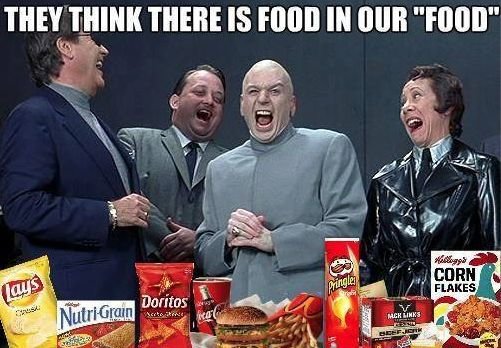
First off, a complaint! I love food just as much as anyone else and have eaten my weight (and more!) in "junk"
food over the years! But, unfortunately, even the "healthy" food I've purchased and consumed has been packed
with all kinds of unhealthy stuff like sugar, Monosodium Glutamate, Butylated Hydroxytoluene, pesticides, heavy
metals, and other chemicals, preservatives and flavor enhancers. Not to mention, of course, Genetically Modified
Organisms (GMO's), coloring, and even radiation being used on the things that I eat!

|
Click Here for my GMO page... |
From the 2008 documentary, Food, Inc.
(transcribed by me!)
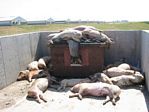
The way we eat has changed more in the last 50 years than in the previous 10,000, but the image that's used to sell the food is still the imagery of agrarian America. You go into the supermarket and you see pictures of farmers - the picket fence, and the silo, and the thirties farmhouse, and the green grass. It's the spinning of this pastoral fantasy.
The modern American supermarket has, on average, 47,000 products. There are no seasons in the American supermarket - now there are tomatoes all year around. Grown half way around the world, picked when it was green and ripened with ethylene gas. Although it looks like a tomato it's kind of a 'notional" tomato. I mean, it's the idea of a tomato.In the meat isle, there are no bones anymore. There is this deliberate veil, this curtain, that's dropped between us and where our food is coming from. The industry doesn't want you to know the truth about what you're eating. Because if you knew you might not wanna eat it. If you follow the food chain, back, from those shrink-wrapped packages of meat you find a very different reality. The reality is a factory, it's not a farm, it's a factory.
That meat is being processed by huge, multinational corporations that have very little to do with ranches and farmers. Now our food is coming from enormous assembly lines where the animals and the workers are being abused. And the food is become much more dangerous in ways that are being deliberately hidden from us. You've got a small group of multinational corporations who control the entire food system, from seed to the supermarket. They're gaining control of food.
This isn't just about what we're eating, this is about what we're allowed to say, what we're allowed to know. It's not just our health that's at risk. The companies don't want farmers talking, they don't want this story told.
|
"The diet that best supports health and healing for humans is a pure vegetable diet centered around starch foods with the addition of fresh fruits and vegetables" p. 17 "Altering the physical form of complex carbohydrates by certain processes, such as the simple grinding of brown rice grains into rice flour, changes the body's response to the food. Grinding affects the rate of digestion and absorption of the carbohydrate and results in a more rapid rise and a higher level of glucose and insulin in the blood. Thus, it is not only important for the foods in a health-supporting diet to include starch, vegetables, and fruit, but they must also be in a whole, unprocessed form whenever possible. One final observation is that slow heating (dextrinization) and cooking of food causes a breakdown of complex sugars into simpler forms, increasing the digestibility and subsequent rise in blood sugar." p. 114
|
|
|
Click Here for my diet page... |
|
|
Click Here for my page on vegetarianism... |
What is Starch?
John A. McDougall, MD and Mary McDougall
from Chapter 1 of their book, The Starch Solution, p.4

"Plants use water, carbon dioxide, and energy from the sun to form simple sugars through a process called photosynthesis. The most basic carbohydrate is the simple sugar glucose. Inside the plant's cells, simple sugars are linked into chains, some of them arranged in a straight line (amylose) and others in many branches (amylopectin). When these sugar chains gather in large quantities inside a plant's cells, they form starch grains, also called starch granules (amyloplasts)." "Plants store in their roots, stems, leaves, flowers, seeds, and fruits the starch they produce. The stored starch provides them with a source of energy when they need it later, keeping them alive through the winter and fueling their reproduction the following spring. It's what makes styarchy vegetables, legumes, and grains so healthy to eat: their high concentration of carbohydrates not only sustains the plants but also provides the energy needed to sustain human life.
"Starch should be our primary source of digestible carbohydrate. The enzyme amylase in our saliva and intestine breaks down the long carbohydrate chains, turning them back into simple sugars. Digestion is a slow process that gradually releases these simple sugars from the small intestine into the bloodstream, providing our cells with a ready supply of energy.
"Fruits offer quick-burning energy mostly in the form of simple sugars, but little of that slow-burning, sustaining starch. As a result, fruits alone won't satisfy our appetite for very long. Green, yellow, and orange nonstarchy perishable vegetables contain only small quantities of starch. Their most important role is to contribute flavor, texture, color, and aroma to your starch-based meals. They offer a bonus in the additional nutrients (such as vitamin A and C) that come along for the ride."
Goodall
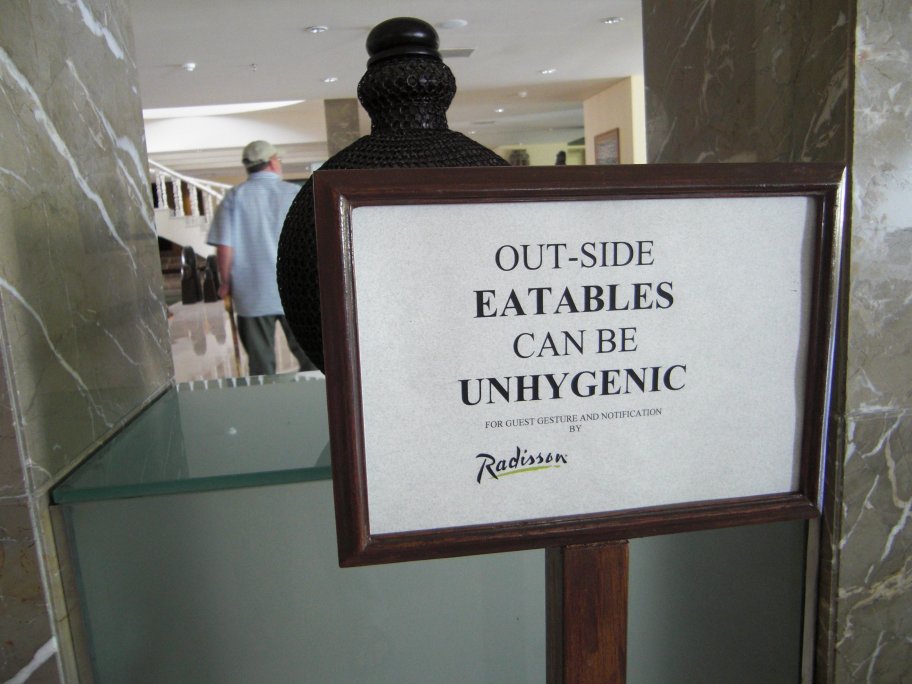
Out-side eatables, India"We need to build a closer connection with the food we eat because, after all, it does become integrated into our bodies, into our muscles and nerves and blood. We are made up, physically, of what we eat and drink. We must begin to choose our food accordingly." p. 206
"It is important, when we buy food from other countries, particularly from the developing world, that we make sure the product was grown and harvested in an environmentally and socially ethical way - which means buying fair trade and organic as much as possible. When any of us eats from local, organic food sources, we are less likely to contribute to the exploitation of another country's people or precious natural resources. Not every region or community can or should produce all its food. But it doesn't make sense for poor, underdeveloped areas of the world to grow cash crops for other countries when their own people go hungry. Nor does it make sense for wealthy countries to import cash crops when they are already growing the same kinds of foods in abundance." p. 216
- Jane Goodall in her book Harvest for Hope
|
Comfort Food
|
Hunger
"Hunger - the painful sensation that someone feels on a regular basis due to lack of food - is a relatively rare phenomenon in America today, but it nevertheless afflicts a small number of U.S. residents on a n intermittent basis. The more common form of food insufficiency is known as food insecurity, a condition experienced by a much larger number of people who regularly run out of food or simply don't know where their next meal will come from. As part of the annual census update, the U.S. Department of Agriculture conducts a survey that determines the number of people who are food insecure (generally between 10 and 12 percent of the U.S. population) and severely food insecure (3 to 4 percent of the population, until 2006 labeled 'food insecure with hunger')."
- Mark Winne
Closing the Food Gap
Resetting the Table in the Land of Plenty, p. xvi
The end of cheap food
The Economist December 8, 2007, p. 11
"For as long as most people can remember, food has been getting cheaper and farming has been in decline. In 1974-2005 food prices on world markets fell by three-quarters in real terms. Food today is so cheap that the West is battling gluttony even as it scrapes piles of half-eaten leftovers into the bin.""That is why this year's price rise has been so extraordinary. Since the spring, wheat prices have doubled and almost every crop under the sun - maize, milk, oilseeds, you name it - is at or near a peak in normal terms. The Economist's food-price index is higher today than at any time since it was created in 1845. Even in real terms, prices have jumped by 75% since 2005. No doubt farmers will meet higher prices with investment and more production, but dearer food is likely to persist for years. That is because 'agflation' is underpinned by long-running changes in diet that accompany the growing wealth of emerging economies - the Chinese consumer who ate 20kg (44lb) of meat in 1984 will scoff over 50 kg of the stuff this year. That in turn pushes up demand for grain: it takes 8kg of grain to produce one of beef."
Food Safety Tips
Salmonella is a bacteria that causes fever, abdominal craps, and diarrhea that can even contain blood at times. Most people recover from salmonella infection in about a week's time. However, some cases can be severe or even life-threatening. Babies, elderly persons, and people with weak immune systems are more likely to succumb to a salmonella infection. I found these tips in the July '07 online issue of WebMD (Keep Food Poisoning off Summer Menu by Miranda Hitti):
- Thoroughly clean your hands, cooking surfaces, countertops, and utensils in hot, soapy water before and after preparing each food item.
- Rinse all produce in running water.
- Separate raw meat from cooked foods. Clean plates, utensils, and cutting boards that have touched raw meat.
- Cook foods thoroughly. Use a clean cooking thermometer to make sure meat and poultry is done.
- Refrigerate meat or poultry as it defrosts; don't let it thaw on the countertop.
- Store foods promptly; don't let them linger on the table.
- Dirk Benedict in his book,
Confessions of a Kamikaze Cowboy p. 169
Food Choices:
|
|
Note: On 09/18/2006, at the age of 50, I was diagnosed with kidney stones (not to mention cancer, three months earlier...). Since mine were analyzed as consisting primarily of calcium oxalate, my doctor asked that I reduce the intake of oxalate containing foods. So, I've been trying to remove things like nuts, peanut butter, chocolate, tea,, spinach, rhubarb, beets, wheat bran, and strawberries from the above list. Again, before undertaking any dietary or health change I strongly encourage you to see your own doctor because you can see (from my kidney stone experience) each and every one of us is so very different...
Pasta Power!
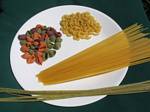
Okay, I have a bias - I've always loved pasta! To me, pasta should have always been listed as a major contributor to a healthy diet - along with vegetables, fruit, legumes, etc. I believe it was Dr. John McDougall who often referred to pasta, especially the whole grain types, as a "clean burning" carbohydrate - despite everyone else's belief that it was fattening or had other deficiencies. Anyway, here's a look at one of my favorite foods:
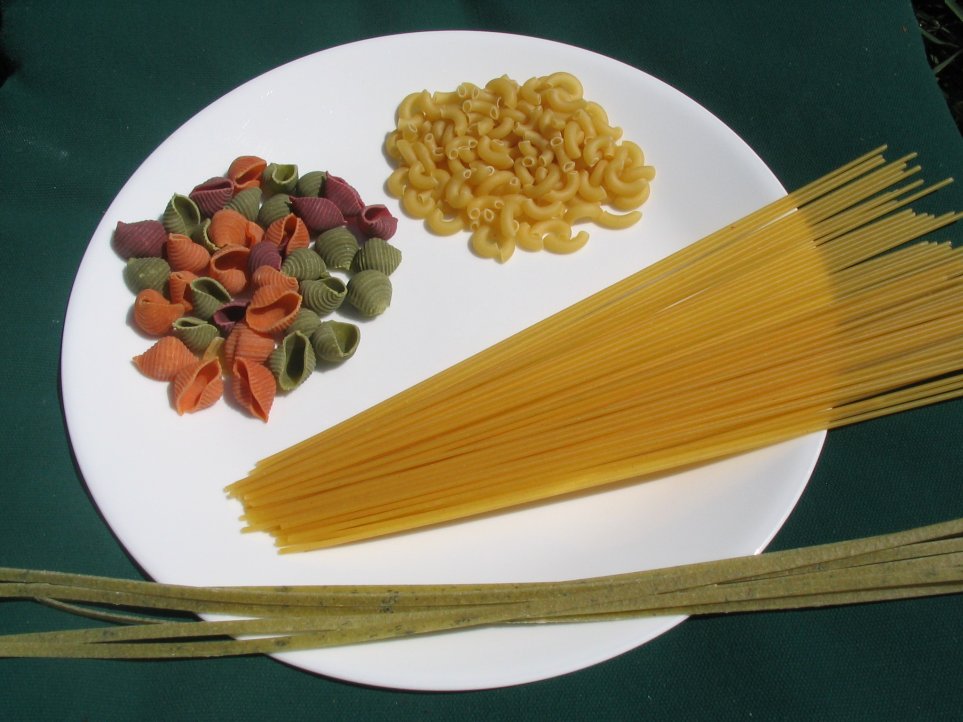
"Pasta" is the Italian word for "paste." Pasta is made from grain flour mixed with water to create a dough. There are all kinds of different shapes and sizes for pasta. And, although most pastas are made from wheat, other grains can be used for people who are gluten intolerant, etc. My own favorite pastas are the whole Durum Wheat elbows with beet, spinach, carrot, or annatto powder mixed in for different colors, taste and texture. Unfortunately I haven't been able to locate a steady supply of these elbows since the early 2000s but find that the spirals and shells work just as well.Pasta dough can be forced through a variety of different molds to create noodles ranging in shape from smooth and flat to solid, hollow or spiral. The Italian name, for any particular style of pasta, is determined from its shape:
The nutritional value of pasta is determined by the flour it's made from. Whole grains, obviously, are more nutritious because the bran and germ of the grain have been left in the flour. Most pasta is made with durum wheat which is high in protein and gluten - making the dough better able to hold its shape because it sticks together better.
- Cannelloni, tube-or cane-shaped pasta
- Capellini (angel hair), "fine hairs"
- Conchiglie, "shells"
- Fettucine," "small ribbons"
- Fusilli, "little spindles" (spirals)
- Lasagna, broad, sometime ruffled, ribbons of pasta (from the Latin "pot")
- Linguini, "little tongues"
- Penne, "quills"
- Ravioli, "little turnips"
- Rigatoni, "furrows," short, wide fluted tubes
- Rotini, "spirals" or "twists"
Spaghetti, from spago, "cord"- Tortellini, "little cakes"
- Vermicelli, "little worms"
Semolina or farina are popular pasta flours that have had the germ and bran removed, making them less nutritious and lower in fiber. However, pasta in general is less nutritious than the same amount of whole wheat or multi-grain bread because the flour is much more refined - packing in a few more calories.
Anyway, I've always enjoyed pasta and even rely on it while on extended backpacking trips and adventure treks. To me, it's easy to prepare, stores well, and seems to provide good energy. Simply boiling the pasta, until it's soft, works well at home and out in the wilderness. Since I also love onions, I boil a whole one along with the pasta, even adding the onion a few minutes earlier if needed. After draining the water I add a simple tomato sauce that's free of fat and oils and I end up with a pretty good main course both at home and outdoors!
Psycho Soup:
|
"Psycho Soup" is something I invented, in the mid 1980s, as a variation of the regular pasta theme. Again, it's a recipe based on simplicity so the idea is easy ingredients, easy preparation, and easy clean-up. For Psycho Soup I boil a potato or two well in advance of the other ingredients (since potatoes take longer to cook and soften-up). After the potatoes are far enough along I add a whole onion and whole garlic. I chop up a Jalapeño pepper but found it can be added at anytime since it's "strength" doesn't seem to diminish too much with cooking. In the past I've also added carrots and other "hard" vegetables, but find these later additions can be optional.
Anyway, nearing the end of the boil, I add the pasta (elbows were always my favorite but hard to get nowadays with the mixed-vegetable powder blends...) and cook it all until tender. Drain the water* and serve the whole thing topped with a health tomato sauce - the result is a healthy, filling meal that's pretty easy for even somebody like me to put together! |
*Sometimes I save the water I drain-off and let it cool for a drink later on Since
so many different vegetables are cooked in "Psycho Soup" the drained-off water
can be packed with nutrients and shouldn't be wasted!
Fish is not health food!
According to Doctor Neal Barnard, M.D., "Fish is not a health food by any stretch of the imagination. According to a study published in The New England Journal of medicine, people who followed a diet emphasizing poultry and fish, called the National Cholesterol Education Program Step II Diet, found that their cholesterol levels changed very little.""Fish's selling point is omega-3 fatty acids. But the fact is, fish fat is a mixture of fats. Anywhere from 15% to 30% of the fat in fish is plain old saturated ('bad') fat. That's somewhat lower than in beef and chicken but far higher than in healtful vegetarian foods. And fish fat is everty bit as fattening as lard or chicken fat. People adding salmon to their diets in hopes of some vague benefit often find it hard to manage their weight, because of the load of fat they are eating. Fish flesh contain plenty of cholesterol too. Ounce for ounce, shrimp and other mobile shellfish have nearly twice the cholesterol of beef.
"Fish often carry contaminants from polluted waterways. About 40% of fish samples have so much bacterial contamination that they have already begun to spoil before they are sold. Fish are also often contaminated with PCBs, which have been linked to cancer and birth defects. Consumer Reports found PCBs in 43% of salmon, 50% of whitefish, and 25% of swordfish. The US Food and Drug Administration and the US Environmental Proteciton Agency warned pgregnant women, women who may become pregnant, breastfeeding women, and children to limit their soncumption of fatty fish because it contains mercury, which can also contribute to birth defects, kidney damage, impaired mental development, aned even cancer.
"So where will we get our omegas-3s? Vegetables, fruits, and beans don't contain much fat, but what fat they do have is relatively high in omega-3. A person aiming for a higher omega-3 intake, for whatever reason, will find it in ground flaxseeds, flaxseed oil, walnuts, soy products, and vegetarian omega-3 supplements, such as Sea Vegg.
"If you really want to work on beating heart disease, forget the fish and try a vegetarian diet rich in fruits, vegetables, whole grains, and bean low in fats of any kind."
PETA's Animal Times, winter 2007, p. 21
"In a comprehensive new study by the U.S. Geological Survey, every fish from 291 streams across the nation tested positive for mercury contamination. By EPA standards, one out of four of the thousand fish tested was unsafe to eat, particularly for children, pregnant women, and nursing mothers. Thanks in large part to emissions from coal-burning power plants, mercury contamination is now ubiquitous." - Sierra Magazine November/December 2009 (Volume 94, Issue 6)
Spit Happens:

Saliva's mysteries revealed
By Elizabeth Landau - cnn.com, March '09
Excerpts:
"Your saliva is doing all kinds of useful things for you all the time -- for instance, helping you chew and taste food. It's also home to more than 600 species of bacteria, which are harmlessly enjoying the moisture of your mouth."
- Saliva contains more DNA than blood because of all of the oral bacteria
- Most common type of bacteria in saliva is Streptococcus, in a mostly harmless form
- Saliva spreads molecules to the taste receptors on the tongue
"...In fact, researchers found that the human salivary microbiome -- that is, the community of bacteria in saliva -- does not vary greatly between different geographic locations. That means your saliva is just as different from your neighbor's as someone's on the other side of the planet."
"Why do you need hundreds of bacteria species in your mouth? It turns out they're mostly not helping you at all -- you're just giving them a warm, moist home."
"One component of saliva that has been shown to vary according to diet is amylase, the only digestive enzyme that converts starch into sugar, Dominy said. Amylase is also found in the pancreas and the small intestine." [Nate Dominy, anthropologist at the University of California, Santa Cruz]
"The human body evolved to start the digestive process early, in the mouth, so we can maximize the amount of sugar that we take in, Dominy said."
"'Given that we have such large brains, and our brains are metabolically very demanding tissues, they're extremely costly and expensive to maintain, so we need a lot of sugar,' he said."
"Americans in particular have a lot of amylase in their saliva because their diets are full of starch: chips, rice and baked potatoes. But the Pygmies of central Africa, for example, eat mostly game animals, honey and fruit. They have relatively little amylase in their saliva."
"Dominy and colleagues found these differences at the genetic level, meaning natural selection has favored large quantities of amylase in populations with starchy diets. "
"Humans have had starch as an important part of their diet for at least 12,000 years, since the advent of agriculture, he said."
"So what else is spit good for?"
"Saliva spreads molecules to the taste receptors on the tongue so you can tell whether something is salty, sour, sweet or spicy, Dominy said. It also helps soften food and spread it to your teeth so that you don't have to chew as hard."
"Compared with other animals, humans are not very good at detecting toxins, he said. As a result, humans vomit much more than other species, and saliva buffers the acid that results from throwing up -- meaning you'll likely salivate immediately beforehand to limit the damage."
"'A lot of the value of saliva is attributable to the fact that, in human evolution, we've had to eat marginal plant foods, things that are marginal in quality and full of toxins, and we need these particular salivary adaptations to help cope with those types of food,' he said."
Food Aversions Explained!
David Solot, CNN Eatocracy, 11-02-2011
Ever wonder why there's a particular food that makes you sick or that you just don't
like? According to David Solot, a Ph.D. psychology student at the time of this article,
your food aversion could be the result of a million-year-old survival mechanism.
Here's how Solot explained it: "You and your buddies go out for a few drinks. You're young and wild and love drinks with the strong coconut flavor of Malibu Rum. Things get a little out of hand, and you spend part of the night praying to the porcelain god. You recover, and next weekend go out for drinks again. The bartender passes you your favorite drink, but this time the smell of coconut immediately makes you want to vomit. You loved Malibu for years, but now, the very thought of it makes you sick."Solot went on to explain that the situation can get a little complicated in that what made you ill, earlier in the day, could confuse your brain and make it think it was something else you ate a little later. It turns out that what you ate later in the day wasn't the problem but your brain thought it was - so now you have an aversion to something that really wasn't harmful to you. The effect is so strong, explains Solot, that chemotherapy patients are often cautioned not to eat their favorite foods while being treated so that they'll still find them enjoyable in the future! Solot also explained that our conscious mind is capable of overcoming food aversions by consciously going slowly, exposing ourselves to the food in positive surroundings. He ended his piece by reminding us that making such a chance can be challenging as "A million years of evolution is hard to overcome!""What you're experiencing is your brain protecting you from being poisoned. When we were primitive creatures, we weren't sure what was safe to eat so we tested things out.
"If you survived the experience, your brain had to make sure that you never ever ate that same thing again. So, if you ate something that made you feel ill, your brain decided "better safe than sorry," and conditioned you to feel sick anytime you saw, smelled or even thought about that same food.
"The next time you went foraging for food and came across a berry that made you feel sick in the past, you would get hit with an overwhelming feeling of nausea and go eat something else. The people who were good at developing taste aversions lived and had children. The ones who were bad at it - well - they largely got poisoned and died. So over the centuries, our ability to form taste aversions got stronger and stronger.
"The reason your night of drinking resulted in a hatred of Malibu is due to this same survival mechanism. When you felt nauseated at 3am, your brain sensed that you had been poisoned. Your brain didn't know for sure what caused it, but it did remember a really strong coconut flavor from earlier that night.
"To protect you, your brain decided "better safe than sorry," and assumed that the coconut flavor was to blame. To make sure you don't poison yourself in the future, it set up a conditioned response so that the smell or taste of coconut will make you feel sick."
|
Links: |
|
|
Other Articles:
 Back to my vegetarianism page...
Back to Roger J. Wendell's Home Page...

Abbey |
About |
Blog |
Contacting
Me |
Copyright |
Disclaimer |
Donate |
Guest
Book |
Home |
Links |
Site
Index |
Solutions |
Terms,
Conditions
and
Fair
Use |
What's
Changed
or
New?
Copyright
© 1955 -