Roger J. Wendell
Defending 3.8 Billion Years of Organic EvolutionSM

Alan Koch with permission

|
"Farming as we do it is hunting, and in the sea we act like barbarians."
|

|
Click Here for a live stream soundscape from 900 metres below the ocean's surface just outsdie Monterey Bay! |
HUMAN POPULATION GROWTH AND OCEANS
From the Center for Biological Diversity website (2018)
"Marine fish provide 15 percent of all animal protein consumed by humans. Under this intense pressure - 15 percent of 7.5 billion people (and growing), every year, year in, year out - global fisheries are collapsing.
"A vast amount of the discarded waste of 7.5 billion consumers also finds its way to the oceans."
"A 2009 assessment of the state of commercial fisheries around the world found that 80 percent of fish stocks are either fully exploited, overexploited, or have collapsed. Though a catch reduction of 20 to 50 percent is needed to make global fisheries sustainable, the demand for fish is expected to increase by 35 million tons by 2030 due to increased consumption and a 'rapidly increasing human population.' The authors of the analysis warn that both biological diversity and human food security are at great risk."
Aquacalypse Now
The End of Fish
by Daniel Pauly, The New Republic
September 28, 2009
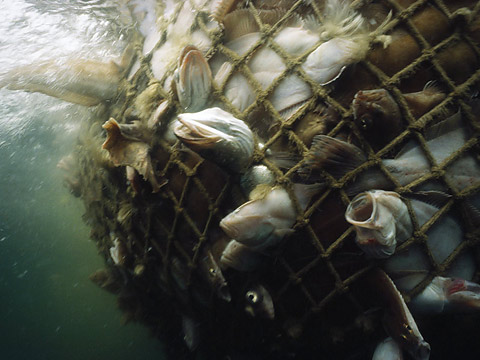
"Our oceans have been the victims of a giant Ponzi scheme, waged with Bernie Madoff-like callousness by the world's fisheries. Beginning in the 1950s, as their operations became increasingly industrialized--with onboard refrigeration, acoustic fish-finders, and, later, GPS--they first depleted stocks of cod, hake, flounder, sole, and halibut in the Northern Hemisphere. As those stocks disappeared, the fleets moved southward, to the coasts of developing nations and, ultimately, all the way to the shores of Antarctica, searching for icefishes and rockcods, and, more recently, for small, shrimplike krill. As the bounty of coastal waters dropped, fisheries moved further offshore, to deeper waters. And, finally, as the larger fish began to disappear, boats began to catch fish that were smaller and uglier--fish never before considered fit for human consumption. Many were renamed so that they could be marketed: The suspicious slimehead became the delicious orange roughy, while the worrisome Patagonian toothfish became the wholesome Chilean seabass. Others, like the homely hoki, were cut up so they could be sold sight-unseen as fish sticks and filets in fast-food restaurants and the frozen-food aisle."
On June 14, 2004 I was listening to the BBC when they opened their News Hour program with a report on world
fish stocks. News Correspondent and Presenter Lyse Doucet started the program with this announcement:
(On February 18, 2007 I was again listening to the BBC when they reported the discovery of huge "dead zones" in various oceans around the planet. The broadcast I listened to was their World News report at 0400 GMT - they described these dead zones as vast areas of ocean where all marine life has been extinguished...)
FISHED OUT:
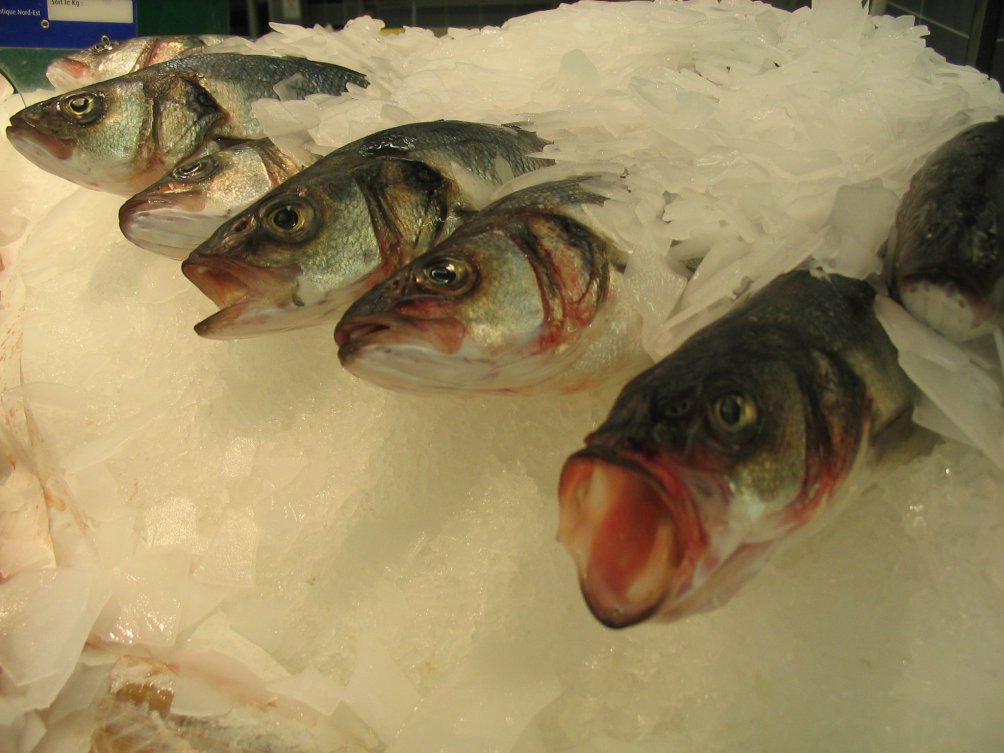
Fish for sale in Calais, France"The U.S. fishing industry is slowly sinking as the catch dwindles." - BusinessWeek September 4, 2006, p.5.
"I cannot tell you in words just how wonderful it is to have intervened for the whales in seasons past, to know that at this moment, there are whales swimming freely in those lonely waters that would now be dead if not for our interventions. Knowing that so many baby whales have been brought into being because we were able to force the whalers to spare their mothers is a source of great happiness for me. I feel them out there, so alive and so aware, in those dark and cold waters, and it is this connection that calms my soul with the purring hum of contentment in my heart."
Farewell to Sharks
(And Yes, That's a Bad Thing)
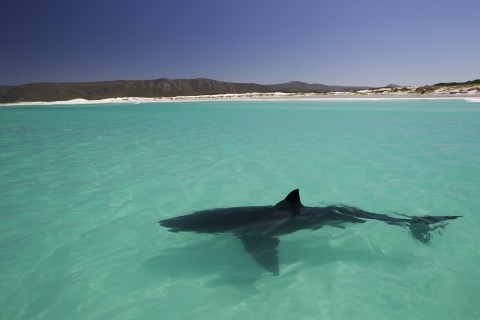
By Bryan Walsh, Time Health, Wednesday, July 06, 2011 "In reality, unlike in the movies, unprovoked shark attacks are extremely rare, and fatal ones even more so. According to the International Shark Attack File, just six people worldwide were killed by sharks last year. But human beings haven't returned the favor. Each year, fishermen kill as many as 73 million sharks, usually cutting off their fins - which are valued for shark-fin soup, a popular dish in Asia - before tossing the bloody carcasses overboard. Tens of millions of other sharks likely die each year accidentally because of fishing gear set for other species. As a result, the International Union for the Conservation of Nature estimates that as many as a third of all shark species are threatened or near threatened with extinction, including the great white. Sharks aren't the true killers - we are. "
Not Enough Ocean
"Even seven seas can't satisfy the world's appetite for fish. According to a study by the environmental-economics institute Redefining Progress, at the rate we're currently fishing, we're overusing the oceans' bilogical capacity by 157 percent, or one and a half additonal earths. Japan, Indonesia, and China have the most egregious 'fishprints'; the United States comes in eight, overfishing by 165 percent."- Paul Rauber
Sierra, May/June 2007 p. 17
|
|
Click Here for my page on Water and other related issues... |
While visiting the UK, in 2006, I found this
interesting piece in one of their tabloids:
Total cod fishing ban 'is needed' "THERE should be a total ban on cod catches in the North sea next year, a report by marien experts claims. The species is still too heavily fished and could suffer a further fall in numbers. There should also be no catches of Nort Sea sand eel, the International Council for the Exploration of the Sea added. ITs findings will be considered by EU ministers 3hen they set catch levels in December."(METRO - Wednesday, October 18, 2006, p. 2)
"Researchers say the world's fish and seafood populations could collapse by 2048 if current trends in habitat destruction and over-fishing continue."
"In an analysis of scientific data going back to the 1960s and historical records over a thousand years, the researchers found that marine biodiversity -- the variety of ocean fish, shellfish, birds, plants and micro-organisms -- has declined dramatically, with 29 percent of species already in collapse."
Down to the Last Sushi
- Paul Rauber, Sierra Magazine, July/August 2010, p. 20
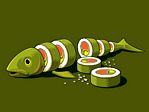
"At the top of the Atlantic Ocean food chain is the bluefin tuna, a half-ton hunting machine that can accelerate faster than a Porsche. Yet it is powerless against the appetites of wealthy Japanese diners: Industrial fishing has reduced bluefin numbers by two-thirds in the Mediterranean and 80 percent in the Atlantic. A fishing ban could restore healthy numbers within a decade, but at the Convention on International Trade in Endangered Species this March in Qatar, Japan marshaled 68 nations to vote against a ban on international trade in the vanishing fish - after treating them to a bluefin sushi buffet."
"What's motivating Japan and the other tuna-fishing nations is more than a taste for raw fish. Prized bluefin sell at auction in Tokyo for as much as $175,000 apiece. Presumably the very last bluefin will fetch an even higher price."
"... I stopped eating fish. They aren't sea vegetables, after all. They have nerve endings and feel pain, which is a great reason not to hurt them. But they also have intelligence, they utilize memory and cooperation, they recognize one another as individuals, they make decisions. Killing them unnecessarily for food (and killing outrageous numbers of their fellow fish and other marine life as ocean 'bycatch' while fishing) struck me as wrong. And while aquaculture - raising fish in confinement - might do away with the bycatch issue, it is, in the words of Jonathan Safran Foer, 'essentially underwater factory farming.'"
Did you know?
|
It is estimated that there are an average of 46,000 pieces of plastic debris floating on or near the surface of every square mile of ocean. Seventy percent of that litter will sink to the bottom while the rest will float indefinitely...
This, according to: |
Fish is not health food!
According to Doctor Neal Barnard, M.D., "Fish is not a health food by any stretch of the imagination. According to a study published in The New England Journal of medicine, people who followed a diet emphasizing poultry and fish, called the National Cholesterol Education Program Step II Diet, found that their cholesterol levels changed very little.""Fish's selling point is omega-3 fatty acids. But the fact is, fish fat is a mixture of fats. Anywhere from 15% to 30% of the fat in fish is plain old saturated ('bad') fat. That's somewhat lower than in beef and chicken but far higher than in healtful vegetarian foods. And fish fat is everty bit as fattening as lard or chicken fat. People adding salmon to their diets in hopes of some vague benefit often find it hard to manage their weight, because of the load of fat they are eating. Fish flesh contain plenty of cholesterol too. Ounce for ounce, shrimp and other mobile shellfish have nearly twice the cholesterol of beef.
"Fish often carry contaminants from polluted waterways. About 40% of fish samples have so much bacterial contamination that they have already begun to spoil before they are sold. Fish are also often contaminated with PCBs, which have been linked to cancer and birth defects. Consumer Reports found PCBs in 43% of salmon, 50% of whitefish, and 25% of swordfish. The US Food and Drug Administration and the US Environmental Proteciton Agency warned pgregnant women, women who may become pregnant, breastfeeding women, and children to limit their soncumption of fatty fish because it contains mercury, which can also contribute to birth defects, kidney damage, impaired mental development, aned even cancer.
"So where will we get our omegas-3s? Vegetables, fruits, and beans don't contain much fat, but what fat they do have is relatively high in omega-3. A person aiming for a higher omega-3 intake, for whatever reason, will find it in ground flaxseeds, flaxseed oil, walnuts, soy products, and vegetarian omega-3 supplements, such as Sea Vegg.
"If you really want to work on beating heart disease, forget the fish and try a vegetarian diet rich in fruits, vegetables, whole grains, and bean low in fats of any kind."
PETA's Animal Times, winter 2007, p. 21
"In a comprehensive new study by the U.S. Geological Survey, every fish from 291 streams across the nation tested positive for mercury contamination. By EPA standards, one out of four of the thousand fish tested was unsafe to eat, particularly for children, pregnant women, and nursing mothers. Thanks in large part to emissions from coal-burning power plants, mercury contamination is now ubiquitous." - Sierra Magazine November/December 2009 (Volume 94, Issue 6)
"We have to face the fact that industrial fishing is causing terrible damage to our oceans, the wondrous ecosystem that sustains us all. Coral reefs - the rain forests of the sea - have declined 30 percent in the last thirty years, largely because of overfishing and shrimp trawling. Industrial fleets have fished out at least 90 percent of all large ocean predators - marlin, swordfish, shark, cod halibut, skate, and flounder - in the past fifty years.""If you care about the sea and its wildlife, if you care about your health and that of your family, especially that of your children, and if you care about the livelihood of the commercial fishermen, there is, of course, something you can do. And you know exactly what that is! You can make ethically informed choices in the purchases you make from the store, or the food you order in a restaurant."
- Jane Goodall, in her book, Harvest for Hope, p. 131

|
"When I was growing up the cod was known as the 'bread of the sea.' It was one of the cheapest fish, so that when, as a treat, we had that very British delicacy, fish and chips, the fish was usually cod. We carried it back, wrapped in grease-proof paper inside sheets of newspaper to keep in the heat. In those days the cod fishing fleet hauled in huge catches. But gradually, as more and more people consumed more and more fish, the great shoals decreased in size. The price gradually went up. This led to increasingly strained relationships between Britain and Iceland." |
"Today the cod is a threatened species. So, too, are countless other fish. The depletion of the world's fish stocks resulting from the overfishing of our seas, lakes, and rivers, along with wasteful and unsustainable methods of extracting the catch, and the pollution of the water itself, is one of the most shocking ecological disasters of our time. Drift nets and long lines that stretch for hundreds of kilometers, nets with small mesh that catch young fish before they have a chance to mature, and the vacuum trawlers that suck everything movable into their giant maws, are some examples of unsustainable methods of fishing that destroy thousands of nontargeted species."ibidem pp. 117-118
Fishing Facts:
In the Sep/Oct 2003 edition of Sierra (p. 19) they stated:
|
|
In the 1992 edition (that's a long time ago!) of The Diversity of Life, Edward O. Wilson said, "About 20 percent of the world's freshwater fish species are either extinct or in a state of dangerous decline. The situation is approaching the critical stage in some tropical countries. A recent search for 266 species of exclusively freshwater fishes of lowland peninsular Malaysia turned up only 122. Lake Lanao on the Philippine Island of Mindanao is famous among evolutionary biologists for the adaptive radiation of cyprinid fishes that occurred exclusively within the confines of the lake. As many as 18 endemic species in three genera were previously known; a recent search found only three species, representing one of the genera. The loss has been attributed to over fishing and competition from newly introduced fish species.""The United States has the largest freshwater mollusk fauna in the world, especially rich in mussels and gill-breathing snails. These species have long been in a steep decline from the damming of rivers, pollution, and the introduction of alien mollusk and other aquatic animals. At least 12 mussel species are now extinct throughout their ranges, and 20 percent of the remainder are endangered. Even where extinction has not yet occurred, the extirpation of local populations is rampant. Lake Erie and the Ohio River system originally held dense populations of 78 different forms; now 19 are extinct and 29 are rare."
pp. 256-257
Turning the Tide on Shellfish Decline
Restoration Lessons in the Chesapeake Bay
Natur Conservancy, WInter 2006, p. 16
Native oyster reefs, which provide an underwater haven for dozens of species of plants and animals and help clean water and stabilize shorelines, have largely disappeared from U.S. coasts. This is especially true in the Chesapeake Bay, which ha lost most of its 400,000 acres of reefs in the past two Centuries.RUNNING THE NUMBERS / SHELFISH
- U.S. oyster harvest in 1880: 154 million pounds
- U.S. Harvest in 2002: 31 million pounds
- Historical range of oyster reefs in the Chesapeake Bay: 400,000 acres
- Today's range: less than 20,000 acres
- Time in 1800 oysters needed to filter the Chesapeake's 19 trillion gallons: one week
- Time needed today: more than a year
Marine Mammals:
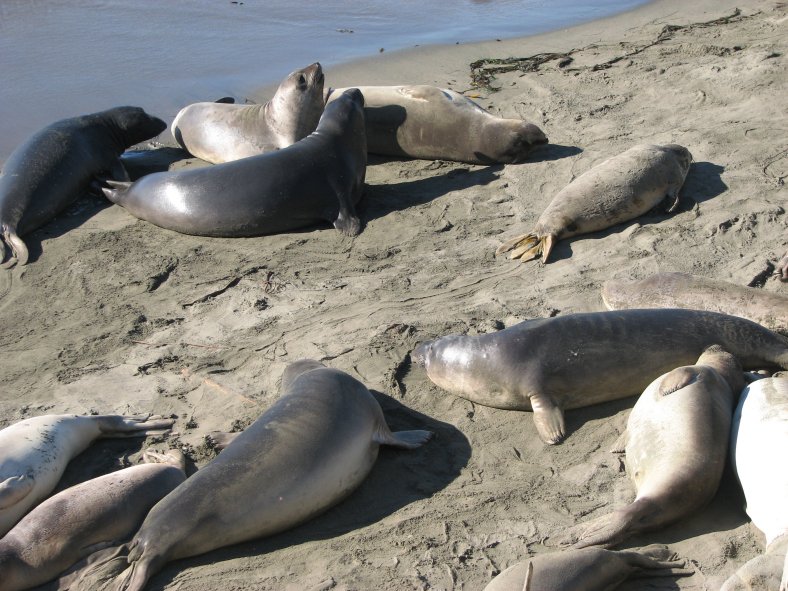
Elephant Seals - CaliforniaIn November 2007 Tami and I drove PCH 1 (California's coastal highway) from the Bay area to San Diego. Along the way down we had a wonderful encounter with Elephant Seals on the beaches at Piedras Blancas. From what we could see, Friends of the Elephant Seal are doing a pretty good job of protecting the Elephant Seal and a portion of its beach habitat. Click Here for a video of the seals on the beach!
Judge to Navy: Limit sonar training
Los Angeles, California (AP), Monday, February 04, 2008
"The Navy must follow environmental laws placing strict limits on sonar training that opponents argue harms whales, despite President Bush's decision to exempt it, a federal judge ruled Monday."A federal judge ruled that the Navy must limit sonar training that some say hurts whales."
"The Navy is not 'exempted from compliance with the National Environmental Policy Act' and a court injunction creating a 12 nautical-mile no-sonar zone off Southern California, U.S. District Judge Florence-Marie Cooper wrote in a 36-page decision."
"'We disagree with the (exemption) judge's decision,' White House spokesman Tony Fratto said. 'We believe the (exemption) orders are legal and appropriate.'"
"Navy spokeswoman Lt. Cmdr. Cindy Moore said the military was studying the decision."
"The president signed a waiver January 15 exempting the Navy and its anti-submarine warfare exercises from a preliminary injunction creating a 12 nautical-mile no-sonar zone off Southern California. The Navy's attorneys argued in court last week that he was within his legal rights."
"Environmentalists have fought the use of sonar in court, saying it harms whales and other marine mammals."
Associated Press
Friday, February 06, 2009
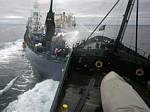
Activists from the Sea Shepherd Conservation Society's vessel, M/Y Steve Irwin, said they were pelted with bloddy chunks of whale meat and blubber after their boat collided with a Japanese whaling vessel during what was described as a dramatic Antarctice Ocean clash. The Associated Press (AP) said, "It was the second battle this week between the whalers and their foes. No one was injured, but the skirmishes mark the resumption of potentially life-threatening run-ins in a contentious fight that has become an annual fixture in the remote, icy and dangerous waters at the bottom of the world."
The AP added, "The clashes come as diplomatic efforts to resolve the controversy surrounding Japan's scientific whaling program appear to have stalled."
"Japan - which has described the protesters as terrorists - plans to harvest up to 935 minke whales and 50 fin whales this season. Under International Whaling Commission rules, the mammals may be killed for research. Opponents say the Japanese research expeditions are simply a cover for commercial whaling, which was banned in 1986.""Watson said Friday's fracas began as his crew tried to maneuver their boat into a position that would have prevented the Japanese from dragging a whale on board their whaling vessel. Another Japanese ship shot in front of Watson's boat, causing a collision, Watson said."
"'We can see the blood pouring out by the barrel,' Watson said from his boat - named after the late Australian conservationist and TV personality Steve Irwin - as he watched the Japanese haul another whale onto their vessel. Earlier in the day, he said, the Japanese hurled pieces of blubber and whale meat at the Steve Irwin."
"Japan blamed Sea Shepherd for the crash, characterizing the incident as a 'deliberate ramming.'"
"Shigeki Takaya, a Fisheries Agency spokesman for whaling in Japan, accused the conservationists of 'appalling and unforgivable' acts."
"Protesters aboard the Steve Irwin set off from Australia in early December for the Antarctic Ocean, chasing the whaling fleet for about 2,000 miles before stopping two weeks ago in Tasmania to refuel. The group found the whalers again on Sunday and resumed their pursuit."
"During the initial chase, Watson's crew pelted the Japanese with bottles of butyric acid, produced from rancid butter. In one December clash, Japan accused the Sea Shepherd crew of ramming one of its vessels, causing minor damage to the ship. Watson said the Steve Irwin only lightly brushed the whaling vessel."
"This week, tensions escalated after Watson said two members of his crew were slightly injured when the Japanese blasted them with a water cannon and hurled heavy hunks of metal. Watson accused the Japanese of using a 'military grade' noise weapon that can cause deafness and vomiting."
Ocean Origins
"Earth's abnormally large Moon, which stabilizes our planet's axial tilt and bestows it with tieds, was born when a Mars-size body collided with the proto-Earth early in our solar system's history. Another impactor, a six-mile-wide asteroid, struck the Earth 66 million years ago and sparked a global mass extinction, ending the age of dinosaurs. Humanity's small mammalian ancestors began their slow progress toward biospheric dominance, and the saurians that didn't die out gradually gave rise to birds. Billions of years before the dinosaurs, the life-giving liquid we recognize as Earth's ocean was mostly delivered by impactors, too, in a shower of water-rich asteroids and comets from the outer solar system. Earth's aquatic abundance, it is thought, lubricates the planet's fractured crustal plates and allows them to drift and slide in the geological process we call plate tectonics, a climate-regulating mechanism unique to our world out of all those in the solar system."
Whale of a Tale
"For thousands of years, people have marveled at some of the most amazing creatures of the sea: the whales and dolphins and their relatives. The ancient cultures of the Mediterranean believed that dolphins swimming beside their ships brought good luck, and the story of Jonah and the whale is a popular one in the Bible. Most of these people regarded whales as just another species of fish, and so the ancients classified whales and dolphins as fish. This is especially true in the biological writings of the Greek philosopher Aristotle, whose ideas became entrenched as part of Church dogma for almost a thousand years. Even today, many people still think of whales and dolphins as fish. Members of a number of traditional cultures hunt whales as if they are just another source of food from the ocean, and not mammals - with large brains, complex societies, and a full range of emotions - that are potentially as smart as humans."
- Donald R. Prothero in his book,
The Story of Life in 25 Fossils (Tales of Intrepid
Fossil Hunters and the Wonders of Evolution), p. 269

|
Links: |
|
|
 Back to Roger J. Wendell's Home Page...

Abbey |
About |
Blog |
Contacting
Me |
Copyright |
Disclaimer |
Donate |
Guest
Book |
Home |
Links |
Site
Index |
Solutions |
Terms,
Conditions
and
Fair
Use |
What's
Changed
or
New?
Copyright
© 1955 -